
The Asia-Pacific food import landscape is transforming rapidly, and Chinese food exporters find themselves at a crossroads. Buyers across Japan, South Korea, Singapore, Australia, and Southeast Asian markets are no longer satisfied with basic food safety compliance. They’re demanding premium, certified supply chains that demonstrate traceability, sustainability, and unwavering quality standards. For Chinese exporters, this shift isn’t just a challenge—it’s an opportunity to secure their position in one of the world’s most dynamic food markets.
Walk into any major supermarket in Tokyo or Sydney, and you’ll notice something striking. Premium Chinese food products now occupy prime shelf space, but they all share common badges: GlobalG.A.P. certifications, ISO 22000 labels, and BRCGS marks. These aren’t decorative symbols. They represent a fundamental change in how Asia-Pacific buyers evaluate Chinese food suppliers. The question facing exporters is no longer whether to pursue certification, but how quickly they can adapt to these evolving standards.
The Forces Driving Change in APAC Markets
Three powerful forces are reshaping buyer expectations across the Asia-Pacific region, and they’re all converging at once.
First, consumers in APAC markets have become remarkably sophisticated. A middle-class family in Singapore or Seoul today researches food origins with the same diligence their parents once reserved for major purchases. They want to know where their food comes from, how it was produced, and whether it meets international safety standards. This isn’t a passing trend. According to recent market data, over 70% of APAC consumers actively seek products with visible quality certifications before making purchase decisions.
Second, food safety incidents have heightened awareness across the region. When contamination issues make headlines, they don’t just affect the implicated companies—they impact entire supply chains and sourcing regions. Buyers have responded by implementing stricter vendor qualification processes. What used to take weeks now takes months, with procurement teams conducting detailed audits of supplier certifications, testing protocols, and quality management systems.
Third, sustainability has moved from a nice-to-have to a must-have. Major retail chains in Australia and Japan are setting ambitious targets for their supply chains. They’re tracking carbon footprints, evaluating water usage, and demanding transparency about agricultural practices. For Chinese exporters, this means documentation and certification can no longer be an afterthought—they’re the price of admission to premium market segments.
Consider the experience of a Guangdong-based seafood exporter who lost a major contract with a Japanese retail chain in 2023. The product quality was excellent, the price competitive. But the company lacked proper traceability documentation and internationally recognized certifications. The buyer moved to a Vietnamese supplier who could provide complete supply chain visibility through certified systems. That single decision cost the Chinese exporter over $2 million in annual revenue.

Navigating the Regulatory Maze
The regulatory landscape governing Chinese food exports to APAC has become increasingly complex, creating both challenges and opportunities for exporters who can navigate it effectively.
China’s General Administration of Customs has tightened export requirements significantly over the past two years. The updated GACC Decree 280 requires overseas food producers to register with Chinese authorities and maintain documented quality management systems. This isn’t bureaucracy for its own sake—it’s China’s response to international pressure for better supply chain governance.
On the receiving end, each APAC market maintains its own set of requirements. Singapore’s Food Agency demands rigorous testing and documentation for imported products. Australia’s Food Standards Code sets specific composition and labeling requirements that vary by product category. South Korea requires detailed ingredient declarations and origin verification. Japan’s Food Sanitation Law imposes strict standards for additives, pesticides, and contaminants.
But here’s what many exporters miss: these regulations aren’t obstacles—they’re market access tools. Countries maintain strict standards precisely because they want to facilitate safe trade. When a Chinese exporter can demonstrate full compliance with both Chinese export regulations and destination country requirements, they’re not just avoiding problems—they’re building competitive advantages.
The practical implications are significant. An exporter targeting the Japanese market needs to understand acceptable pesticide residue levels, which differ from those in China. They must maintain testing records that prove compliance. They need bilingual labeling that meets Japanese consumer information laws. Without proper systems and certifications, managing this complexity becomes overwhelming. With them, it becomes routine.
Forward-thinking exporters are treating regulatory compliance as a strategic investment rather than a cost center. They’re implementing systems that exceed minimum requirements, knowing that standards will only get stricter. When new regulations emerge, these companies adapt quickly because their infrastructure was already built to handle complexity.
The Certification Imperative
Three certification frameworks have emerged as the gold standard for Chinese food exporters targeting premium APAC markets: GlobalG.A.P., ISO 22000, and BRCGS. Understanding why these matter requires looking beyond the certificates themselves to what they represent.
GlobalG.A.P. certification demonstrates that agricultural producers follow good practices from farm to fork. For a Chinese fruit exporter, this means documented procedures for everything from soil management to harvest handling. Buyers in Australia and New Zealand particularly value GlobalG.A.P. because it provides assurance about agricultural inputs, worker safety, and environmental management. The certification isn’t just paperwork—it requires real changes in farming practices, record-keeping systems, and supply chain management.
ISO 22000 focuses on food safety management systems, integrating HACCP principles with broader quality management. A Chinese processed food manufacturer with ISO 22000 certification tells buyers something crucial: they have systematic processes for identifying and controlling food safety hazards. This matters enormously when dealing with large retail chains that face enormous liability risks from food safety failures.
BRCGS (formerly BRC Global Standards) has become the benchmark for retailers and food service operators across APAC. Achieving BRCGS certification requires rigorous facility standards, extensive documentation, and regular third-party audits. For exporters targeting premium market segments—high-end restaurants in Singapore, specialty retailers in Hong Kong, quality-focused chains in Japan—BRCGS certification often determines whether conversations even begin.
The real value of these certifications extends beyond market access. They transform how companies operate. A Sichuan-based condiment manufacturer that achieved ISO 22000 certification found that their internal quality metrics improved dramatically. Defect rates declined substantially, and customer complaints were significantly reduced. The certification process forced them to examine every aspect of their operation, identify weak points, and implement systematic improvements.
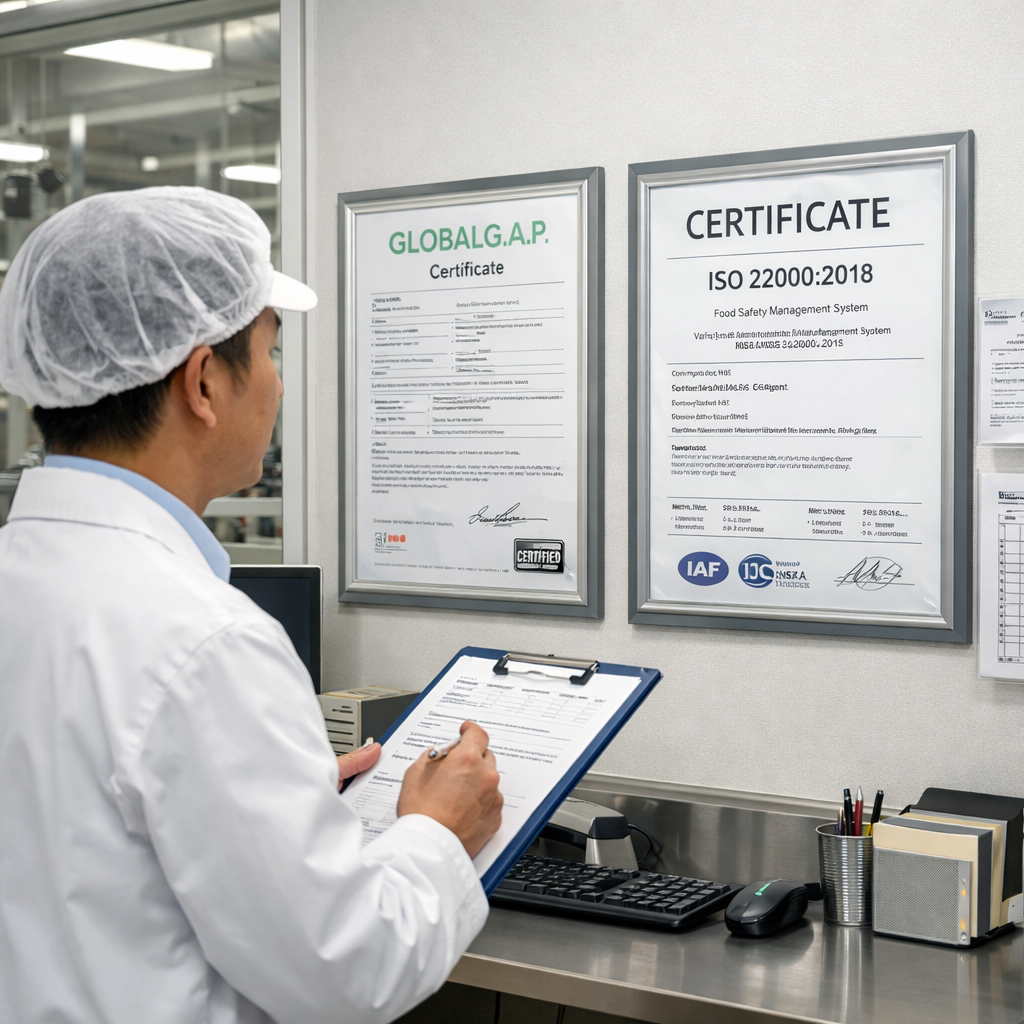
Buyers recognize this transformation. When a procurement manager evaluates two potential suppliers—one certified and one not—the certified supplier faces fewer questions, faster approval processes, and more favorable contract terms. The certification serves as third-party validation that reduces buyer risk and speeds decision-making.
Strategic Advantages in Competitive Markets
The Asia-Pacific food market is becoming increasingly competitive, with suppliers from Southeast Asia, Australia, and New Zealand all vying for buyer attention. In this environment, Chinese exporters with premium, certified supply chains are discovering strategic advantages that translate directly to business outcomes.
First, certification creates pricing power. When a Chinese dim sum manufacturer can demonstrate ISO 22000 compliance and provide complete traceability documentation, they’re not competing solely on price. They’re offering reduced risk, consistent quality, and peace of mind. Buyers pay premium pricing for these benefits. Industry observations show that certified suppliers are often able to command meaningful price premiums over non-certified competitors for comparable products.
Second, certification opens doors to long-term contracts. Retail chains and food service operators prefer stable supplier relationships that minimize disruption and ensure consistency. A certified supplier with documented quality systems becomes a valued partner rather than a transactional vendor. One Shanghai-based meat processor reported that after achieving BRCGS certification, their average contract duration increased from 12 months to 36 months, providing revenue stability and better planning visibility.
Third, certification accelerates market entry. When exploring new markets within APAC, certified exporters can compress the typical 12-18 month qualification process into 4-6 months. Buyers already trust the certification framework, so they focus on specific product attributes rather than fundamental capability questions. This speed advantage can be decisive in fast-moving markets where timing determines success.
Consider the strategic positioning of companies like those Jade Premium partners with—exporters who’ve embraced comprehensive certification as core business strategy rather than compliance checkbox. These organizations don’t just meet buyer standards; they help define them. They participate in industry associations, contribute to standards development, and position themselves as quality leaders rather than commodity suppliers.
The competitive moat created by certification is substantial. New entrants face significant barriers: certification costs ranging from $10,000 to $50,000 depending on scope, implementation timelines of 6-18 months, and the organizational capability required to maintain certified systems. Existing certified exporters enjoy advantages that compound over time as they build buyer relationships and refine their systems.
Economic Realities and Practical Pathways
For Chinese food exporters considering the journey toward premium, certified supply chains, the economic equation involves careful analysis of costs, benefits, and implementation pathways.
The upfront investment is substantial. Initial certification costs vary by standard and company size, but exporters should budget $15,000-$40,000 for GlobalG.A.P. or ISO 22000, and $25,000-$60,000 for BRCGS. These figures include consulting support, system implementation, facility upgrades, staff training, and initial audits. Annual maintenance costs add another 20-30% of initial investment for ongoing audits, system updates, and recertification.
However, the return on investment typically becomes visible over time through higher order values, improved customer retention, and lower sales friction. Contract retention rates improve dramatically, reducing the costly churn that plagues commodity suppliers.
The practical pathway begins with honest assessment. Exporters should audit their current capabilities against certification requirements, identifying gaps in documentation, facility standards, testing protocols, and quality management systems. This assessment phase typically reveals that 60-70% of required elements already exist in some form—they just need formalization and documentation.
Next comes systematic implementation. Working with experienced consultants or trade service providers who understand both Chinese operations and international standards dramatically improves success rates. These partners help navigate cultural differences, translate requirements into practical actions, and avoid common pitfalls that delay certification.
Staff training represents a critical investment that many exporters underestimate. Certification isn’t sustainable unless employees understand why procedures exist and how to execute them consistently. Forward-thinking exporters invest in comprehensive training programs that build quality consciousness throughout the organization.
Technology adoption accelerates the certification journey. Modern supply chain management systems, digital traceability platforms, and automated quality monitoring tools reduce the manual burden of maintaining certified systems. What once required extensive paperwork now happens through integrated software that captures data automatically and generates required documentation.
The most successful exporters view certification as a continuous improvement journey rather than a destination. They use the framework to drive operational excellence, regularly reviewing metrics, identifying enhancement opportunities, and staying ahead of evolving standards. This mindset transforms certification from compliance burden into competitive advantage.
The Path Forward for Chinese Exporters
Chinese food exporters who embrace premium, certified supply chains are positioning themselves for sustained success in Asia-Pacific markets that will only become more demanding over time.
The outcomes are increasingly clear. Certified exporters enjoy preferential access to high-value market segments that non-certified competitors cannot reach. They build long-term relationships with major buyers who value reliability and risk reduction. They command pricing that reflects the real value they deliver rather than competing in commoditized markets where margins compress relentlessly.
Beyond individual company benefits, this transformation strengthens China’s position as a trusted food supplier to the region. As more Chinese exporters adopt international standards and certifications, they collectively build the reputation and credibility that benefits the entire ecosystem. Buyers who once approached Chinese food products cautiously now actively seek them out, confident that robust systems ensure quality and safety.
The Asia-Pacific market will continue evolving, with standards becoming stricter and buyer expectations rising. Exporters who establish certified supply chains today are building foundations that will serve them for decades. Those who delay face mounting challenges as the gap between market requirements and their capabilities widens.
For Chinese food exporters serious about competing in premium APAC markets, the race toward certified, transparent supply chains isn’t optional—it’s essential. The question isn’t whether to pursue this path, but how quickly and effectively to implement the systems that will define competitive success in the years ahead. The exporters who answer that question decisively, supported by partners who understand both the technical requirements and cultural nuances of international food trade, will be the ones setting standards rather than chasing them.