
- The Export Challenge: Freshness Doesn't Travel Easy
- What Is Cryogenic Freezing and Why Does It Matter?
- Case Study 1: Frozen-Dormant Lychee — From Seasonal Fruit to Year-Round Export Star
- Case Study 2: Prepared Seafood — Cryogenic Freezing Meets China's Booming Ready-Meal Exports
- What This Means for International Buyers
- The Bottom Line
Chinese cuisine is celebrated worldwide — but shipping delicate, flavor-rich specialty foods across oceans without losing quality has always been a challenge. Ultra-low-temperature quick freezing is changing the game.
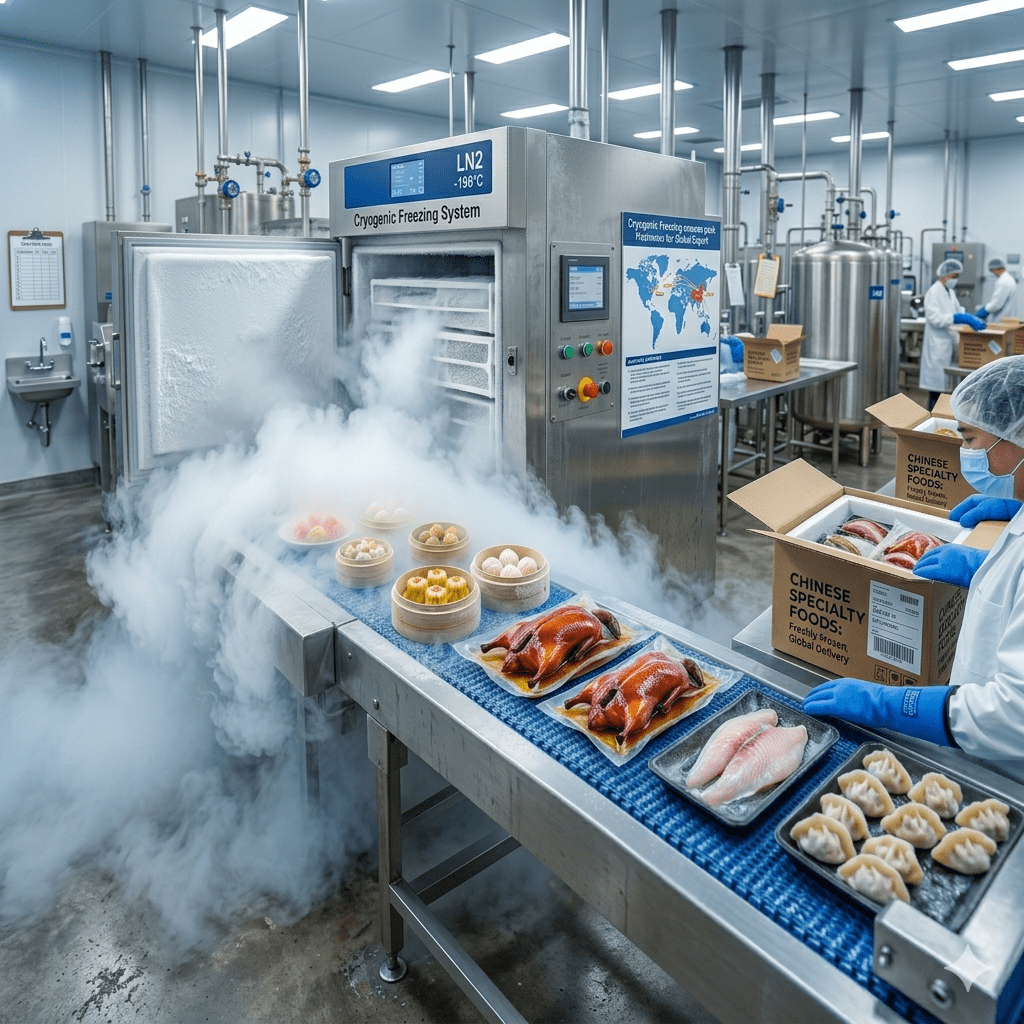
The Export Challenge: Freshness Doesn’t Travel Easy
China produces some of the world’s most sought-after specialty foods — from seasonal tropical fruits to intricately seasoned prepared seafood dishes. Yet for decades, the biggest barrier to global distribution hasn’t been demand; it has been freshness.
Conventional freezing methods cool food slowly. During this drawn-out process, large ice crystals form inside the food’s cells, puncturing membranes, breaking down muscle fibers, and releasing moisture. The result? Products that arrive overseas with a mushy texture, dull color, significant drip loss after thawing, and diminished flavor — a far cry from the original eating experience.
For international buyers sourcing premium Chinese frozen foods, this quality gap directly impacts customer satisfaction, repeat orders, and brand reputation. That’s why an increasing number of Chinese food manufacturers are turning to cryogenic freezing technology — and why it matters for every importer and distributor looking to bring authentic Chinese flavors to global tables.
What Is Cryogenic Freezing and Why Does It Matter?
Cryogenic freezing — often called liquid nitrogen quick freezing or ultra-low-temperature rapid freezing — uses liquid nitrogen at approximately −196°C to freeze food within minutes rather than hours.
At this extreme temperature, the food passes through the critical ice crystal formation zone so rapidly that only very fine, uniformly distributed ice crystals form. Unlike the large, jagged crystals produced by conventional freezing, these micro-crystals cause minimal damage to the food’s cellular structure.
The practical benefits for exported food products are significant:
Better texture retention. Because cell walls remain largely intact, thawed products maintain a firmness and mouthfeel much closer to their fresh state. This is especially critical for delicate items like seafood, fruits, and dim sum.
Higher moisture retention and reduced drip loss. Smaller ice crystals mean less cellular rupture. When the product is defrosted, it retains more of its natural juices instead of losing them as unsightly liquid in the packaging — a key quality indicator for end consumers and food service operators.
Preserved original flavor and color. Liquid nitrogen is an inert, non-toxic gas in its natural state. During the freezing process, it creates a barrier between the food and ambient air, effectively reducing oxidation and fat rancidity. The result is better preservation of the original aroma, taste, and visual appeal.
Extended shelf life for long-distance export. Products frozen with cryogenic technology show greater stability during extended cold-chain transport and storage. Research published in Foods (MDPI) has demonstrated that liquid nitrogen freezing minimizes protein denaturation and structural degradation even through multiple freeze-thaw fluctuations — the kind of temperature stress that routinely occurs during cross-border logistics.
Lower microbiological risk. The extremely rapid cooling minimizes the time food spends in the temperature “danger zone” where bacteria multiply most actively, contributing to a safer end product.
Case Study 1: Frozen-Dormant Lychee — From Seasonal Fruit to Year-Round Export Star
Few fruits are as emblematic of southern China as lychee. Yet lychee is notoriously perishable — the ancient Chinese saying “一日色变, 二日香变, 三日味变” (the color changes in one day, the fragrance in two, the flavor in three) captures the challenge perfectly.
Ultra-low-temperature freezing has transformed lychee from a fleeting summer luxury into a year-round export commodity. Using liquid nitrogen at −196°C, producers in Guangdong Province can freeze lychees so rapidly that the fruit enters a state of “frozen dormancy.” The cellular structure, juice content, color, and sweetness are locked in place.
In 2024, the Conghua district of Guangzhou achieved a landmark milestone: its first commercial export of frozen-dormant lychees to the United Arab Emirates, with the product certified compliant for international food safety standards. According to local government sources, the technology extends shelf life from just days to over 12 months while maintaining over 90% similarity to fresh fruit in taste, color, and texture after thawing.
This breakthrough means overseas buyers can now offer Chinese lychee in winter — a premium, differentiated product that commands higher margins and fills a gap no conventionally frozen fruit can match.
Case Study 2: Prepared Seafood — Cryogenic Freezing Meets China’s Booming Ready-Meal Exports
Let’s recap the sensory journey and practical takeaways for international buyers considering Lion’s Mane mushrooms for their plant-based seafoChina’s prepared food sector has seen explosive growth, and international demand is rising fast. Products such as spicy crayfish, fish balls, shrimp paste, and seasoned seafood dishes are increasingly finding their way onto supermarket shelves and restaurant menus from Canada to the Middle East.
For these products, cryogenic or rapid freezing technology is particularly valuable. Seafood is high in moisture and protein — two attributes highly vulnerable to quality loss during conventional freezing. Ultra-fast freezing preserves the delicate texture of shrimp and fish, prevents the breakdown of seasoning flavors, and locks in the umami-rich taste profiles that make Chinese prepared seafood distinctive.
Chinese customs records show that prepared seafood products — including shrimp paste, fish balls, and spicy crayfish — have been successfully exported via sea freight to markets like Canada, passing rigorous international food safety inspections. The combination of rapid freezing, certified production facilities (HACCP, ISO 22000, FDA), and professional cold-chain logistics makes these products viable for long-distance B2B distribution at scale.
What This Means for International Buyers
For food distributors, importers, and food service operators sourcing from China, cryogenic freezing technology translates into tangible commercial advantages:
- More consistent product quality across shipments, reducing rejection rates and customer complaints.
- Longer usable shelf life, providing greater flexibility in inventory management and distribution planning.
- Access to seasonal and regional Chinese specialties that were previously impossible to ship internationally without unacceptable quality loss.
- Premium positioning — products frozen with advanced technology can command higher price points in retail and food service channels.
- Stronger food safety assurance, supported by both the freezing process itself and the certified production environments of leading Chinese manufacturers.
At Jade Premium, we work closely with verified manufacturers across China who employ ultra-low-temperature freezing and other advanced preservation technologies. Our end-to-end supply chain services — from factory audits and compliance management to cold-chain logistics coordination — ensure that the quality locked in at the production line is the quality that arrives at your warehouse.
The Bottom Line
Cryogenic freezing isn’t just a technical upgrade — it’s a market enabler. It allows Chinese specialty foods to travel farther, last longer, and taste better upon arrival. For global buyers looking to tap into the rich diversity of Chinese cuisine, understanding this technology is no longer optional; it’s a competitive advantage.
Interested in sourcing premium Chinese frozen foods with guaranteed quality and freshness? Contact Jade Premium to explore our certified product catalog and supply chain solutions.