
Singapore imports more than 90% of its food, and Chinese products are in record-high demand. But for local importers trying to source directly from China, the reality is messier than it looks. Here’s what actually works.
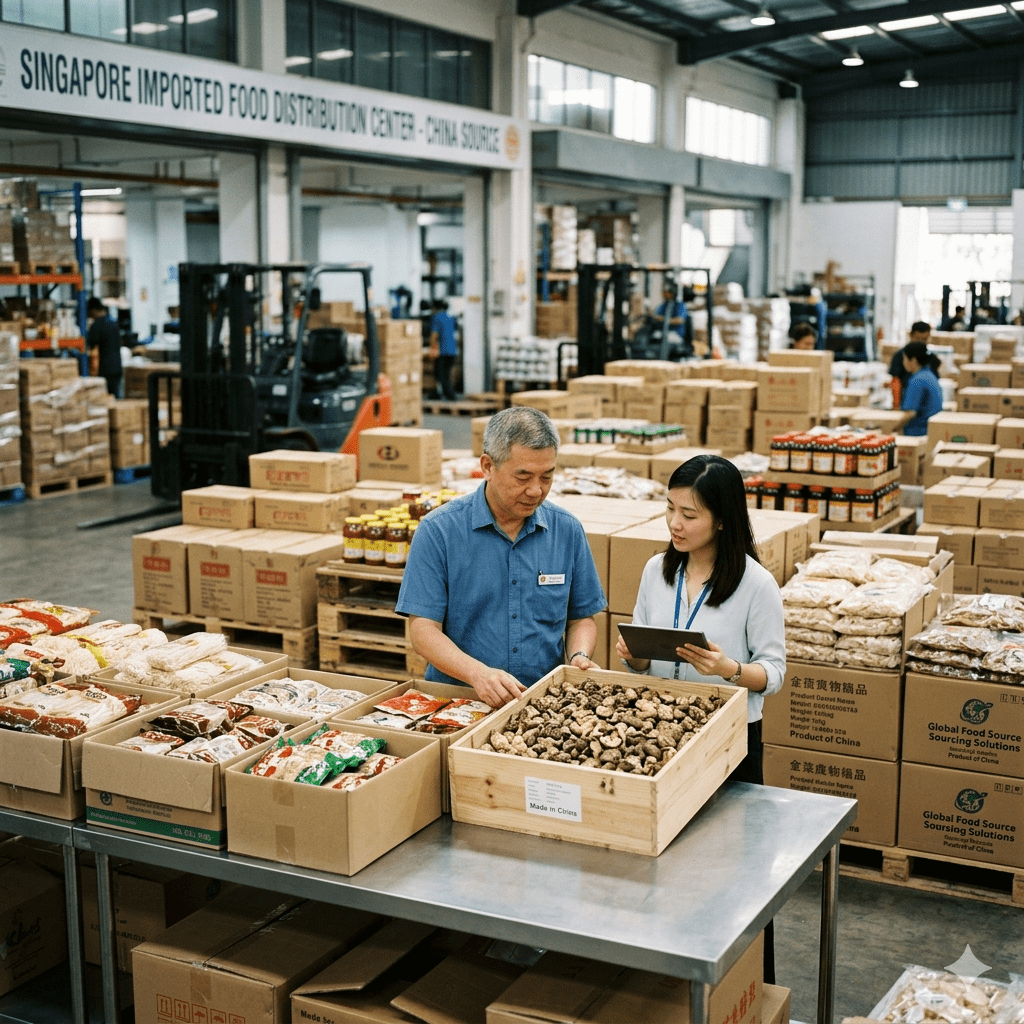
The Chinese Food Opportunity in Singapore Has Never Been Bigger
Walk into any FairPrice, Cold Storage, Sheng Siong, or Don Don Donki today and you will notice something: the Chinese food aisle keeps expanding. And that is before you factor in Scarlett Supermarket, which has grown from zero to 41 outlets in just five years and now positions itself as “the one-stop Chinese supermarket outside mainland China.”
The numbers explain why Singapore importers are paying attention.
Singapore imports more than 90% of its food, according to the Singapore government’s official food security briefing. Demand for Chinese-origin products — from Sichuan hotpot bases and chili crisps, to bubble tea ingredients, frozen dumplings, bao, instant noodles, festive CNY goods, regional sauces, and specialty snacks — has exploded alongside the arrival of more than 85 Chinese F&B brands and 405 outlets in Singapore as of 2025, more than double the year before (Reuters / Momentum Works).
For Singapore distributors, supermarkets, restaurant groups, and specialty retailers, this is a clear commercial signal: Chinese food is no longer niche. It is mainstream.
But here is what most buyers discover the hard way — sourcing authentic Chinese food directly from China at scale is significantly harder than it looks from a trade show or an Alibaba listing.
The 5 Real Challenges Singapore Importers Face When Sourcing from China
1. Finding the Right Supplier Is the Hardest Part
Alibaba, Canton Fair, WeChat contacts, third-hand referrals — most Singapore buyers start with a mix of all four, and quickly realize the same thing: sellers on these channels do not equal manufacturers, and a polished English-language brochure does not equal export readiness.
A huge portion of China’s food production happens at factories that do not market themselves internationally. Many of the best manufacturers — especially for regional specialties like Sichuan hotpot base, Guangdong dim sum, Shandong frozen foods, or Hunan condiments — don’t speak English, don’t have export teams, and only work through referrals. Buyers without on-the-ground networks in China often end up with traders adding a markup, not the actual producer.
2. MOQs Are Often a Dealbreaker for Singapore Buyers
China’s food manufacturing scale is built for the domestic market, where a single supermarket chain can absorb millions of units. That shapes supplier expectations.
For a Singapore importer testing a new SKU, the typical Chinese factory MOQ — a full 20-foot container, several thousand kilograms, or a full production run — can be a serious barrier. Experienced buyers know Chinese suppliers often inflate initial MOQ quotes by 30–50% as a negotiation tactic, but breaking through requires knowing the category, the factory, and the realistic minimums.
Without that knowledge, Singapore buyers either overcommit capital on unproven SKUs, or walk away from products their customers would love.
3. SFA Compliance Is Unforgiving — Especially With the New 2026 Labeling Rules
The Singapore Food Agency (SFA) runs one of the most rigorous food import regimes in Asia. To import processed food for commercial sale in Singapore, you must:
- Be registered with ACRA
- Activate your UEN with Singapore Customs
- Register to import Processed Food and Food Appliances with SFA
- Apply for a valid Cargo Clearance Permit (CCP) for every consignment
- Meet SFA’s risk-based documentation requirements, which may include health certificates, Regulated Source documentation, or laboratory reports depending on product category SFA
On top of this, the Food (Amendment) Regulations 2025 came into force on 30 January 2026, bringing Singapore’s prepackaged food labeling requirements into alignment with Codex standards — including changes to how ingredient lists, claims, and gluten-free dietary information must be displayed on packaging.
Translation for buyers: a Chinese factory label that looks fine in Shenzhen can get your entire shipment rejected at the Singapore port if it doesn’t match the new SFA rules. We have seen small importers lose six-figure shipments over exactly this.
4. Cold Chain and Logistics Break in the Middle — If No One Is Watching
A large share of trending Chinese food categories — frozen dim sum, bao, seafood-based prepared meals, ice cream novelties, fresh-style condiments — depend on temperature-controlled logistics from the factory all the way to the Singapore distribution center.
Gaps happen at five points: factory loading, truck transfer to port, ocean freight container monitoring, customs dwell time at Singapore ports, and last-mile delivery to cold storage. Any one of these breaking down can quietly destroy product quality before the first jar or box is even placed on a shelf.
5. Quality Consistency Across Shipments Is the Silent Killer
The first container is often perfect. It’s shipment 3, 4, and 5 — after the factory is busy with other orders, after a raw material change, after a seasonal production shift — that quietly drift in taste, texture, packaging, or fill weight.
Singapore consumers and retailers are unforgiving about this. A FairPrice or Cold Storage category buyer will delist an SKU at the first sign of inconsistency. Without someone physically verifying production batch after batch, quality drift is almost inevitable.
What a Proper Sourcing Partner Actually Does for Singapore Buyers
Experienced Singapore importers have learned that there are essentially two ways to source Chinese food at scale:
Option A: Hire your own China sourcing team, fly to factories multiple times a year, build QC and compliance capabilities in-house, absorb the learning curve on MOQ negotiation, and hope your shipments pass SFA every time.
Option B: Work with a China-based food sourcing partner that already has the factory network, the compliance know-how, the on-ground QC, and the import documentation pipeline built — and pay for the service instead of the mistakes.
For most buyers — especially specialty retailers, restaurant groups, SME distributors, private label brands, and new market entrants — Option B delivers lower total cost, shorter time-to-shelf, and dramatically less risk.
A proper Chinese food sourcing partner should handle:
Ongoing consistency management — batch tracking and repeat QC so shipment 10 tastes identical to shipment 1
Supplier discovery and verification — matching your product spec to vetted, export-ready Chinese manufacturers, not middlemen
Factory audits — on-site inspections, certification validation (HACCP, ISO 22000, FDA, BRC, IFS, Halal where needed)
MOQ negotiation and order planning — getting realistic minimums and payment terms that work for your cash flow
Pre-shipment quality control — microbiological, heavy metal, pesticide, and allergen testing before goods leave the factory
SFA-ready compliance and labeling — ensuring every consignment meets current Singapore regulations, including the 2026 prepackaged labeling rules
End-to-end logistics — cold chain management, ocean or air freight, customs clearance, and CCP documentation
Ongoing consistency management — batch tracking and repeat QC so shipment 10 tastes identical to shipment 1
How Jade Premium Helps Singapore Buyers Source Chinese Food
This is exactly the gap Jade Premium was built to close. As a Hong Kong-headquartered Chinese food sourcing and supply chain specialist, we operate through offices in Hong Kong, Shenzhen, Guangzhou, Shanghai, Chengdu, Wuhan, and Changsha, giving our Singapore clients direct access to verified producers across every major Chinese food region.
Our services are built around what Singapore importers actually need:
- Supplier Sourcing — access to certified Chinese manufacturers across frozen, ambient, condiments, snacks, beverages, and regional specialties
- Factory Verification — on-site audits and HACCP / ISO 22000 / FDA / BRC / IFS / Halal certification validation
- Compliance Management — SFA-ready documentation, labeling review against 2026 regulations, Cargo Clearance Permit preparation
- Quality Control — pre-shipment inspection, third-party lab testing, batch traceability
- Order Planning & Price Negotiation — realistic MOQ, competitive pricing, payment terms that protect your cash flow
- Logistics Coordination — temperature-managed shipping from Chinese factory to Singapore distribution center
- Private Label & Brand Support — custom packaging, recipe tuning, and SKU localization for Singapore shelves
Whether you run a supermarket chain, a restaurant group, a specialty store, a CNY gift basket business, or a new brand launching its first Chinese product line — you get one team in China handling everything you would otherwise need a full sourcing department to manage.
Ready to Source Chinese Food to Singapore Without the Headaches?
The Chinese food opportunity in Singapore is only accelerating. The buyers who win over the next three years will be the ones who move fast, source smart, and stay compliant — without building a China operation from scratch.
Talk to Jade Premium about your next Chinese food sourcing project. Visit jadepremium.com to explore our end-to-end procurement services, or browse certified Chinese manufacturers on our B2B platform at jadepremium.com.hk.