
- From Storefront Hype to Supermarket Shelves: Why the Game Is Shifting
- The Three Categories Singapore Buyers Should Watch in 2026
- The Singapore Buyer's Checklist: What "Sourcing-Ready" Actually Means
- The Quality Bar Singapore Consumers Already Set
- Localisation Is the New Moat: Nanyang Flavours Meet Chinese Supply Chains
- Ready-to-Ship Examples: Daxiao Foods Frozen Dim Sum and Pastry Range
- Beyond Sourcing: Building Your Own Private Label for the 2026 Festive Calendar
- How Jade Premium De-risks the Process
- The Sourcing Window for 2026 Is Open — Briefly
Walk into a Scarlett Supermarket in Singapore on any weekday evening in 2026 and you’ll notice something that wasn’t there two years ago. Beyond the bubble tea fridges and the imported snack aisles, the freezer cabinets are filling up — custard buns, durian puffs, taro patties, red bean cakes, ready-to-steam siew mai. A few aisles over, mooncake gift boxes are already being merchandised months before Mid-Autumn. Chinese F&B in Singapore is no longer just a storefront story; it has moved into the freezer and onto the festive shelf, and that shift is where the real sourcing opportunity now lives.
We covered the storefront side of this story earlier this year in Chinese Bakery in Singapore: How China’s Pastry Boom Is Reshaping the Lion City’s Dessert Scene. This follow-up is for the buyers, distributors, and private-label brands who are asking the obvious next question: what comes after Bao’s Pastry and RUXU?
From Storefront Hype to Supermarket Shelves: Why the Game Is Shifting
The headline numbers are familiar by now. Around 85 Chinese F&B brands were operating roughly 405 outlets in Singapore as of August 2025, more than double the count from a few years earlier, according to Reuters. What is less discussed is that this storefront wave is starting to plateau in obvious ways. Rents on Orchard, Somerset and Paya Lebar are unforgiving. Queue-driven concepts have a known half-life. And single outlets, however viral, can only serve a catchment of a few kilometres in a city where most consumers do their real food spending at NTUC FairPrice, Sheng Siong, Cold Storage, and the Scarlett chain that has now grown past 40 outlets.
The growth is quietly migrating to retail. Euromonitor projects Southeast Asia to record the fastest packaged food CAGR in Asia-Pacific through 2029, ahead of China, Japan and South Korea. Singapore imports more than 90% of its food. And FoodNavigator Asia reported in March 2026 that Chinese suppliers increasingly view Singapore not as an end market but as a sourcing and credibility gateway into the wider region.
Translated for buyers: the next twelve months of margin in Chinese F&B sourcing aren’t in opening another café. They’re in the categories that scale across hundreds of supermarket doors, repeat weekly, and spike hard during festivals.
The Three Categories Singapore Buyers Should Watch in 2026
Frozen Dim Sum and Bao
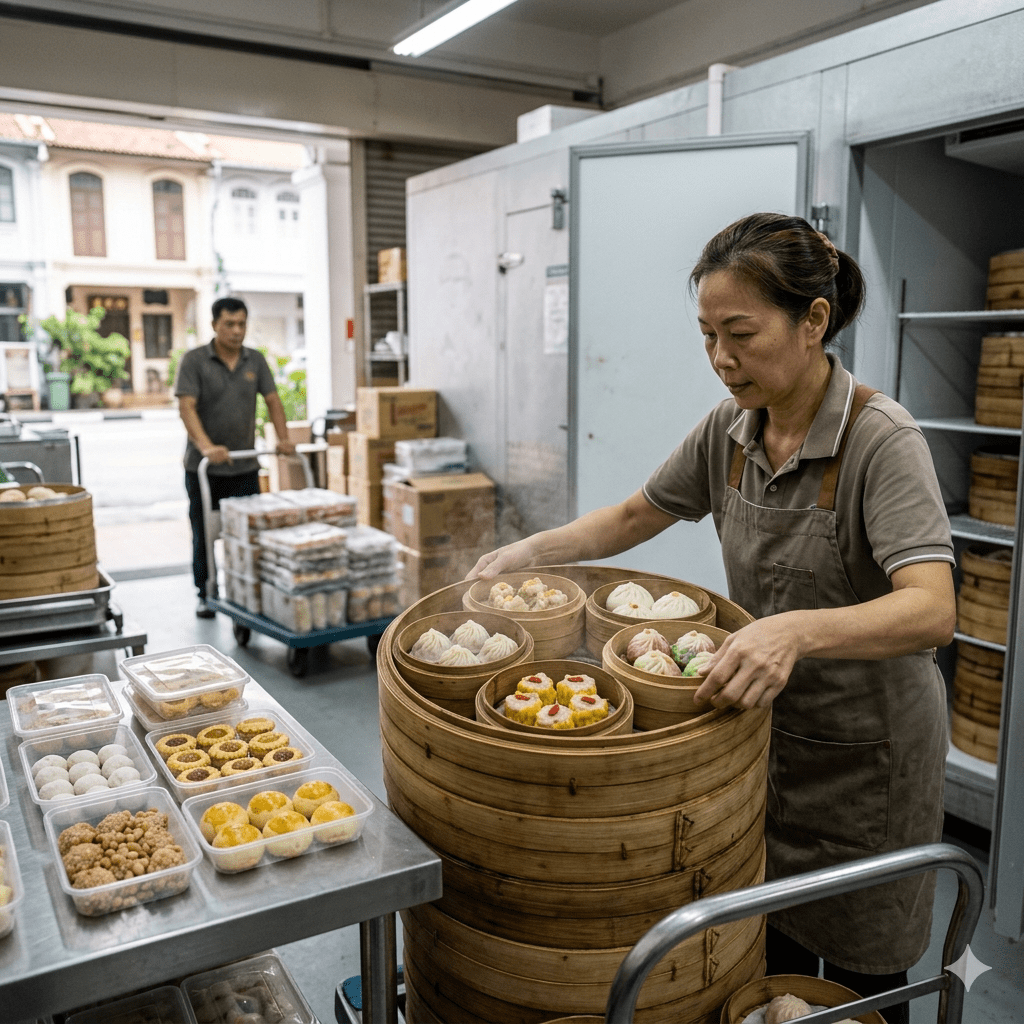
This is the single most under-supplied category in Singapore right now relative to demand. Custard buns, char siu bao, siu mai, har gao, pan-fried dumplings, lotus paste buns — these are products Singaporean households already buy weekly, but the freezer aisle has been dominated for years by a handful of legacy brands with dated formulations. The arrival of better-formulated Chinese frozen dim sum from established Cantonese manufacturers is changing the benchmark.
A useful reference point is Foshan-based Daxiao Foods, the manufacturing line behind Jade Premium’s frozen dim sum range. The factory was named a Cantonese Dim Sum R&D Base by the Cantonese Dim Sum Chefs’ Association in 2017 and currently exports to Hong Kong, the United States, Australia and the EU under HACCP and ISO 9001 certification. That kind of credentialed Cantonese supply base is exactly what Singapore importers need to displace incumbents whose products consumers tolerate rather than enjoy.
Festive SKUs: Mooncakes, CNY Boxes, Mid-Autumn Gifting
The festive calendar is the most profitable ninety days of the Singapore F&B retail year, and it is also the part of the calendar most vulnerable to late sourcing decisions. Mooncake trends for 2026 are clear: snow-skin formats continue to gain share over traditional baked, fruit and custard centres are outpacing lotus seed paste in younger demographics, low-sugar and reduced-fat claims have moved from niche to default, and Bingsu-style and lava-centre mooncakes are the social-media units that pull foot traffic into stores.
What most Singapore buyers underestimate is the lead time. To launch a private-label mooncake range for Mid-Autumn (typically September), recipe lock and packaging approval needs to happen in Q1–Q2; first production is in June–July; sea freight and SFA clearance in August. For Chinese New Year boxes, the equivalent cycle starts in Q3 of the previous year. The brands that win the festive shelf are the ones that started six months ago.
Ready-to-Eat Chinese Pastry and Snacks
The third category is the quiet workhorse: ambient and chilled ready-to-eat Chinese pastries and traditional snacks — egg tarts, sweet potato pastries, mung bean cakes, red bean cakes, taro patties, wife cakes. These are the products driving the most viral Scarlett haul videos on TikTok and Lemon8, precisely because they sit at the intersection of nostalgia, convenience, and gifting. Unlike fresh storefront pastries, they ship well, hold shelf life of three to twelve months depending on format, and require no cold-chain investment from smaller retailers — which makes them ideal for distribution beyond the Chinese-specialty channel into mainstream FairPrice and Sheng Siong assortments.
The Singapore Buyer’s Checklist: What “Sourcing-Ready” Actually Means
This is where most first-time importers learn an expensive lesson. A factory that exports successfully to Hong Kong or the mainland Chinese domestic market is not automatically ready for Singapore. Four hard gates decide whether a Chinese frozen or festive product can actually land on a Singapore shelf.
The first is SFA compliance. The Singapore Food Agency requires importer licensing, ingredient-level disclosure, mandatory bilingual labelling where applicable, full nutritional panels, and clear allergen declarations. Products with non-compliant labels are routinely held at port, and reworking labels in-bond is expensive.
The second is halal certification. With roughly 15% of Singapore’s population Muslim and halal-certified products commanding shelf space far beyond that base demographic — many non-Muslim Singaporean consumers and most institutional buyers prefer halal-certified options as a default trust signal — MUIS recognition is effectively a market-access requirement for any product hoping to scale beyond Chinese-specialty retail. Importantly, Chinese domestic halal certificates are not automatically recognised by MUIS; the practical route is either MUIS-recognised foreign certification through bodies on its accepted list, or working with manufacturers that already hold the right paperwork. This is one of the most common reasons promising sourcing projects stall.
The third is cold chain. Frozen dim sum needs an unbroken −18°C chain from factory to retailer, with documented temperature logs across ocean freight, port handling, and last-mile delivery. Shelf life of six to twelve months is standard for well-formulated frozen dim sum; anything shorter eats into your effective sell-through window once transit is accounted for.
The fourth is export-grade certification stack. HACCP and ISO 22000 are baseline. BRC or IFS open doors to modern-trade buyers. FDA registration matters if you intend to use the same SKU for re-export to the US market, which several Singapore distributors now do as a margin play.
The Quality Bar Singapore Consumers Already Set
Singaporean consumers have been trained — by Bao’s Pastry, by Moe Moe’ Soft Soufflé, by RUXU, by every viral Xiaohongshu post they’ve scrolled past in the last eighteen months — to taste the difference between real ingredients and shortcuts. That benchmark now applies to packaged products too.
For frozen dim sum and festive bakery, the quality signals are concrete. Bun dough should be naturally proofed, soft and slightly springy, not the dense and chemically uniform texture of older mass-market bao. Custard fillings should derive their richness from real egg yolk and dairy, not pure palm fat with yellow colouring. Meat fillings should be cleanly minced with visible texture rather than emulsified paste. Sweet pastry fillings — red bean, mung bean, lotus, taro — should taste of the bean or root they claim to contain, with restrained sweetness in the modern Cantonese style. And the ingredient panel should be short enough to read out loud, free of unnecessary preservatives and trans fats.
These are the same first principles that made the storefront wave work. The brands moving them into the freezer and onto the festive shelf are the ones that will own the next phase.
Localisation Is the New Moat: Nanyang Flavours Meet Chinese Supply Chains
There is one more shift worth flagging, because it changes how serious buyers should think about private label. The first wave of Chinese F&B in Singapore was straight import — same SKU, same flavour, same packaging as in Shanghai or Guangzhou. The current wave is hybrid. Buboo CHAFFEE positioned itself as Singapore’s first “Nanyang new-wave” tea and coffee bar in late 2025. Boba derivatives are showing up as croissants, cakes, and lava desserts. Local flavour identity is being reasserted on top of Chinese supply chain capability.
For frozen and festive sourcing, this opens a clear moat for any Singapore brand willing to do proper OEM or ODM development rather than just buy stock product. Pandan custard buns. Gula melaka lava mooncakes. Salted egg yolk taro patties. Kaya-filled puff pastry. Durian-pandan snowskin. Coconut-pulut hitam mung bean cakes. None of these exist as off-the-shelf Chinese SKUs — but all of them are technically straightforward for an experienced Cantonese dim sum and pastry factory to develop, given the right specification and a partner who can manage the development cycle from Singapore-side brief to first production run.
This is the part of the market with the most defensible margin. A pandan-gula melaka snowskin mooncake under your own label, produced to your spec by a HACCP- and ISO-certified Cantonese factory, cannot be undercut by a generic importer the way a stock SKU can.
Ready-to-Ship Examples: Daxiao Foods Frozen Dim Sum and Pastry Range
For buyers who want to move on the 2026 festive and frozen calendar without starting a private-label development cycle from scratch, the Daxiao Foods range available through Jade Premium is a useful starting catalogue. The factory — Foshan Shunde Yuexiang Food Manufacturing — already exports to Hong Kong, the US, Australia and the EU, holds ISO 9001 and HACCP certification, and has more than 300 SKUs across frozen dim sum, fried snacks, traditional Cantonese pastries and prepared dishes.
Five SKUs in particular map cleanly onto the Singapore opportunity:
- Custard Buns — the single highest-velocity frozen Chinese SKU in modern-trade retail; works for both Chinese-specialty and mainstream supermarket distribution.
- Durian Puffs — a Southeast Asian flavour profile already validated; strong fit for Singapore freezers and dessert cafés sourcing semi-finished product.
- Taro Patty — high-margin festive and yum-cha-occasion SKU with localisation potential (orh nee variants, taro-coconut).
- Red Bean Cake — staple ambient gifting SKU for Mid-Autumn and CNY assortments.
- Mung Bean Cake — light, low-sweetness traditional pastry that performs particularly well in halal-trending channels.
These can be brought in as branded Daxiao product for fast market entry, or used as base specifications for private-label development with localised flavour profiles.
Beyond Sourcing: Building Your Own Private Label for the 2026 Festive Calendar
If your goal is to own a brand on the shelf rather than resell someone else’s, the OEM and ODM path is what matters, and the calendar is unforgiving. For Mid-Autumn 2026, recipe and packaging lock should be done by mid-Q2; pilot production by June; mass production and shipment by July; SFA clearance and retail listing in August. For Chinese New Year 2027 boxes, that whole cycle moves three months earlier. Anything later than this introduces real risk of missing the listing window with major Singapore retailers, who close festive planograms months in advance.
The work itself splits into a few clear tracks: flavour and recipe development with the factory’s R&D team, structural and graphic packaging design that meets both Singapore SFA labelling rules and your shelf-presence goals, halal pathway decision and certification routing, pilot batch sensory evaluation, and a managed first-production QC cycle. None of this is exotic — but all of it requires someone on the ground in China who can sit in the factory when needed.
How Jade Premium De-risks the Process
This is the role Jade Premium is built for. The company operates as a specialised China-side trade and sourcing partner for Chinese F&B exports, with offices across Hong Kong, Shenzhen, Guangzhou, Shanghai, Chengdu, Wuhan and Changsha — including direct proximity to the Foshan Shunde manufacturing cluster behind Daxiao Foods and most of southern China’s Cantonese dim sum supply base.
For Singapore buyers, that translates into three concrete things. First, access to a curated catalogue of more than 500 SKUs from over 50 verified factories, all carrying internationally recognised certifications including HACCP, ISO 22000, FDA and IFS — including the Daxiao frozen dim sum and pastry range. Second, full OEM and ODM development support, covering recipe customisation, localised flavour development for the Singapore and broader Southeast Asian palate, custom packaging design, and private-label production. Third, end-to-end compliance and logistics management: SFA documentation, halal certification routing, allergen and nutritional panel preparation, pre-shipment lab testing, cold-chain coordination and customs clearance.
For buyers, that means the choice is no longer “fly to China and figure it out” versus “buy whatever the local trader has in stock.” It is a structured path from product brief to landed Singapore inventory, with a single accountable partner on the China side.
The Sourcing Window for 2026 Is Open — Briefly
The bakery wave has shown what happens in Singapore when a Chinese F&B category moves from novelty to mainstream: the brands that move first take the shelf, the social proof, and the repeat purchase. Frozen dim sum and festive Chinese SKUs are now sitting exactly where bakery sat eighteen months ago — proven demand, undersupplied quality tier, and a buying public that has already been educated to expect better. The festive calendar is the forcing function. Mid-Autumn 2026 planograms are being decided right now.
If you’re evaluating ready-to-ship product, the Daxiao Foods frozen dim sum and pastry range is the fastest entry point, with five SKUs already export-validated to Hong Kong, the US, Australia and the EU. If you’re evaluating a private-label or localised Nanyang range, contact Jade Premium to scope an OEM or ODM development brief — the realistic window for Mid-Autumn 2026 closes within weeks, and CNY 2027 development should be opening now.
For context on how this opportunity emerged, our earlier breakdown of Singapore’s Chinese bakery boom covers the storefront side of the same wave.