
For food procurement managers and wholesale purchasers in Singapore, sourcing directly from a manufacturing facility in mainland China seems like the ultimate strategy to maximize profit margins. The logical premise appears flawless: eliminate the intermediary trading partner, secure absolute factory-direct pricing, and scale your supply chain volume. However, in the international food and beverage sector, this “direct factory” strategy frequently collapses at the border. Containers filled with premium frozen dim sum, plant-based items, or regional Chinese specialties are routinely delayed, impounded, or rejected at Pasir Panjang port due to compliance or logistical errors.
The stark reality is that exceptional domestic manufacturing capability does not translate into international trade proficiency. Sourcing food cross-border requires navigating a dense matrix of overseas regulations, strict cold-chain parameters, and meticulous customs filings. For Singapore businesses, evaluating the operational choice between a Certified Chinese food exporter vs direct factory is not just an exercise in price comparison—it is a critical determination of supply chain resilience and risk management.
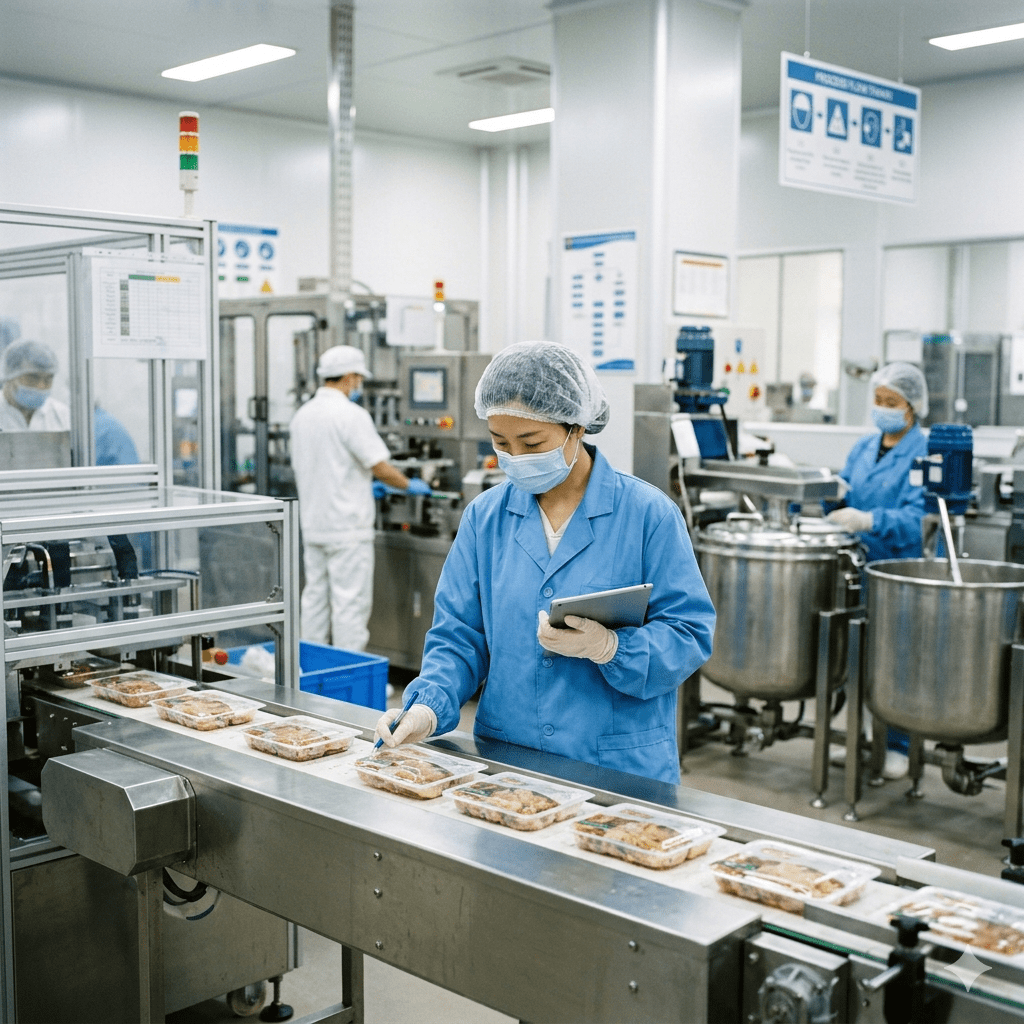
The Sourcing Dilemma: Certified Chinese Food Exporter vs Direct Factory
The Allure—and Hidden Pitfalls—of Sourcing Factory-Direct
When Singaporean F&B procurement buyers search wholesale digital directories, the incredibly low unit prices offered by direct factories are highly attractive. What these raw quotes fail to reflect are the substantial hidden overhead costs associated with trade compliance, cargo clearance, and risk management. Individual factories are engineered for a singular, localized task: high-volume domestic production. Their business metrics, operational pacing, and sales personnel operate entirely within standard domestic protocols, meaning they are rarely equipped to navigate the shifting compliance frameworks of external jurisdictions.
Furthermore, when a direct factory quotes an FOB (Free on Board) price, their legal and operational responsibility terminates the precise moment the container is loaded onto a vessel at a Chinese port. For the Singaporean importer, this means inheriting 100% of the downstream cross-border logistical risk, customs liabilities, and port clearance procedures without local boots on the ground to manage disruptions.
Why Domestic Production Capabilities Don’t Equal Export Expertise
Operating high-standard export food and beverage services demands a fundamentally different knowledge base and compliance infrastructure than serving a domestic market. A mainland direct factory may possess state-of-the-art automated machinery and impressive domestic output, but they consistently fall short in several international benchmarks:
- Absence of Global Certifications: Many individual factories lack universally recognized food safety benchmarks such as HACCP, ISO 22000, FSSC 22000, or BRCGS.
- Regulatory Ignorance: Factory management is often unaware of localized chemical, additive, or microbiological limits enforced overseas, operating under the false assumption that compliance with China’s domestic national standards (GB standards) is globally sufffcient.
- Inadequate Export Infrastructure: Without dedicated international trade teams, direct factories struggle to accurately execute specialized multi-market documentation.
Conversely, a certified Chinese food exporter functions as an active compliance and supply chain bridge. Rather than simply facilitating transactions, a certified specialist actively audits production lines, validates certifications, and structures the entire logistical pipeline to meet the destination country’s exact parameters before the product ever leaves the facility.
SFA Compliance: The Ultimate Hurdle for Singapore Food Importers
Navigating Singapore’s Strict Labeling and Additive Regulations
The Singapore Food Agency (SFA) enforces exceptionally stringent public health and consumer safety rules under the Sale of Food Act and the national Food Regulations. Every single food item entering Singapore for commercial sale must comply precisely with local guidelines regarding food composition, permitted additives, preservative thresholds, and strict English-language labeling rules.
Direct factories routinely fail to meet these exacting criteria. For instance, specific food additives or synthetic coloring agents that are perfectly legal under China’s GB standards may be strictly prohibited or capped at much lower parts-per-million (ppm) tolerances under Singapore law. Labeling is another major friction point. The SFA requires all pre-packaged food labels to display an accurate, English-language breakdown of ingredients, explicit allergen declarations, country of origin, and the specific registration details of the local importer. Additionally, Singapore’s comprehensive Nutri-Grade labeling requirements impose strict grading on beverages and specific sugar/saturated fat contents. A certified exporter like Jade Premium conducts proactive formula and label reviews at the source, redesigning packaging to guarantee 100% SFA alignment prior to shipment.
The Financial Chaos of Incomplete Documentation and Lab Reports
To secure a crucial Cargo Clearance Permit (CCP) via Singapore’s TradeNet system, local food importers must be properly registered or licensed with the SFA. Depending on the product classification, specific food items face high-intensity import control. For example, processed food products and specific agricultural goods require comprehensive supporting documentation to certify safety:
- Veterinary Health Certificates: Absolutely mandatory for meat, poultry, seafood, and egg products, which must be sourced exclusively from overseas establishments accredited by the SFA.
- Laboratory Analytical Reports: Official test sheets proving compliance with Singapore’s specific heavy metal limits, pesticide residues, and rigid microbiological standards.
When dealing with a direct factory, requests for these precise, English-language reports are frequently met with extreme delays, unaccredited internal testing data, or complete operational inertia. A single missing health certificate or an unapproved ingredient code will trigger an immediate “hold and test” directive from SFA inspectors at the Singapore port. This subjects the consignment to mandatory laboratory testing while locked in a customs warehouse, racking up compounding daily port demurrage fees and threatening to spoiltemperature-sensitive inventory.
Logistics and Quality Assurance: Where Direct Factories Drop the Ball
The Operational Reality of End-to-End Cold Chain Integrity
For perishable, frozen, or temperature-sensitive goods—such as specialized seafood ball pastes, frozen dim sum, or pre-packaged desserts—uncompromised logistics is the literal lifeline of the business. Maintaining high-standard cold chain logistics demands precision temperature-controlled warehousing, seamless intermodal transfers, and rigorous multi-stage quality control.
Direct factories rarely command the logistical network or specialized oversight required to monitor international shipping parameters. Once the cargo is transferred to a domestic freight forwarder, the factory’s operational oversight drops to zero. If an unmonitored temperature fluctuation occurs during overland transit to the Chinese port or during oceanic shipping, the entire batch’s texture, safety, and shelf-life are permanently compromised. A certified Chinese food exporter like Jade Premium eliminates this vulnerability by integrating with advanced cold chain infrastructures, utilizing strategic offices across China’s major supply hubs (including Shenzhen, Guangzhou, Shanghai, Chengdu, Wuhan, and Changsha) and leveraging the comprehensive network of Yuhu Cold Chain to monitor real-time thermal integrity from production to final delivery.
How Documentation Errors and Delays Drain Business Capital
In the highly regulated arena of international food commerce, a superior product is financially worthless if it remains legally locked inside a shipping container. When documentation omissions or classification errors happen due to a factory’s lack of export experience, the downstream financial consequences escalate exponentially for Singaporean businesses:
- Demurrage & Detention Fees: Daily port storage fees can compound into thousands of dollars within days, completely eroding import profit margins.
- Retail Stockouts: Delays trigger severe supply gaps, leading to empty shelves across Singaporean supermarket chains or critical ingredient shortages in F&B restaurant groups.
- Regulatory Penalties: Repeated compliance failures can damage an importer’s corporate standing with the SFA, leading to enhanced inspection frequencies or permit suspensions.
The Jade Premium Advantage: Seamlessly Bridging China and Singapore
Securing an End-to-End Managed Supply Chain: When weighing the procurement path of a certified Chinese food exporter vs direct factory , the choice ultimately centers on risk tolerance. Sourcing directly from an uncertified factory forces the importer to manage highly fragmented operational, legal, and logistical risks. Conversely, collaborating with a certified specialist secures an integrated, predictable, and legally bulletproof supply chain asset.
Jade Premium positions itself precisely as this indispensable compliance and logistics partner. Operating as a Hong Kong-registered corporation backed by an expansive operational footprint across China’s primary culinary and agricultural manufacturing zones, Jade Premium delivers factory-direct pricing structures while completely absorbing the complexities of cross-border trade. By managing the end-to-end journey— encompassing strategic supplier sourcing, localized factory audits, comprehensive SFA label customization, and optimized cold chain delivery—Jade Premium ensures that Singaporean food purchasers receive pristine, compliant, and market-ready products every single time. Protect your procurement margins and establish an uninterrupted flow of supply by partnering with a certified specialist who understands exactly what global success requires.