
Matcha Is Everywhere in 2026 — And Supply Can’t Keep Up
When a coffee chain or bakery brand watches quarterly margins slip, the cause often isn’t the recipe on the menu — it’s what’s happening several steps back in the supply chain, long before a single cup is poured. For many food and beverage buyers in 2026, that pressure point has a name: matcha.
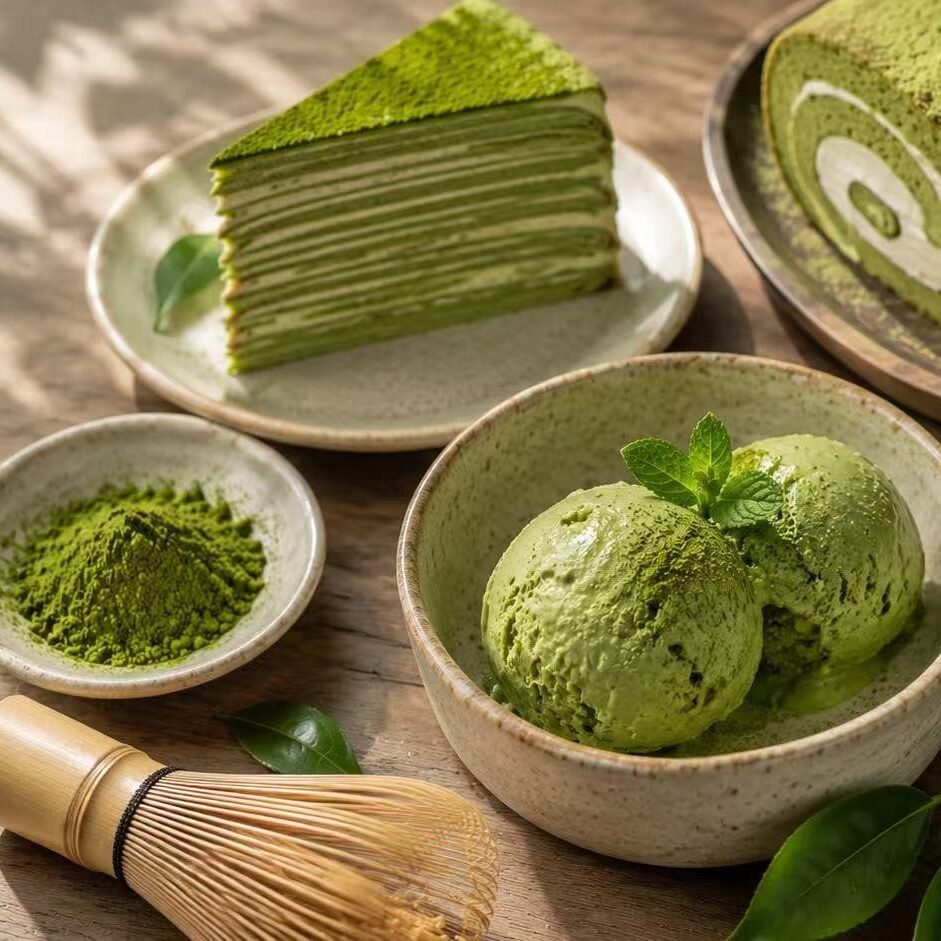
Matcha has outgrown the tea ceremony. It’s now a latte at the coffee shop on the corner, a cookie on the bakery shelf, a soft-serve flavour, a boba tea base, and increasingly the entire concept behind cafés that serve nothing else. What started as a Japanese specialty has become one of the most versatile ingredients in global food and beverage development, showing up in bakery, confectionery, ready-to-drink beverages, and foodservice menus across markets that had barely heard of it a decade ago.
The industry data backs up what buyers are seeing on shelves. Multiple market research firms now put the global matcha market in the multi-billion-dollar range, with mid-to-high single-digit annual growth forecast through the early 2030s. But growth on the demand side only tells half the story. For importers, brand owners, and foodservice buyers trying to secure product, the more pressing question in 2026 isn’t whether matcha will keep growing — it’s who can actually supply it, in what grade, and at what volume.
That question is reshaping where buyers look for matcha in the first place.
Japan’s Matcha Squeeze
Japan remains the name most associated with matcha, and for good reason: its tea-growing regions have generations of expertise in shade-grown, stone-milled tencha, the raw material matcha is made from. But that heritage comes with a ceiling. Tencha production is labour-intensive, land is limited, and the same harvest now has to stretch across booming export demand, a growing domestic market, and tourism-driven consumption at home.
The result has been tighter supply and rising prices at the premium end, particularly for ceremonial-grade matcha, alongside longer lead times for buyers used to ordering on shorter cycles. Rising input tariffs into some Western markets have added further cost pressure on Japanese-origin product, making the economics even harder for buyers working with tight margins or private-label price points.
Buyers Are Feeling the Pressure
For a brand trying to launch a matcha latte line or a bakery scaling up a matcha croissant across multiple locations, this squeeze isn’t abstract. It shows up as suppliers quoting longer delivery windows, minimum order quantities that no longer fit a smaller buyer’s cash flow, and per-kilo pricing that erodes margin on a product category that was supposed to be a growth driver.
Buyers who built a menu or product line around a single Japanese supplier are now asking a harder question: what happens if that supplier can’t scale with us? For many, the answer has meant looking at where else in the world matcha is being produced — and produced well.
In short: when a single origin controls both supply and price, margin pressure isn’t a risk buyers can plan around — it’s one they have to actively solve for. That’s exactly what’s pushing more buyers to look at China’s matcha industry.
China as a Strategic Matcha Supplier: Meeting Global Demand
China has answered that question with scale. According to the 2026 China Matcha Industry Development Report, national matcha output topped 12,000 tonnes in 2025, close to 70% of global production, with the industry posting an average annual growth rate above 28% over the past five years. [1]
Production hubs in Guizhou and Zhejiang have both reported triple-digit export growth in recent reporting periods, with shipments now reaching dozens of destination markets rather than a handful.
What’s driving that growth is range as much as volume. Chinese manufacturers are increasingly supplying matcha tailored to specific use cases rather than a single generic grade, which matters more to buyers than the topline production numbers. A bakery in Hong Kong sourcing matcha powder for bakery applications needs a heat-stable, consistent-colour powder that performs in an oven, which is a different specification from what a beverage brand in Thailand needs when formulating matcha powder for drinks meant to dissolve cleanly in milk or water. A café group in Singapore building a premium menu around organic ceremonial matcha is buying on colour, umami and certification, while a bubble tea chain sourcing matcha powder for boba tea is buying on cost stability and consistent flavour at high volume. Further along the spectrum, brands entering the US market are increasingly asking specifically for USDA organic matcha powder, reflecting how far compliance expectations have moved beyond just “matcha” as a category.
| Quick Tip: Matching Matcha Grade to Application Not every matcha powder performs the same way once it leaves the tin. Oven heat, milk fat, and mixing method all change how colour and flavour hold up. Before locking in a specification, buyers typically confirm: heat stability (bakery), solubility (beverages), certification and colour grade (ceremonial/retail), and cost-to-volume ratio (high-throughput boba and QSR formats). See how these specifications map to an actual product: Natural Matcha Powder No. 912 specification. |
That range is also where the category itself is expanding. What buyers now call “matcha” is no longer confined to the classic shade-grown green tea base — the definition itself is shifting, from a single functional ingredient into a customisable flavour platform. Some Chinese producers are experimenting with alternative tea bases, including black tea, to create matcha-style powders with different flavour and colour profiles for particular product applications. For product developers, that’s an added degree of flexibility that simply didn’t exist when matcha meant one thing from one country.
Where to Find Verified Matcha Suppliers
The practical challenge for most buyers isn’t convincing themselves China can produce matcha at scale — the data already makes that case. It’s finding a specific supplier that’s export-ready: properly certified, consistent between batches, and set up to handle international documentation and logistics rather than domestic sales alone.
This is where a sourcing partner with direct manufacturer relationships makes the search shorter. Jade Premium works with verified Chinese matcha suppliers whose products are already produced to the certification standards international buyers ask for. One example available through the Jade Premium platform is Natural Matcha Powder No. 912, manufactured under HALAL, ISO22000 and FDA certification, with an existing export track record into Japan — a market that is itself famously exacting about matcha quality. That existing track record is a useful proxy for buyers: a powder that already clears Japanese quality expectations has a strong head start on meeting most other international specifications. Buyers can view the product specification directly on the Jade Premium site and request samples through the platform.
Looking for a different grade, certification, or format than what’s currently listed? Jade Premium’s sourcing network extends beyond what’s published on the site. The team can help narrow down the right specification before you commit to a volume — contact Jade Premium directly to walk through your matcha requirements.
Looking Ahead
The matcha boom isn’t slowing down, and neither is the pressure on buyers to secure supply that can keep pace with it. What’s changing is where that supply is coming from. China’s matcha industry has moved from a supporting role to a serious production base in its own right, offering the range of grades, formats and certifications that a global, multi-application category now demands.
This shift is best understood not as a wholesale replacement of Japanese supply, but as a resilience strategy. A “primary supplier plus complementary supplier” model — pairing an existing Japanese source with a verified Chinese matcha supplier — gives buyers a practical hedge against the kind of single-origin bottlenecks now squeezing the category. Rather than betting an entire product line on one region’s harvest, tariff environment, or lead time, buyers can diversify sourcing the same way they would any other high-demand commodity: not by abandoning what already works, but by building redundancy around it.
For importers, brand owners and foodservice buyers, the opportunity isn’t simply about finding an alternative to Japan — it’s about building a supply chain resilient enough to support matcha’s next phase of growth, wherever that growth happens to be strongest. The businesses that move on this now, rather than waiting for the next round of price hikes or allocation cuts, are the ones that will hold their margins when the rest of the category is still scrambling for supply.
[1] Source: 2026 China Matcha Industry Development Report, released at the 2026 China Matcha Conference in Tongren, Guizhou Province, on May 31, 2026.