
Why International Buyers Are Turning to Turmeric, Red Ginseng and Other Dual-Purpose Ingredients for the Next Wave of Medicine-Food Homology Beverages
- Medicine-Food Homology Is Moving from Tradition to Global Wellness Retail
- Modern Formulation Technology Is Turning Ancient Ingredients into Everyday Drinks
- A Younger, Global Consumer Base Is Driving the Functional Beverage Boom
- Product Spotlight: Medicine-Food Homology Beverages in Practice
- Looking Ahead: Where Medicine-Food Homology Beverages Go Next
Medicine-Food Homology Is Moving from Tradition to Global Wellness Retail
For more than 2,000 years, Chinese food culture has operated on a simple premise: many of the ingredients used to nourish the body are the same ones used to treat it. This principle, known as medicine-food homology, underpins everyday staples such as ginger, cinnamon, red dates and ginseng — items that sit as comfortably in a kitchen cupboard as they do in a traditional pharmacy.
What has changed is where this thinking is now showing up. Medicine-food homology is no longer confined to soups simmered at home or herbal teas brewed for specific ailments. Chinese herbal beverages have become a defined product category in their own right, and one that global beverage buyers are watching closely.
The medicinal and food homologous health product market was valued at over USD 12 billion in 2024 and is forecast to more than double by 2033, according to Verified Market Reports — a trajectory that mirrors the wider functional beverage market, which Mordor Intelligence estimates will grow from roughly USD 164 billion in 2026 to nearly USD 240 billion by 2031.
This is not simply a story about traditional Chinese medicine finding new packaging. It is a story about a functional beverage industry searching for ingredient credibility, and finding it in a food philosophy that has already been tested by centuries of everyday use. For importers, retailers and foodservice buyers, the opportunity lies in ready-to-drink and easy-to-prepare formats that translate this heritage into something a global consumer can pick up off a shelf.
Jade Premium, a Hong Kong-based sourcing specialist connecting international buyers with verified Chinese manufacturers, works with producers turning this category into exportable, retail-ready products. INZONE, a beverage line developed by Shandong-based Lushang Group, is one example of how medicine-food homology formulas are being reworked into contemporary drinks — without losing the ingredient logic that makes them credible in the first place.
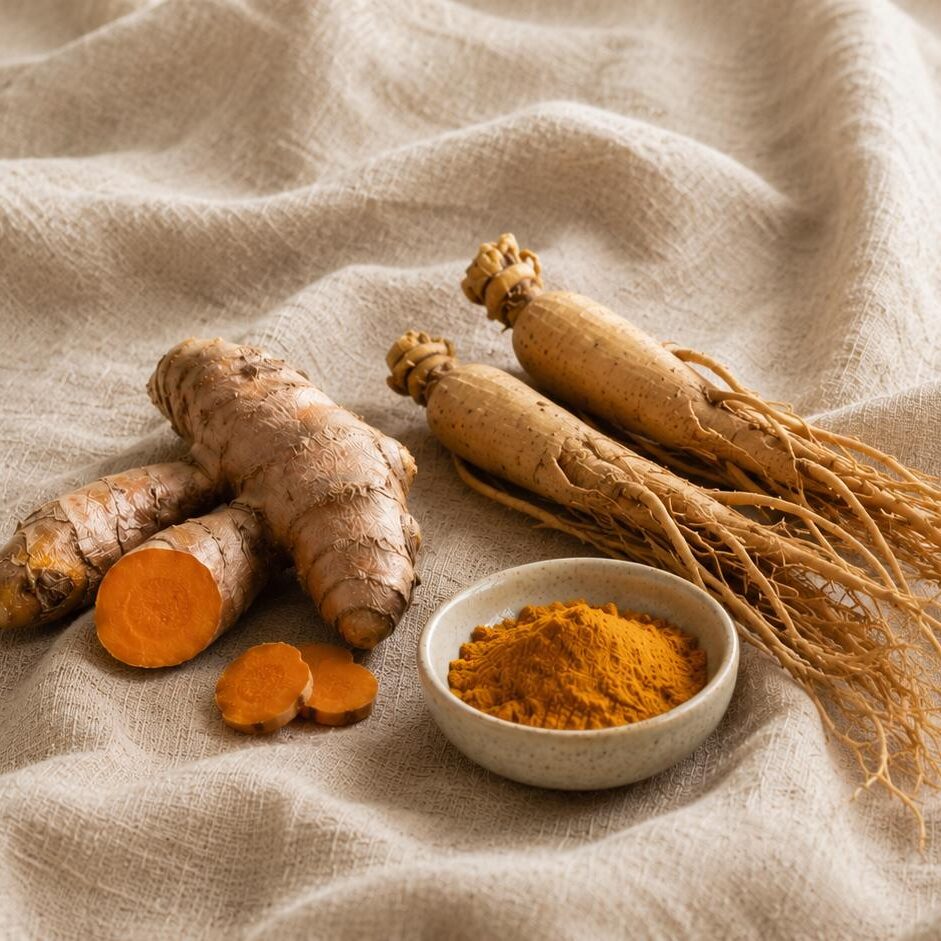
Whole and sliced turmeric root, ground turmeric powder in a ceramic bowl, and fresh ginseng roots arranged on natural linen fabric, representing the raw ingredients behind medicine-food homology beverages.
Modern Formulation Technology Is Turning Ancient Ingredients into Everyday Drinks
Translating a simmered herbal remedy into a bottled or single-serve drink is not a simple act of repackaging. Many of the ingredients associated with medicine-food homology — turmeric, ginseng, mushroom extracts — are difficult for the body to absorb in their raw form, slow to prepare, or simply unpleasant to consume quickly. Closing that gap has become one of the more active areas of food science investment in China’s beverage manufacturing sector.
Microencapsulation and Advanced Absorption Technology
Microencapsulation is one of the more significant advances. By stabilising active compounds inside a protective coating, manufacturers can preserve potency during processing and storage while improving how efficiently the body absorbs them — often pairing ingredients like curcumin with absorption enhancers such as black pepper extract. Water-soluble powder formats, designed to dissolve within seconds rather than minutes, are also making these products viable for on-the-go consumption in a way that a simmered decoction never could be.
Clean-Label Formulation for Global Markets
Clean-label formulation has developed alongside these absorption technologies. Zero added sucrose, zero artificial flavourings and zero preservatives are increasingly treated as a baseline expectation rather than a premium claim, particularly for buyers supplying health-conscious retail channels in Europe, North America and Australasia.
Taken together, these advances mean a format historically associated with home preparation and an older consumer base can now compete directly with mainstream functional beverages — offering the same convenience as an energy drink or a bottled tea, while drawing on an ingredient story that is difficult for newer wellness brands to replicate.
A Younger, Global Consumer Base Is Driving the Functional Beverage Boom
Medicine-food homology products have traditionally served a narrower audience: consumers already familiar with Chinese dietary therapy, often buying with a specific health goal — or a gift recipient — in mind. That audience is still there, and remains significant. But it is no longer the only one driving demand.
A parallel trend is playing out across other markets. In India, functional beverage growth is increasingly built around Ayurvedic ingredients such as turmeric, tulsi and ashwagandha, reflecting a broader global appetite for traditional, food-based wellness solutions rather than synthetic supplementation, according to Coherent Market Insights. In the United States, import data shows Asian-origin wellness beverages — spanning ginseng, adaptogens and herbal tonics from Japan, India, China and South Korea — represent a combined market worth close to USD 7 billion, according to a 2026 analysis of the US functional beverage sector by Sourceready. Read together, both data points point to the same underlying shift: consumers raised on adaptogen-driven wellness trends are increasingly open to ingredients with centuries of traditional use behind them, regardless of where those ingredients originated.
For buyers, this broadens the realistic retail footprint for medicine-food homology drinks considerably. Health food retailers and specialist Asian grocery channels remain a natural fit, but increasingly so are mainstream supermarkets, office wellness programmes, gyms and premium gifting channels — particularly for products like ginseng-based drinks, which carry an established gifting tradition in East Asian markets that can translate well into premium retail positioning elsewhere.
This opportunity does come with regulatory nuance. Health-related claims for beverages are scrutinised differently across markets — the EU’s Novel Food framework and varying national rules on functional and health claims mean that messaging which works well in one market may need adjustment in another. This is less a barrier than a planning consideration, but one that buyers introducing medicine-food homology products to new markets should factor into their launch timelines.
Product Spotlight: Medicine-Food Homology Beverages in Practice
INZONE Turmeric Lemon Drink
Turmeric has become one of the most recognisable ingredients in the global wellness conversation, but its functional beverage applications are often limited by how poorly the body absorbs curcumin, turmeric’s primary active compound, in its natural state.
INZONE Turmeric Lemon Drink is built around a medicine-food homology formula that combines cinnamon and ginger — ingredients traditionally used to support circulation and help the body manage inflammation — with a microencapsulated, water-soluble turmeric powder designed to dissolve within three seconds. The formula pairs curcumin with piperine, an extract from black pepper, in a combination the manufacturer states can increase absorption efficiency by up to tenfold compared with unprocessed turmeric.
Key product characteristics include:
- Medicine-food homology formula combining cinnamon and ginger
- Microencapsulated curcumin paired with black pepper piperine for improved absorption
- Water-soluble powder format, dissolving within three seconds
- Caffeine-free, positioned as an alternative source of alertness
- Zero added sucrose, zero artificial flavourings, zero preservatives
- Fortified with Vitamin C
INZONE Red Ginseng and Pomegranate Drink
Red ginseng holds a particular place in East Asian wellness culture, both as a warming, restorative ingredient and as a traditional gifting item. INZONE’s Red Ginseng and Pomegranate Drink builds on that heritage with a formula combining red dates, ginger and red ginseng, rounded out with a naturally fruity note from pomegranate.
The formula is fortified with Vitamin B1, Vitamin B2 and Vitamin C, positioning it as a daily energy-support drink rather than an occasional tonic — a format shift that makes it easier for retailers to merchandise alongside mainstream functional beverages rather than only within a traditional health or gifting section.
Key product characteristics include:
- Medicine-food homology formula combining red dates, ginger and red ginseng
- Fortified with Vitamin B1, Vitamin B2 and Vitamin C
- Naturally fruity flavour profile from pomegranate
- Suitable for daily energy-support positioning as well as traditional gifting channels
Both drinks are produced by Lushang Group Co., Ltd., established in 1992 and based in Shandong, China. Whether you are looking to introduce medicine-food homology beverages to a health food retail range, explore private label functional drinks in China with an established Chinese wellness beverage manufacturer, or simply want to understand which formats are gaining traction in this category, Jade Premium connects international buyers with verified manufacturers like Lushang Group, backed by quality assurance and export expertise. Whether you need a turmeric functional beverage supplier or a broader medicine-food homology drink supplier, we can shortlist verified options against your specifications.
Sourcing medicine-food homology beverages? Contact Jade Premium’s team to shortlist verified turmeric and red ginseng beverage suppliers for your specifications.
Looking Ahead: Where Medicine-Food Homology Beverages Go Next
Medicine-food homology is not a new idea — it is one of the oldest frameworks for thinking about food that exists. What is new is the format: ready-to-drink bottles, dissolvable powders and shelf-stable formulas that let a global consumer engage with centuries-old ingredient logic in the time it takes to open a can.
For international buyers, the category offers something increasingly rare in functional beverages — an ingredient story with genuine depth behind it, rather than one built purely around marketing. As formulation technology continues to close the gap between traditional preparation and modern convenience, medicine-food homology products are likely to move further from niche wellness shelves into the everyday functional beverage aisle.
Buyers looking to explore this category — whether through established formulas like INZONE’s turmeric and red ginseng drinks, or through wider sourcing across Jade Premium’s manufacturer network — are welcome to contact our team to discuss requirements and available options.
Related Articles
Continue exploring the latest market trends shaping the global food industry.
Read more about private label food trends and sourcing strategies from China.
Explore how Asia’s vegetarian expos are shaping global plant-based retail trends.