
- Understanding Private Label Supply Chain Structures
- What Makes a Private Label Chinese Food Supplier Reliable?
- Critical Certifications and Standards for International Markets
- Navigating Regulatory Requirements for Your Target Markets
- The Supplier Evaluation Checklist Every Buyer Needs
- Quality Assurance Throughout the Product Lifecycle
- Essential Contract Terms for Private Label Partnerships
- Five Red Flags That Should Stop You Immediately
- Practical Risk Reduction Strategies
- Your 5-Point Private Label Sourcing Checklist
When you’re sourcing private label Chinese food products for your retail brand, one wrong supplier choice can cascade into a nightmare scenario: detained shipments at customs, product recalls that destroy customer trust, or compliance violations that trigger six-figure penalties. For international buyers building their brand on authentic Chinese cuisine, the stakes couldn’t be higher.
The financial consequences of partnering with an unreliable private label Chinese food supplier extend far beyond the initial purchase order. A single mislabeled product can halt your entire inventory at the border. An undisclosed allergen can trigger lawsuits and irreparable brand damage. A supplier who cuts corners on quality control can leave you scrambling to explain to retailers why your “premium” product line failed basic safety standards.
This isn’t about being overly cautious—it’s about protecting your business. The Chinese food manufacturing landscape offers incredible opportunities for international buyers, but navigating it successfully requires knowing exactly what to look for and what warning signs demand your immediate attention. The difference between a profitable private label partnership and a costly disaster often comes down to recognizing red flags before you commit.
Understanding Private Label Supply Chain Structures
Before identifying red flags, you need to understand who you’re actually dealing with. The Chinese food supply chain operates through distinct supplier models, each with different capabilities and risk profiles.
OEMs (Original Equipment Manufacturers) produce goods according to your exact specifications. They manufacture the product but you control the recipe, formulation, and branding. For private label Chinese food, this means a factory follows your requirements for ingredients, processing methods, and packaging design while you maintain full ownership of the brand identity.
ODMs (Original Design Manufacturers) take it one step further. They offer pre-existing product formulations that you can rebrand as your own. An ODM might have a proven dumpling recipe, sauce formula, or noodle product that you simply relabel with your brand. This reduces development time but gives you less control over the core product.
Third-party quality partners act as independent verification layers. These include inspection companies, testing laboratories, and compliance consultants who validate supplier claims. In the complex world of international food trade, these partners provide the objective verification that protects your brand when you can’t physically oversee production yourself.
For international buyers, understanding these distinctions matters because your risk tolerance and control requirements should determine which supplier model fits your business. A seasoned importer building a premium dumpling line might work directly with an OEM for complete recipe control. A startup testing market demand might begin with an ODM’s proven formulation. Both approaches work—but both require rigorous vetting to avoid the red flags we’ll explore.
What Makes a Private Label Chinese Food Supplier Reliable?
Reliability in private label food sourcing isn’t just about timely deliveries. It’s about consistent quality, regulatory compliance, and transparent communication that lets you sleep at night knowing your brand is protected.
Demonstrated private label capability means more than a factory claiming they can “do private label.” It means documented experience producing for international brands with verifiable references. Reliable suppliers can show you their portfolio of existing private label partnerships, explain their design-to-production workflow, and demonstrate understanding of brand differentiation requirements.
Strong quality control framework operates at multiple checkpoints. Before production begins, reliable suppliers conduct incoming raw material inspections. During production, they implement in-process monitoring at critical control points. After production, they perform finished product testing before anything ships. This isn’t optional—it’s the foundation of food safety.
Necessary certifications signal that a supplier has invested in meeting recognized standards. For international trade, certifications like HACCP (Hazard Analysis Critical Control Points) and GMP (Good Manufacturing Practices) aren’t just paperwork—they represent systematic approaches to preventing food safety hazards that align with global best practices.
Transparency in operations separates professional suppliers from problematic ones. Can you schedule factory audits? Will they share detailed production records? Do they openly discuss their ingredient sourcing and processing methods? Suppliers who operate with transparency have nothing to hide. Those who dodge questions or restrict access raise immediate concerns.
At Jade Premium, we’ve built our reputation on this transparency principle. Our clients can trace the journey of their products from ingredient sourcing through final packaging because we believe international buyers deserve complete visibility into what they’re putting their brand name on.
Critical Certifications and Standards for International Markets
When you’re sourcing private label Chinese food for international markets, certifications aren’t administrative formalities—they’re your first line of defense against compliance disasters.
HACCP certification demonstrates that a supplier has implemented a preventive food safety system recognized worldwide. This system identifies potential hazards in food production—biological, chemical, and physical—and establishes critical control points to prevent them. A HACCP-certified Chinese supplier has proven they can systematically manage food safety risks according to Codex Alimentarius standards, the international food safety framework.
GMP (Good Manufacturing Practices) certification shows that a factory maintains baseline hygiene, sanitation, and operational standards. GMP covers everything from employee training and facility cleanliness to equipment maintenance and pest control. For food production, GMP certification confirms that the basic infrastructure for safe manufacturing exists.
Additional certifications depend on your target market and product category. If you’re selling organic Chinese products, look for certified organic credentials. For halal markets, valid halal certification is non-negotiable. For quality-conscious buyers, ISO 22000 (Food Safety Management) or SQF (Safe Quality Food) certifications demonstrate commitment to internationally recognized food safety management systems.
Here’s what international buyers must understand: legitimate certifications come from recognized third-party auditors, not self-declared claims or certificates from unknown entities. Always verify certification authenticity through the issuing organization’s database. Counterfeit certificates circulate in international trade, and accepting one can expose your business to severe liability.
Navigating Regulatory Requirements for Your Target Markets
Different markets demand different compliance approaches, and your private label Chinese food supplier must understand the regulatory landscape of wherever you’re selling.
US FDA requirements are particularly stringent. The FDA requires that food facility registration, prior notice of imported food shipments, and compliance with the Food Safety Modernization Act (FSMA). Your supplier needs to understand Foreign Supplier Verification Program (FSVP) requirements, which place responsibility on US importers to verify that foreign suppliers meet US safety standards.
Labeling compliance varies dramatically by market. The US requires detailed nutrition facts panels in specific formats, allergen declarations in particular language, country-of-origin marking, and ingredient lists in descending order by weight. Europe has different requirements under EU Regulation 1169/2011. Middle Eastern markets may require Arabic translations and halal certifications. Your supplier must be capable of producing compliant labels for your specific destination market—not generic labels that work nowhere.
Documentation accuracy can make or break your shipment. Commercial invoices, packing lists, certificates of origin, health certificates, and test reports must all align perfectly. Discrepancies between documents trigger customs delays and inspections. A reliable private label Chinese food supplier maintains meticulous documentation practices because they understand that paperwork errors cost you time and money.
The complexity of international food regulations is exactly why buyers need partners like Jade Premium. Our deep expertise in navigating compliance requirements across different markets helps prevent the costly mistakes that happen when suppliers lack international regulatory knowledge.
The Supplier Evaluation Checklist Every Buyer Needs
Before you commit to any private label Chinese food supplier, work through this systematic evaluation process:
Step 1: Request and verify certifications. Don’t just accept PDF copies—verify every certification through the issuing organization’s verification system. Check expiration dates and ensure the certification scope covers the specific products you want to source.
Step 2: Conduct factory audits. Either visit personally or hire a reputable third-party inspection company. Look beyond the presentation room into actual production areas. Observe employee practices, check equipment maintenance, examine raw material storage, and review quality control records.
Step 3: Review private label portfolio. Ask for references from existing international clients. Contact these references and ask pointed questions about quality consistency, communication reliability, problem resolution, and compliance track record.
Step 4: Request product samples and testing reports. Have samples tested by independent laboratories for both safety parameters and quality characteristics. Compare lab results against supplier claims.
Step 5: Evaluate communication capabilities. Assess whether the supplier has competent English-speaking staff who understand international business practices. Communication breakdowns in food sourcing lead to specification errors, missed deadlines, and compliance failures.
Step 6: Examine their regulatory knowledge. Ask specific questions about your target market’s requirements. A knowledgeable supplier should immediately understand FDA, USDA, or EU regulatory concerns relevant to your product category.
Quality Assurance Throughout the Product Lifecycle
Quality control isn’t a single checkpoint—it’s a continuous process from pre-production through post-production stages.
Pre-production phase begins with ingredient verification. Reliable suppliers inspect incoming raw materials against established specifications before they enter the production line. They maintain supplier qualification programs for their ingredient sources and can trace ingredients back to specific farms or manufacturers.
During production, critical control points must be monitored continuously. For Chinese food products, this might include cooking temperatures for ready-to-eat items, metal detection for packaged goods, weight accuracy for portioned products, and seal integrity for packaged items. Monitoring records should be maintained and available for review.
Post-production quality checks happen before products ship. This includes finished product testing for safety parameters like microbiology and heavy metals, sensory evaluation to ensure consistency with approved samples, packaging inspection to verify label accuracy and seal quality, and storage condition verification to ensure proper temperature control until loading.
Documentation and traceability tie it all together. Every batch should have complete records showing ingredient sources, production dates, quality check results, and distribution tracking. If a problem emerges months later, you need the ability to trace affected product back to specific production runs.
Essential Contract Terms for Private Label Partnerships
Your contract with a private label Chinese food supplier must protect your interests across multiple dimensions:
Product specifications should be detailed and attached as appendices. Include ingredient lists with acceptable suppliers, processing parameters with acceptable ranges, sensory characteristics with benchmarked samples, and packaging specifications including all label artwork.
Quality acceptance criteria must be defined clearly. What defect rates are acceptable? What testing must be performed before shipment? Who bears the cost of testing? What happens if products fail specifications after production but before shipment?
Intellectual property protections are critical in private label arrangements. Your contract should explicitly prohibit the supplier from producing your formulation for other buyers, using your brand name or design elements, or disclosing your proprietary information to third parties.
Change control agreements establish processes for modifications. If you want to adjust a recipe, change packaging, or modify production methods, the contract should specify how these changes are proposed, tested, approved, and implemented.
Liability and remedy provisions clarify responsibility when problems occur. If products are detained at customs due to compliance issues, who pays the storage fees and remediation costs? If products must be recalled due to safety issues, what are the supplier’s financial responsibilities?
Five Red Flags That Should Stop You Immediately
Now that you understand what to look for, here are the warning signs that should make you walk away from a potential supplier:
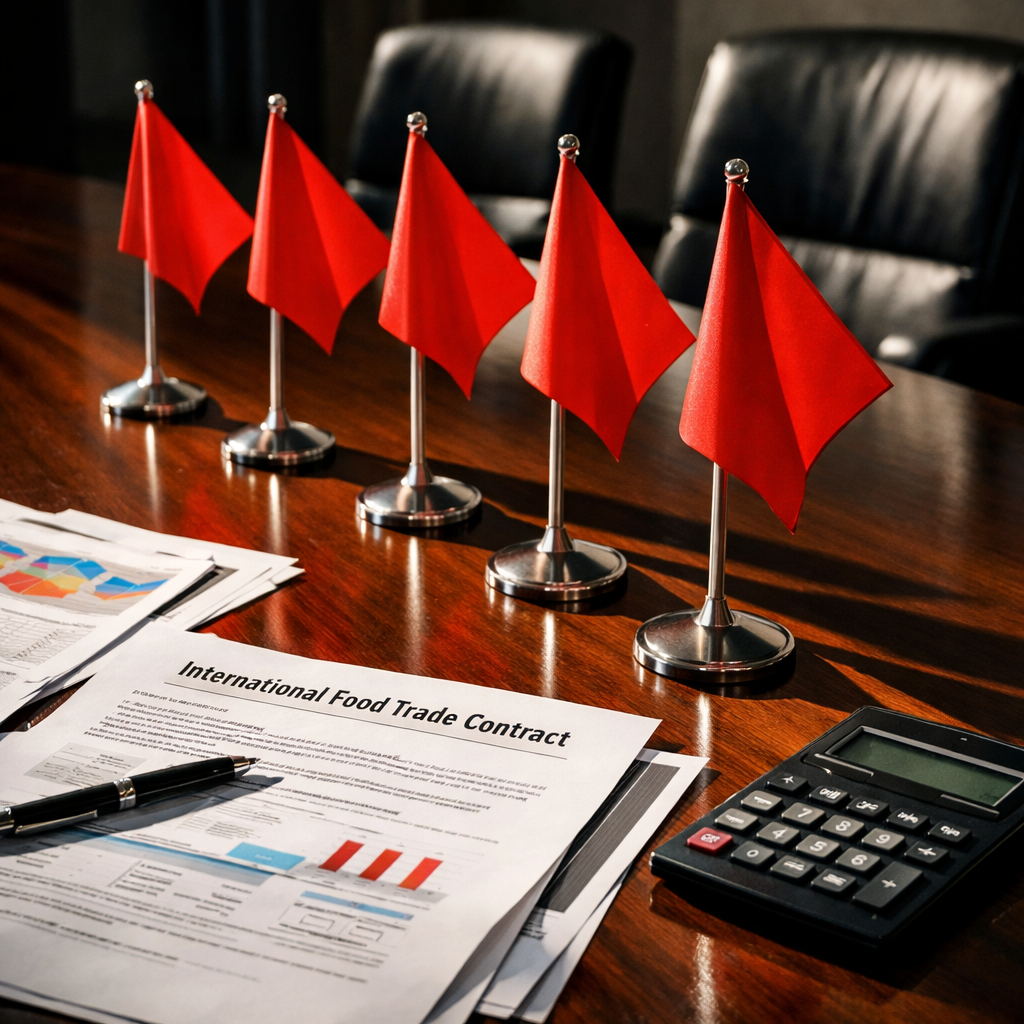
#1: Suspiciously low prices. If a supplier’s quote is significantly below market rates, they’re cutting corners somewhere. Maybe it’s lower-quality ingredients, skipped quality control steps, or non-compliant production practices. In food sourcing, below-market pricing typically signals higher risk, not better value.
#2: Vague or inconsistent responses. When you ask specific questions about certifications, production processes, or compliance capabilities, professional suppliers provide detailed answers. If responses are vague (“we can meet all requirements”), inconsistent across different communications, or delayed repeatedly, communication problems now predict bigger problems during production.
#3: Resistance to factory audits or inspections. Legitimate suppliers welcome inspections because they have nothing to hide. If a potential supplier discourages factory visits, restricts access to production areas, or delays audit scheduling indefinitely, assume they’re hiding problems you don’t want to discover after placing orders.
#4: Inability to provide verifiable references. Professional private label suppliers have established international clients willing to vouch for their performance. If a supplier claims extensive private label experience but can’t provide verifiable references, or provides references that don’t respond or give lukewarm endorsements, your risk level is unacceptably high.
#5: Pressure tactics or requests for unusual payment terms. Be immediately suspicious if a supplier pressures you to commit quickly, offers unsolicited advice on avoiding tariffs or regulations, or requests payment to personal accounts rather than company accounts. These tactics signal either desperation or dishonesty—neither makes a good partner.
Practical Risk Reduction Strategies
Even after thorough vetting, international buyers should implement risk reduction strategies:
Start with small pilot orders. Before committing to container quantities, order smaller trial batches that let you test the supplier’s quality, communication, and reliability without massive financial exposure. Use pilot orders to verify that products arriving at your destination match factory samples and meet all compliance requirements.
Implement third-party inspection programs. Even with trusted suppliers, periodic third-party inspections provide objective verification. Pre-shipment inspections catch problems before products leave China. During-production inspections verify that approved processes are being followed.
Maintain alternative supplier relationships. Don’t become completely dependent on a single supplier, no matter how reliable they seem. Qualified backup suppliers provide leverage in negotiations and insurance against disruption if your primary supplier faces production problems.
Build relationships beyond transactions. Visit your supplier regularly, understand their business challenges, and maintain open communication channels. Strong relationships encourage suppliers to prioritize your needs and communicate proactively when problems emerge.
At Jade Premium, we’ve seen how these strategies protect international buyers. Our clients leverage our extensive supplier network and on-ground presence across China to implement thorough verification, maintain relationship oversight, and ensure consistent quality. We exist to be your trusted partner who manages these complexities so you can focus on building your brand.
Your 5-Point Private Label Sourcing Checklist
Before you finalize any private label Chinese food supplier relationship, confirm these five non-negotiables:
Proven private label capability verified through reference checks, portfolio review, and demonstrated understanding of brand-specific requirements.
Regulatory alignment with your target market requirements, including appropriate certifications, labeling capabilities, and documentation practices.
Third-party validation through factory audits by independent inspection companies and product testing by recognized laboratories.
Comprehensive contract covering product specifications, quality criteria, IP protections, change control, and liability provisions.
Successful pilot order demonstrating that products meet specifications, arrive on time, and clear customs without compliance issues.
Sourcing private label Chinese food products offers tremendous opportunity for international buyers building authentic cuisine brands. The Chinese manufacturing base combines traditional culinary expertise with modern production capabilities and competitive pricing. But success requires more than finding a factory that claims they can produce what you need—it requires rigorous vetting, clear agreements, and ongoing oversight.
The red flags we’ve explored aren’t theoretical concerns. They represent real risks that cost unprepared buyers significant money, time, and brand reputation. By understanding these warning signs and implementing systematic evaluation processes, you protect your business from preventable disasters while accessing the authentic Chinese food products your customers want.
Your private label success depends on choosing suppliers who share your commitment to quality, transparency, and compliance. When you find that partner, you’re not just sourcing products—you’re building a foundation for long-term brand growth in the dynamic world of international food trade.