
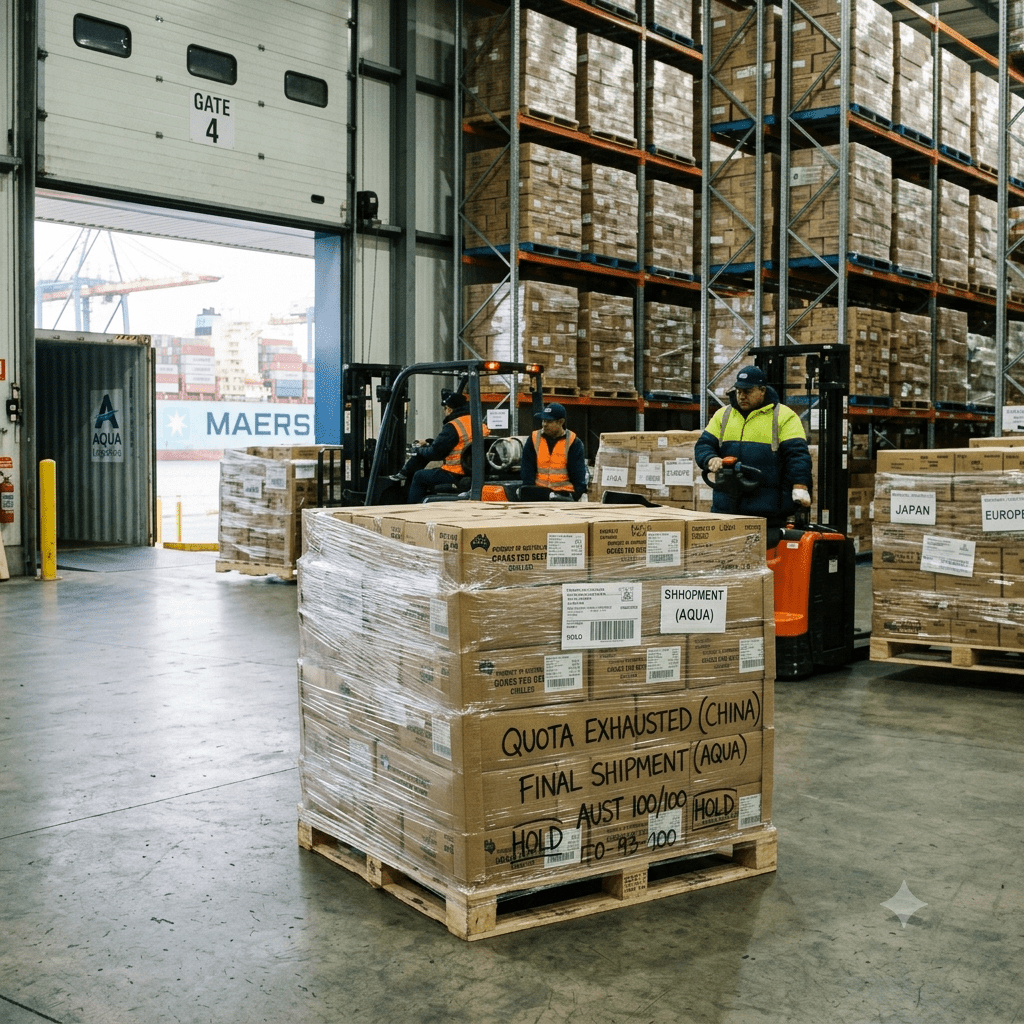
In mid-June 2026, the global meat industry witnessed a massive shockwave. Australian beef shipments to China officially crossed the 205,000-tonne annual safeguard limit. In response, China immediately implemented an additional 55% tariff on all incoming Australian beef for the remainder of the calendar year.
For international B2B food purchasers, this is more than just a bilateral trade headline—it is the catalyst for a fundamental realignment of global meat prices and trade routes. As a leading supply chain specialist, Jade Premium is closely monitoring these global beef market shifts to help overseas buyers navigate the volatility and secure stable sourcing.
The Catalyst for the Beef Supply Chain Disruption
In January 2026, China introduced a new three-year safeguard system to protect its domestic cattle farmers from falling local prices. This system assigned strict import quotas to major meat-producing nations.
Australia’s 205,000-tonne limit was exhausted before the year was even half over. With the new 55% tariff effectively pricing most Australian beef out of the Chinese market (save for extremely small volumes of premium Wagyu), a massive beef supply chain disruption is currently unfolding. This tension is further compounded by the fact that Brazil—China’s largest beef supplier—has already consumed over 70% of its own 1.106 million-tonne quota, signaling wider restrictions ahead.
The Supply Shock: Where Does the Beef Go Now?
400,000–500,000 Tonnes Must Be Redirected
This is the number that B2B buyers across Southeast Asia, the Middle East, and North America need to understand. Market experts estimate that between 400,000 and 500,000 tonnes of Australian and Brazilian beef will need to be redirected to alternative markets during H2 2026. That is not a minor trade adjustment — it is a structural redirection of some of the world’s highest-quality grass-fed and grain-fed beef into markets that were not originally priced for it. ukragroconsu
For Australia alone, up to 30,000 tonnes per month — approximately 21% of all its exports — that previously went to China must find new buyers. The Australian Meat Industry Council has estimated the financial impact at approximately AUD $1 billion in lost sector value.
Southeast Asia Becomes the Pressure Valve
Southeast Asian markets — including Vietnam, Indonesia, the Philippines, Malaysia, and Thailand — are expected to absorb the largest volume of diverted supply. This is both an opportunity and a pricing challenge for buyers in those markets. As more premium Australian beef competes for shelf space and cold chain capacity in Southeast Asia, buyers with established relationships and volume commitments will be positioned to negotiate more aggressively on price and contract terms. kragroconsult
Brazil and the US Remain Under Their Quotas — For Now
As of mid-June 2026, Brazil and the United States have not yet reached their respective quota ceilings. Brazil’s allocation of 1,106,000 tonnes gives it considerably more headroom, though its own domestic exporters are grappling with internal quota-allocation debates. For importers seeking continuity of supply from the China-approved supply chain, Brazilian beef remains accessible at standard duty rates for now — but competitive pressure on that quota will intensify as the year progresses.
Analyzing Market Shifts for H2 2026
HWhen the world’s top meat exporters hit trade ceilings in the world’s largest import market, the ripple effects are felt across all continents. Here is how the landscape is changing for the second half of 2026:
Diverted Volumes and Regional Price Pressures
Australian beef output remains at record highs. The massive volumes of meat that would have traditionally flowed into China are now being aggressively redirected. Markets such as South Korea, Japan, the United States, and Southeast Asia are the primary alternative destinations. For buyers in these regions, this sudden influx of Australian beef is increasing competition and putting downward pressure on local wholesale meat prices.
The Search for Stable Processing Corridors
With traditional trade routes bottlenecked by quotas and unpredictable tariffs, international buyers are rapidly re-evaluating their sourcing strategies. Dependence on a single origin country is no longer viable. Importers are increasingly looking toward diversified processing hubs that offer stable pricing, comprehensive certifications, and robust cold-chain logistics.
Strategic Implications for Wholesale Beef Buyers
Opportunity in the Dislocation
Market dislocations of this scale are, historically, where procurement advantages are won. Importers in Southeast Asia, the GCC, and developing Asian markets who move quickly to secure volume commitments with Australian exporters now — before the full redirection is complete — stand to lock in favorable pricing before spot market rates stabilize.
Qualification and Compliance Due Diligence
For buyers in markets with strict import regulations, this period requires elevated due diligence. Australian beef exporters redirecting product to new markets will be managing new documentation, customs procedures, and potentially different specification requirements simultaneously. Working with a supply chain partner that understands both the source-market regulatory environment and the destination-market compliance requirements reduces the risk of shipment delays or certification failures.
Long-Term Sourcing Diversification
This event has accelerated a conversation the industry should have been having: the risk of single-origin dependence for a commodity as strategically sensitive as beef protein. B2B buyers who relied on a single-corridor beef supply — whether Australian-to-China, or Brazilian-to-China — are now recalibrating their sourcing mix. Diversifying across origins, formats (fresh, frozen, further processed), and incoterms is no longer just a risk management conversation; it is a competitive necessity.
Working with Jade Premium
This is exactly the kind of supply-chain complexity that Jade Premium is built to navigate. As a Hong Kong-headquartered international food supply chain specialist with over a decade of experience and a network spanning 30+ countries, Jade Premium works with international buyers who need more than a product catalogue — they need a strategic sourcing partner who understands the regulatory environment, the logistics corridors, and the pricing dynamics that are shifting right now.