
When a food safety incident occurs, every second counts. In 2018, a romaine lettuce contamination outbreak in the United States took weeks to trace back to its source, affecting hundreds of consumers across multiple states. The delay wasn’t due to lack of effort. Rather, it was because the fragmented data systems across the supply chain made it nearly impossible to quickly pinpoint where the problem began. Such scenarios play out repeatedly in global food trade. They cost companies millions in recalls, damage consumer trust, and sometimes even claim lives.
Food traceability—the ability to track a food product’s journey from farm to fork—has evolved from a nice-to-have feature to an absolute necessity in today’s interconnected global marketplace. For companies navigating Chinese export regulations, understanding these requirements is crucial. For companies involved in international food trade, robust traceability isn’t just about compliance anymore. This is especially true for those exporting Chinese food products to markets in Europe, North America, and beyond. Your supply chain data can be the difference between a smooth export transaction and a deal that falls apart at customs, between maintaining market access and facing regulatory barriers.
At Jade Premium, we’ve witnessed firsthand how traceability capabilities separate successful exporters from those who struggle to meet international standards. As we connect authentic Chinese cuisine with global tables, we recognize a fundamental truth. Every product carries with it a story—a verifiable record of its origin, handling, and journey. This story, told through data, is what international buyers increasingly demand and what regulations now require.

The New Global Standard: Understanding FSMA 204 and Beyond
The regulatory landscape for food traceability has undergone a dramatic transformation. In January 2023, the FDA’s Food Safety Modernization Act Section 204 (FSMA 204) introduced the most comprehensive traceability requirements ever implemented in the United States. This regulation targets high-risk foods on the Food Traceability List. It requires detailed record-keeping at critical tracking events throughout the supply chain.
But FSMA 204 isn’t an isolated requirement. It’s part of a global movement toward enhanced food safety through better traceability. The European Union’s General Food Law requires operators to identify suppliers and customers for all food products. China’s own food safety laws have strengthened traceability requirements for both domestic and exported products. International standards like ISO 22005, which provides guidelines for traceability systems in the feed and food chain, offer frameworks that transcend national borders.
For companies exporting Chinese food products, this means navigating a complex web of requirements that vary by destination market but share a common thread: the need for comprehensive, accurate, and accessible supply chain data. A shipment of frozen dumplings headed to California must meet FSMA 204 requirements. The same product going to Germany faces EU regulations. Understanding these overlapping yet distinct requirements is crucial for maintaining market access.
The impact on international food trade is profound. Buyers in regulated markets increasingly conduct supplier audits specifically focused on traceability capabilities. Without documented systems that can quickly trace products backward to their source and forward to their destination, exporters risk losing contracts regardless of product quality. This challenge is particularly acute for those working with Chinese frozen food suppliers who must meet stringent international standards. This is where many traditional food exporters struggle. They may produce excellent products but lack the data infrastructure that international markets now demand.
The Data Foundation: What Your Traceability System Must Capture
At the heart of effective food traceability lies data—specific, standardized, and structured information that creates an unbroken chain of custody. But not just any data will suffice. Modern traceability systems require capturing core elements at every critical tracking event in your supply chain.
Product identity forms the foundation. Every food item must be uniquely identifiable using standardized codes. The Global Trade Item Number (GTIN), administered by GS1, provides this standardization. A GTIN ensures that your spicy Sichuan hotpot base can be distinguished from every other product in the global marketplace. When combined with lot or batch codes, GTINs create precise identifiers that can track specific production runs. This precision becomes critical during recalls, enabling you to isolate affected products without unnecessarily expanding the scope.
Location data follows product identity in importance. The Global Location Number (GLN) standardizes how we identify physical locations and legal entities in the supply chain. Whether it’s the farm where vegetables were harvested, the processing facility where dumplings were made, or the warehouse where products await shipment, GLNs provide a universal language for describing “where” in the supply chain journey.
Temporal data answers the “when” questions. Timestamps at each critical tracking event create a chronological record of a product’s movement. When did ingredients arrive at your facility? When was the product manufactured? When did it leave your control? These timestamps become invaluable during food safety investigations, helping authorities determine exposure windows and potentially affected consumers.
The movement history ties everything together. This includes who received products from whom, in what quantities, and under what conditions. Temperature logs for cold chain products, transportation details, and handling information all contribute to a complete picture of the product’s journey.
Without standardized identifiers and comprehensive data capture, traceability systems become disconnected islands of information. A Chinese food manufacturer might maintain excellent internal records. But if their data can’t seamlessly integrate with their distributor’s systems, and subsequently with retailers’ systems, the chain breaks. International buyers understand this, which is why they increasingly require suppliers to adopt GS1 standards and demonstrate interoperable data systems.
Building the Framework: Global Trade Compliance Architecture
Creating a traceability system capable of meeting international trade requirements demands more than just collecting data. It requires a thoughtful architecture that ensures data quality, accessibility, and interoperability across borders and organizational boundaries.
The foundation starts with adopting standard data models. GS1 EPCIS (Electronic Product Code Information Services) standard provides a framework for sharing information about the physical movement and status of products across the supply chain. EPCIS captures the “what, when, where, why” of supply chain events in a format that trading partners worldwide can understand and process. For a Chinese exporter, implementing EPCIS means their traceability data can be readily consumed by trading partners worldwide. American distributors, European retailers, or Middle Eastern food service operators can all use the data without translation or conversion headaches.
End-to-end data capture requires strategic thinking about where in your supply chain critical tracking events occur. For Jade Premium, this means working with Chinese suppliers to ensure proper data capture begins at the source—whether that’s a farm producing vegetables or a factory making ready-to-eat meals. Data must flow seamlessly from ingredient suppliers through manufacturing, packaging, warehousing, and distribution. Each handoff point represents a potential break in the traceability chain if not properly managed.
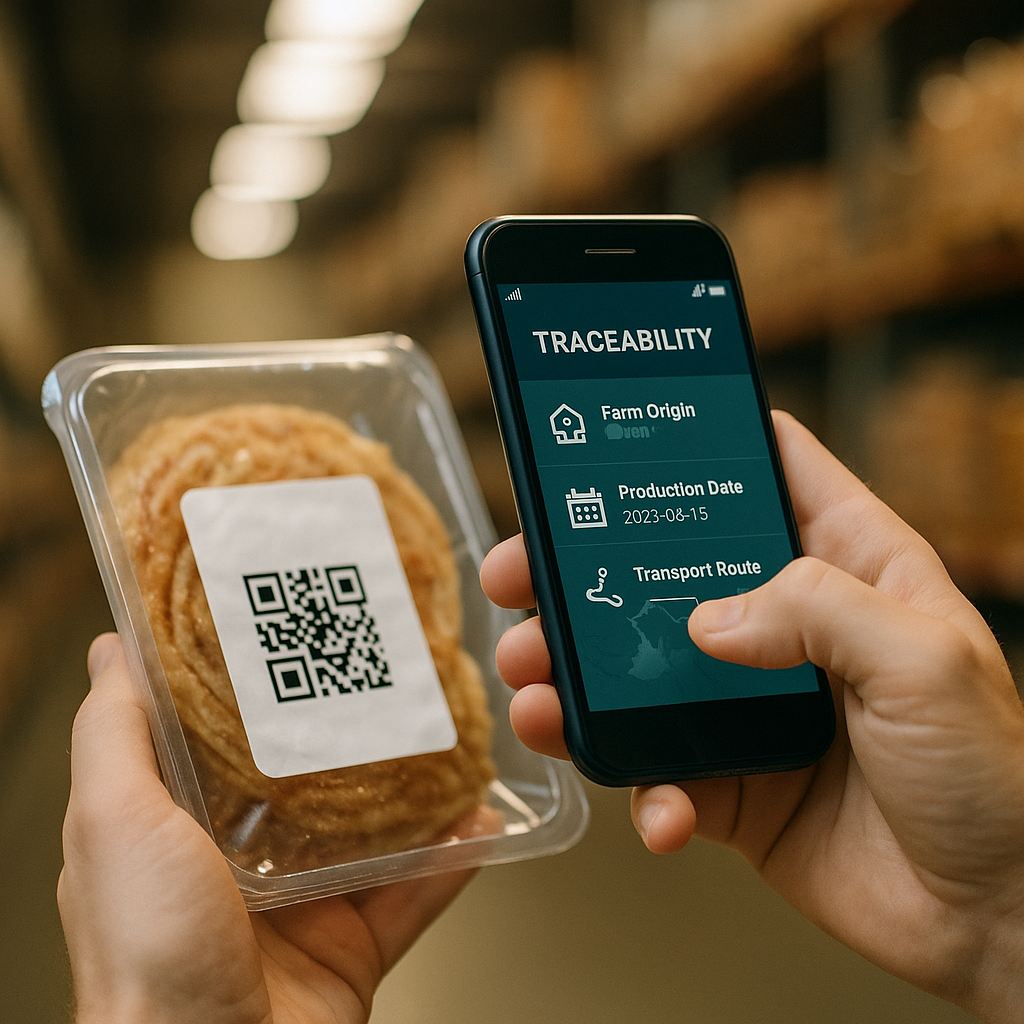
Digital infrastructure plays an increasingly vital role. Cloud-based platforms enable real-time data sharing across geographic boundaries. Blockchain technology offers immutable record-keeping that builds trust with international buyers. IoT sensors automatically capture environmental data like temperature and humidity, eliminating manual recording errors and providing continuous monitoring of product conditions.
Regulator access capabilities must be built into the system from the start. When food safety authorities in the destination market request traceability information, you need to provide comprehensive data within hours, not days or weeks. This means maintaining data in formats that regulators can readily access and understand. Under FSMA 204, certain foods require records to be available immediately. Building systems that enable rapid response protects not just your current shipment but your ongoing market access.
Real-time data sharing with trading partners creates transparency that strengthens relationships and facilitates faster response to issues. This transparency strengthens relationships and facilitates faster issue response. For example, when your distributor can instantly verify your product’s origin, it builds confidence.
The Roadmap: Implementing Comprehensive Traceability
For companies working to build or enhance their traceability capabilities, a structured implementation approach increases success likelihood while minimizing disruption to ongoing operations.
Step one involves mapping your entire supply chain with brutal honesty. Document every entity that touches your products from raw material suppliers through to end customers. Identify which suppliers provide ingredients for your products, which co-packers or manufacturers you work with, which logistics providers handle transportation, and which distributors or retailers represent your final links to consumers. This mapping often reveals complexity that wasn’t previously apparent—a single product might pass through eight or ten different hands before reaching consumers.
Establishing data capture points comes next. At each critical tracking event—receiving ingredients, manufacturing, packaging, shipping, receiving at distribution centers—you need systems to record the required data elements. This might mean implementing barcode scanning at your warehouse, requiring suppliers to provide advance ship notices electronically, or installing automated weighing systems that capture quantities. The goal is to eliminate manual data entry wherever possible, as human transcription introduces errors that can compromise traceability integrity.
Building robust data governance policies ensures consistency and quality. Define who is responsible for data entry and verification at each point. Establish protocols for handling exceptions when automated systems fail. Create backup procedures that maintain traceability even during system outages. Document data retention policies that comply with the longest regulatory requirement you face—FSMA 204 requires two years for most records, but some markets require longer retention.
Partner training and compliance enforcement can’t be overlooked. Your traceability system is only as strong as its weakest link. If a key ingredient supplier fails to provide proper lot codes, your entire product batch loses traceability. This is why supplier selection and due diligence are critical components of any traceability strategy. Jade Premium works closely with Chinese suppliers to ensure they understand international buyer requirements and can meet data quality expectations. This often involves providing training on GS1 standards, explaining why specific data elements matter, and sometimes even helping suppliers implement necessary technology solutions.
System testing before full deployment saves headaches later. Run mock recalls to verify you can quickly identify all products from a specific lot. Test data sharing with key trading partners to ensure interoperability. Validate that your data formats meet destination market regulatory requirements before your first shipment under new rules.
The Competitive Advantage: Benefits Beyond Compliance
While regulatory compliance drives initial investment in traceability systems, the benefits extend far beyond avoiding penalties or maintaining market access.
Faster outbreak investigation and response directly protects your brand and your customers. When a food safety concern arises, companies with robust traceability can react swiftly. They can identify affected products within hours and execute precise recalls. Compare this to companies with poor traceability who must recall entire product categories across extended timeframes, destroying their reputation and absorbing massive financial losses. In 2021, a company with excellent traceability systems recalled only 23,000 units when contamination was detected. A competitor with weaker systems had to recall over 400,000 units of similar products because they couldn’t narrow the scope—the cost difference was measured in millions of dollars.
Enhanced consumer trust represents an increasingly valuable asset. Today’s consumers want to know their food’s story. Where did it come from? How was it produced? What’s its journey to their table? Companies that can provide this transparency through technology like QR codes linking to blockchain-verified supply chain data build emotional connections with consumers. This is particularly valuable for Chinese food exports, where concerns about food safety and authenticity sometimes create market barriers. Effective traceability systems work hand-in-hand with proper food product certifications to build market confidence. Demonstrable traceability addresses these concerns directly, transforming skeptics into confident buyers.
Improved operational efficiency often emerges as an unexpected benefit. The same systems capturing traceability data provide visibility that helps optimize inventory management, reduce waste, and improve demand forecasting. When you can see exactly where products are in your supply chain at any moment, you can make better decisions about production scheduling, logistics routing, and resource allocation.
Cross-border trade efficiency improves dramatically with proper traceability. Customs clearance accelerates when authorities can quickly verify product origins and compliance with import requirements. Disputes with trading partners resolve faster when both parties have access to complete, reliable data about what was shipped, when, and in what condition. This efficiency translates directly to reduced logistics costs and faster time-to-market.
For Jade Premium, robust traceability systems enable us to confidently connect Chinese food producers with international markets. When we tell buyers in Europe or North America that we can verify every aspect of a product’s journey, we’re not making empty promises—we have the data infrastructure to back it up. This capability has become central to our role as a bridge between authentic Chinese cuisine and global tables. It ensures the quality and safety that international consumers expect.
Navigating Challenges: Implementation Realities
Despite clear benefits, building comprehensive traceability systems presents real challenges that must be acknowledged and addressed.
Regulatory variability across markets creates complexity. What satisfies FSMA 204 in the United States might not fully meet EU requirements or align with Chinese export regulations. Managing these overlapping requirements demands careful analysis and often requires maintaining additional data elements beyond any single regulation’s minimum requirements. The mitigation strategy involves aligning with the most comprehensive international standards like ISO 22005 and GS1 guidelines, which typically exceed minimum regulatory requirements across multiple markets.
Data quality issues pose persistent threats to traceability system effectiveness. Illegible handwriting on paper logs, transposed numbers in manual data entry, missing information from supplier shipments, or inconsistent naming conventions all create gaps in the traceability chain. Addressing this requires implementing automated data capture wherever feasible, establishing validation rules that prevent incomplete data entry, and building strong quality assurance processes that catch errors before they propagate through the system.
Cost concerns naturally arise, particularly for smaller exporters or suppliers operating on thin margins. Traceability technology, staff training, and ongoing maintenance require investment. However, the true comparison isn’t between traceability costs and zero investment—it’s between proactive traceability implementation and the eventual cost of recalls, market access loss, or regulatory penalties. Starting with high-risk products and critical control points allows phased investment that spreads costs while delivering value quickly.
Technology integration with legacy systems challenges companies that have operated for years or decades with traditional paper-based processes. The transition requires thoughtful change management, often involving parallel systems during migration periods. Working with technology providers experienced in food industry implementations helps avoid common pitfalls and accelerates deployment timelines.
Conclusion: Traceability as Strategic Imperative
The question facing food companies engaged in international trade is no longer whether to implement comprehensive traceability, but how quickly and effectively they can do so. Supply chain data has emerged as a strategic asset that determines market access, enables efficient operations, and builds consumer trust in an increasingly transparent global food system.
For exporters of Chinese food products navigating complex international markets, traceability capabilities represent both a challenge and an opportunity. Challenge lies in building systems that meet diverse regulatory requirements while maintaining operational efficiency. Meanwhile, the opportunity exists in using superior traceability to differentiate from competitors, accessing premium markets, and commanding buyer confidence.
At Jade Premium, our commitment to bringing authentic Chinese cuisine to global tables rests on a foundation of supply chain excellence that includes world-class traceability. We understand that every product we source and every shipment we facilitate carries responsibility not just for this transaction, but for the long-term reputation of Chinese food exports. By working with suppliers who embrace comprehensive traceability and implementing robust data systems across our operations, we ensure that the cultural richness and culinary excellence of Chinese food reaches international consumers with the safety and quality assurances they demand.
The future of food trade belongs to companies that recognize traceability not as a regulatory burden but as an essential capability that enables trust, efficiency, and growth. Your supply chain data truly can make or break your next export deal—ensuring it tells a story of quality, safety, and professionalism determines your success in the global marketplace.