
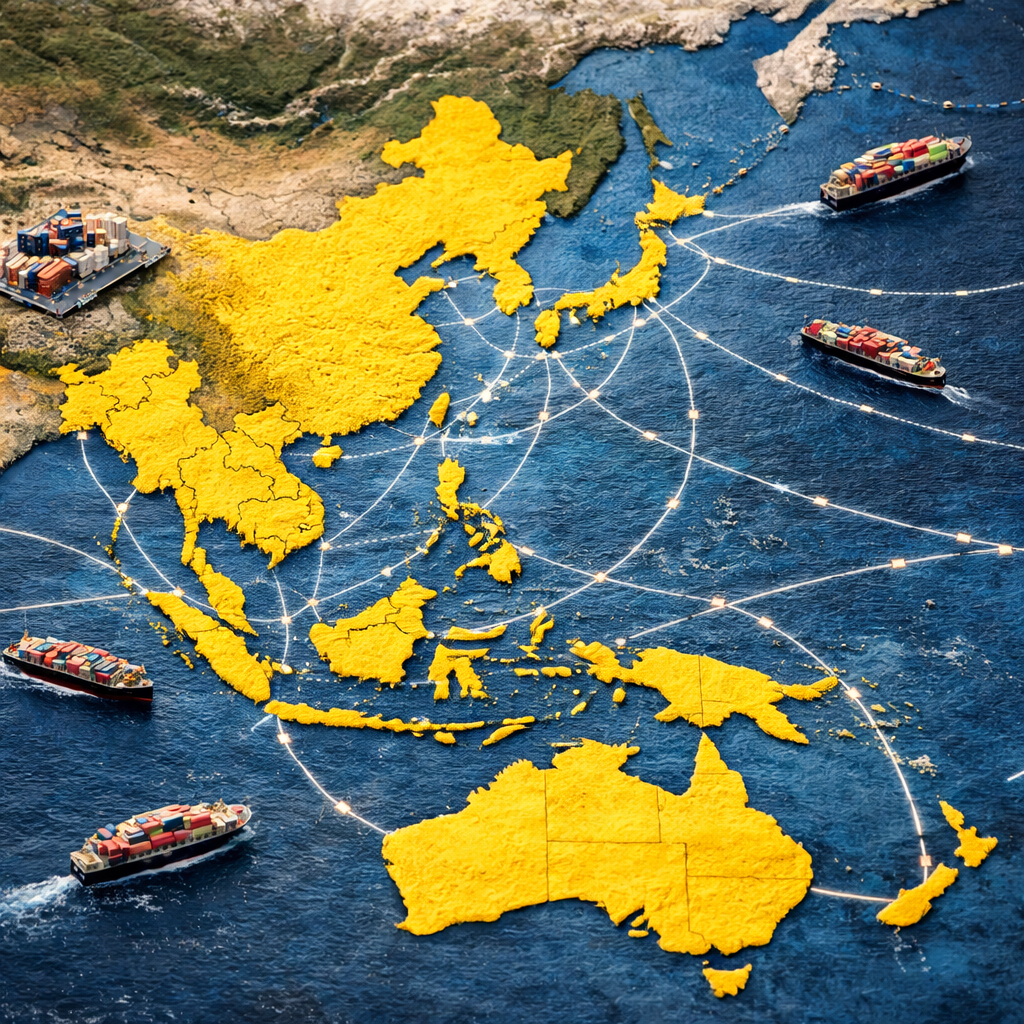
The Regional Comprehensive Economic Partnership, or RCEP, isn’t just another trade agreement gathering dust in diplomatic archives. It’s actively reshaping how food moves across Asia, creating the world’s largest free-trade area and transforming the way international food importers, distributors, and retailers source products across 15 member countries. Spanning from Japan and South Korea in the north to New Zealand and Australia in the south, and encompassing the entire ASEAN bloc plus China, RCEP represents roughly 30% of global GDP and nearly a third of the world’s population.
Since its entry into force in January 2022, this partnership has been systematically dismantling trade barriers that once made cross-border food sourcing expensive and complicated. For food service operators running restaurants in London, retail chain buyers in Dubai, or international trading companies in Singapore, RCEP means something concrete: lower costs, simpler paperwork, and faster access to authentic Asian ingredients. The agreement doesn’t just reduce tariffs—it harmonizes standards, streamlines customs procedures, and creates new opportunities for businesses that understand how to navigate this evolving landscape.
What makes RCEP particularly significant for the Asia food trade is its inclusivity. Unlike previous regional agreements that excluded major players, RCEP brings together countries at different development levels, each with unique food production strengths. China’s vast agricultural resources, Japan’s processed food expertise, Thailand’s seafood prowess, and Australia’s premium meat production now operate within a unified framework designed to reduce friction and boost trade efficiency. This isn’t theoretical—companies are already seeing tangible benefits in their supply chains and bottom lines.
Tariff Eliminations and Rules of Origin: The Real Game-Changers
The most immediate impact of RCEP on the Asia food trade comes from its ambitious tariff reduction schedule. Over 90% of goods traded between member countries will eventually enjoy zero tariffs, with many food products already benefiting from immediate or phased reductions. For an international food importer bringing Chinese dim sum to European markets via Australia, or a distributor sourcing Korean sauces through Singapore, these tariff cuts translate directly into cost savings that can be passed along the supply chain.
But here’s where it gets interesting: RCEP’s rules of origin (ROO) create opportunities that previous bilateral agreements couldn’t match. Under traditional trade deals, a product had to originate entirely within one country to qualify for preferential tariffs. RCEP introduces cumulative rules of origin, meaning that goods produced using materials from multiple RCEP countries can still qualify for preferential treatment—as long as at least 40% of the regional value content come from within the RCEP region.
Let me paint a practical picture. Imagine a food manufacturer in Thailand creating ready-to-cook noodle kits using Chinese wheat, Vietnamese spices, and Japanese seasoning. Under old trade rules, this product might not qualify for preferential tariffs anywhere. Under RCEP’s cumulative ROO, it qualifies for reduced tariffs across all 15 member countries because the inputs come from within the RCEP region. This flexibility fundamentally changes how retail chain buyers and food service operators can approach sourcing, allowing them to optimize for quality and cost simultaneously rather than being constrained by single-origin requirements.
For international food importers and distributors, these ROO provisions mean that regional value chains become more competitive. A European retailer can source Chinese hotpot ingredients that incorporate Australian beef and New Zealand dairy, all while benefiting from RCEP’s preferential tariffs when these products transit through member countries. The agreement acts as a “bridge” between preferential tariff commitments and actual benefits, but only if businesses understand how to document and certify their products’ origins correctly.
The tariff benefits extend across the food category spectrum. Fresh fruits, seafood products, processed foods, and even ready-to-eat meals are seeing graduated tariff reductions. Chinese exporters of premium food products, for instance, now enjoy improved market access to Japan and South Korea—historically challenging markets with high non-tariff barriers. For a company like Jade Premium, which specializes in bringing authentic Chinese cuisine to global tables, RCEP’s tariff structure creates new pathways to position high-quality Chinese food exports competitively in markets that once seemed prohibitively expensive to enter.
Implementation Timeline and Digital Trade Facilitation
RCEP didn’t flip a switch overnight. The agreement follows a carefully structured implementation timeline, with different countries joining at different dates and tariff reductions phasing in over periods ranging from immediate implementation to 20-year gradual reductions. Understanding these timelines matters enormously for businesses planning their sourcing strategies.
The agreement entered into force for the first 10 signatories—Brunei, Cambodia, Laos, Singapore, Thailand, Vietnam, China, Japan, New Zealand, and Australia—on January 1, 2022. South Korea followed on February 1, 2022, with Malaysia joining on March 18, 2022, and Indonesia on January 2, 2023. The Philippines became the 15th member to ratify the agreement, with implementation beginning on June 2, 2023. This staggered entry created a rolling wave of new opportunities, with each country’s participation opening additional trade corridors and expanding the effective market size.
What truly accelerates RCEP’s impact, however, is its comprehensive approach to digital trade facilitation. The agreement’s Chapter 11 specifically addresses e-commerce and digital trade, establishing frameworks that allow food businesses to handle documentation, customs declarations, and compliance certifications electronically. This might sound mundane, but for international trading companies managing complex multi-country shipments of perishable products, digital facilitation can mean the difference between products arriving fresh or spoiled.
Full digital trade facilitation under RCEP has the potential to significantly reduce trade costs across the region, particularly for time-sensitive food products. For food products—where speed matters, cold chain integrity is critical, and documentation requirements are extensive—these efficiency gains compound quickly. When a container of Chinese dim sum leaves Guangzhou bound for Sydney via Singapore, digital systems allow customs pre-clearance, real-time tracking, and automated compliance verification. Delays shrink, paperwork errors decrease, and the cost per unit drops.
The digital provisions also enhance e-commerce opportunities, particularly relevant as food service operators and retail chain buyers increasingly source specialty ingredients through online platforms. RCEP’s rules prohibit customs duties on electronic transmissions and restrict data localization requirements that once complicated cross-border digital commerce. For buyers searching for authentic Chinese ingredients or specialty Asian products, this creates more transparent, efficient online marketplaces where they can connect directly with verified suppliers across the region.
These digital facilitation measures particularly benefit small and medium-sized enterprises that lack the resources for extensive customs departments or legal teams. A smaller restaurant chain in Dubai looking to source authentic Sichuan hotpot ingredients can now navigate RCEP’s frameworks with relative ease, accessing products that were once effectively limited to larger importers with specialized expertise.
Practical Implications for Stakeholders: Opportunities and Challenges
RCEP’s impact ripples through every level of the Asia food trade ecosystem, creating both opportunities and challenges for diverse stakeholders. For farmers and food producers in China, the agreement opens doors to premium markets in Japan, South Korea, and ASEAN countries that historically imposed high tariffs on imported food products. A Chinese fruit grower in Sichuan can now realistically target Japanese retail chains, knowing that tariff barriers are falling and ROO certifications provide pathways to preferential treatment.
Processors and exporters face a more complex landscape. While tariff reductions and streamlined customs procedures reduce trade costs, RCEP’s ROO requirements demand sophisticated documentation and compliance systems. The 40% regional value content threshold, while more flexible than single-origin rules, still requires careful tracking of input sources, production stages, and value addition. For exporters of processed foods—like ready-to-cook meals, packaged dim sum, or specialty sauces—this means investing in supply chain transparency systems that can document every ingredient’s origin.
This is where capacity challenges emerge, particularly for small and medium-sized enterprises. While RCEP creates opportunities, capturing those opportunities requires understanding complex rules, maintaining meticulous documentation, and often obtaining certification from authorized bodies. A small Chinese food processor might produce excellent dumplings but struggle to navigate the paperwork required to certify RCEP origin, effectively locking them out of preferential tariffs their products technically qualify for.
Governments across the RCEP region recognize this challenge and are implementing capacity-building programs to help businesses, especially SMEs, understand and utilize the agreement’s provisions. Training sessions on ROO certification, digital customs platforms, and compliance requirements are becoming common. Yet the learning curve remains steep, and businesses that master these requirements early gain significant competitive advantages.
For international food importers and retail chain buyers, RCEP presents strategic sourcing opportunities that require rethinking traditional procurement models. Instead of sourcing finished products from a single country, buyers can now optimize supply chains across multiple RCEP members, taking advantage of each country’s strengths while maintaining preferential tariff treatment. A European retailer might source base ingredients from China, have preliminary processing done in Thailand, and final packaging in Singapore—all while qualifying for RCEP benefits when importing to Australia or Japan for eventual re-export or consumption.
Food service operators benefit from increased product variety and potentially lower prices as competition increases within the RCEP market. A hotel chain in the Middle East can now access a broader range of authentic Asian ingredients at more competitive prices, knowing that suppliers face lower barriers to cross-border trade. This democratizes access to premium products that were once prohibitively expensive due to tariff and compliance costs.
Consumers, while perhaps least aware of RCEP’s mechanics, stand to benefit through lower food prices, greater product variety, and improved food safety standards. The agreement’s provisions on sanitary and phytosanitary measures, while sometimes challenging for exporters, ultimately create more confidence in the safety and quality of imported foods. When a consumer in Melbourne purchases Chinese hotpot ingredients, RCEP’s framework provides assurance that these products meet harmonized safety standards across the region.
Yet challenges persist beyond ROO complexity. Cultural and language barriers, differing food safety standards, and varying consumer preferences across RCEP countries mean that successful market entry requires more than just understanding tariff schedules. Companies must invest in market intelligence, cultural adaptation, and localized marketing to truly capitalize on RCEP’s opportunities. This is precisely where the gap between policy potential and practical results often emerges.
Bridging Eastern and Western Markets: The Jade Premium Approach
This brings us to a critical question: How do businesses actually translate RCEP’s technical provisions into successful market outcomes? The agreement creates opportunities, but capturing them requires deep expertise in both Chinese food production and international market dynamics—exactly the intersection where Jade Premium operates.
Since 2015, Jade Premium has built its business model around understanding not just the mechanics of international food trade, but the cultural nuances that determine success or failure when bringing authentic Chinese cuisine to global markets. RCEP aligns perfectly with this mission, providing a regulatory framework that supports what Jade Premium has always believed: that high-quality, authentic Chinese food products deserve a place on global tables, and that success requires more than just shipping containers across borders.
Consider the challenge of sourcing Chinese dim sum for international markets. The product itself—whether it’s har gow, siu mai, or char siu bao—carries deep cultural significance and specific quality expectations. Chinese consumers know what authentic dim sum should taste like, while international buyers might appreciate the product but lack the expertise to evaluate supplier quality or authenticity. RCEP’s tariff reductions make it economically feasible to import these products across the region, but someone still needs to bridge the cultural gap, verify supplier credentials, ensure products meet international food safety standards, and manage the complex logistics involved.
This is where Jade Premium’s comprehensive approach proves valuable. With offices strategically located across major Chinese cities including Hong Kong, Shenzhen, Guangzhou, Shanghai, Chengdu, Wuhan, and Changsha, the company maintains direct relationships with premium Chinese producers—the farmers, processors, and manufacturers who create authentic, high-quality products. These relationships, built over years and rooted in cultural understanding, allow Jade Premium to identify products with genuine export potential and verify their quality before they enter the supply chain.
But identifying good products is only the beginning. RCEP’s opportunities fully materialize when someone can navigate the agreement’s ROO requirements, manage compliance across multiple jurisdictions, optimize logistics routes to take advantage of preferential tariffs, and ultimately present products to international buyers in ways that build confidence and trust. Jade Premium’s end-to-end supply chain management addresses precisely these challenges.
The company’s expertise in compliance and quality standards proves particularly crucial under RCEP’s framework. Understanding that a Chinese hotpot ingredient might transit through Singapore before reaching a buyer in Australia, and knowing exactly how to document its origin to qualify for RCEP benefits while meeting Australian food safety requirements, exemplifies the specialized knowledge required to truly capitalize on the agreement’s potential.
Moreover, Jade Premium recognizes that successful international food trade isn’t purely transactional. The company positions itself as sharing not just products but stories—the cultural heritage behind Chinese cuisine, the innovations driving the industry forward, and the people whose expertise creates these authentic products. This approach aligns with RCEP’s broader vision of deepening regional integration, not just through reduced tariffs but through genuine cultural and economic exchange.
As RCEP continues maturing and more businesses learn to navigate its frameworks, companies that combine technical expertise with cultural understanding will increasingly define success in the Asia food trade. The agreement provides the infrastructure—reduced tariffs, streamlined procedures, harmonized standards. But transforming that infrastructure into thriving international food trade requires partners who understand both where products come from and where they’re going, who can communicate across cultural boundaries, and who maintain the quality control and compliance systems that build trust in increasingly complex supply chains.
The Asia food trade revolution isn’t just about lower tariffs and digital customs systems. It’s about creating pathways for authentic, high-quality products to reach consumers who value them, building relationships that transcend borders, and fostering the kind of deep market understanding that turns technical trade agreements into real business opportunities. RCEP creates the framework, but it’s the companies with comprehensive expertise, extensive networks, and genuine commitment to quality that will ultimately determine how transformative this agreement becomes for the global food industry.