
The global halal food market is exploding. With the Muslim population representing one of the fastest-growing consumer segments worldwide, halal certification has shifted from a specialized requirement to a mainstream business imperative. For international food importers and distributors, this presents both tremendous opportunity and significant risk.
At Jade Premium, we’ve witnessed firsthand how the complexities of cross-border food trade can create unexpected challenges. Our mission of bringing authentic Chinese cuisine to global tables means navigating diverse regulatory landscapes, including halal compliance for our Muslim consumer markets. The experience has taught us that certification isn’t just a checkbox—it’s a critical component of supply chain integrity that can make or break an importer’s business.
The stakes are higher than many realize. Behind every halal certificate lies a web of suppliers, processors, and logistics partners. When any link in this chain breaks, importers don’t just face product recalls—they face financial hemorrhaging, legal penalties, and reputational damage that can take years to repair.
The Hidden Complexity Behind Halal Certification
On the surface, halal certification seems straightforward: get your products certified by a recognized body, display the logo, and access Muslim consumer markets. The reality is far more complicated.
The fundamental challenge lies in the fragmented certification landscape. Unlike international standards such as ISO certification frameworks, halal certification operates through a patchwork of different certifying bodies, each with varying requirements and recognition levels. A certificate valid in Malaysia might not be accepted in Saudi Arabia. A Dubai-approved supplier might face scrutiny in Indonesia. This fragmentation creates certification gaps—blind spots where products slip through without proper verification or where oversight fails to catch critical violations.
Consider what happens when an importer sources chicken from a Chinese supplier claiming halal certification. The certificate looks legitimate. The supplier provides documentation. But has anyone verified that the slaughterhouse follows proper Islamic slaughter methods? Are the processing facilities truly free from pork contamination? Were the cleaning agents used between production runs halal-compliant? These granular details determine whether a product is genuinely halal or merely wearing a halal label.
Supply chain breaches occur with alarming frequency. In one documented case, meat products entered Malaysia through ports with fraudulent certificates, bypassing proper oversight—a scenario that mirrors the compliance traps that plague cross-border food trade. The dubious meat had been falsely certified as halal when it failed to meet basic standards. The importers who unknowingly purchased these products faced not only financial losses from product seizures but also legal action and damaged relationships with retailers who had trusted their supply.
The concept of an auditable chain of custody becomes crucial here. Every step—from farm to slaughterhouse, from processor to warehouse, from transport to retail—must maintain halal integrity. A single broken link contaminates the entire chain. Yet many importers lack the systems to track and verify compliance at each stage. They rely on supplier assurances and surface-level documentation without the deep due diligence that genuine halal compliance demands.
At Jade Premium, we’ve built our reputation on understanding these nuances. When we facilitate exports of Chinese food products to markets requiring halal certification, we don’t just check boxes. We verify supplier qualifications, audit production facilities, and establish transparent documentation trails that provide genuine accountability. This approach reflects our core belief that authentic quality requires authentic verification.
Market Dynamics and Hidden Costs
The halal certification market itself contributes to compliance risks through several structural problems. With hundreds of certifying bodies operating globally, no universal authority exists to standardize requirements or police fraudulent practices. This creates a race to the bottom where some bodies offer quick, inexpensive certifications with minimal verification, while more rigorous certifiers struggle to compete on price.
Regional standard variations compound the problem. Middle Eastern markets typically require stricter certifications than Southeast Asian ones. European markets may accept different bodies than those recognized in the Gulf states. An importer serving multiple markets must navigate this maze of requirements, often needing multiple certifications for the same product—each adding cost and complexity.
The education gap among stakeholders presents another hidden danger. Many food producers in non-Muslim majority countries lack deep understanding of halal requirements. They may believe that avoiding pork ingredients is sufficient when halal compliance extends far beyond ingredient lists to encompass production methods, equipment sterilization, storage conditions, and even the religious beliefs of slaughter personnel. When suppliers don’t fully understand what they’re certifying, certification becomes meaningless.
These gaps create substantial hidden costs for importers. Consider the financial impact of discovering mid-shipment that your halal certificate isn’t recognized in your destination market. The products sit in customs, accruing storage fees. You scramble to obtain alternative certification, but the products have exceeded their optimal freshness window. Eventually, you negotiate a heavily discounted sale or face total loss. One such incident can erase months of profit margins.
Misrepresented or fake halal certificates represent a particularly insidious cost driver. Investigations by regulatory watchdogs in recent years have uncovered 44 separate allegations of meat being misrepresented or mislabeled as halal, alongside documentation fraud. When importers unknowingly purchase products with fraudulent certificates, they bear the financial consequences—even though they were the victims of deception. Product recalls, legal fees, regulatory fines, and lost sales create a cascade of expenses that can devastate smaller importers.
Ingredient risks add another layer of hidden costs. Halal compliance isn’t just about the primary product—it extends to every ingredient, additive, and processing aid used. That chicken you’re importing might be slaughtered correctly, but if the marinade contains non-halal enzymes or the packaging uses gelatin-based coatings derived from pork, the entire product fails compliance. Importers who don’t rigorously audit ingredient lists face costly product rejections.
Cross-contamination presents yet another expensive pitfall. Shared production lines, inadequate cleaning between runs, improper storage near non-halal products—any of these can compromise halal status. A food processing facility in China might produce both regular and halal-certified products. If they don’t maintain completely separate production lines or implement rigorous cleaning protocols between runs, cross-contamination becomes inevitable. The importer who trusted the halal certificate without auditing production practices pays the price.
Fraud Vectors and Regulatory Consequences
The financial incentives for halal fraud are substantial, creating multiple vectors for abuse. Fake certifications represent the most brazen form of fraud. Scammers create official-looking certificates from non-existent or unrecognized certifying bodies. Others forge documents from legitimate certifiers. Some even operate websites mimicking real certification organizations, complete with verification portals that confirm their fraudulent certificates.
The meat industry has proven particularly vulnerable to these schemes. Cases have emerged of non-halal meat being repackaged and sold as halal-certified, with profits pocketed by unscrupulous middlemen. In some instances, low-grade meat products were fraudulently certified and exported, with officials allegedly facilitating the scheme in exchange for bribes. These aren’t isolated incidents but systematic abuses that exploit gaps in verification and oversight.
Non-halal substitutions offer another fraud opportunity. A supplier might use halal-certified chicken for their first few shipments, building trust with the importer. Once the relationship is established, they gradually substitute cheaper, non-certified sources while continuing to provide halal documentation. The importer, confident in the established relationship, may not conduct ongoing audits—until an inspection or customer complaint exposes the fraud.
Regulatory penalties for halal violations vary by jurisdiction but universally carry serious consequences. In Malaysia, selling non-halal products as halal can result in fines up to RM100,000 and imprisonment. The UAE imposes heavy penalties for halal fraud, including business closures. Even in Western markets with smaller Muslim populations, consumer protection laws treat fraudulent halal labeling as deceptive trade practices subject to significant fines.
Beyond direct regulatory penalties, the reputational impact often proves more devastating. When a major retailer discovers that an importer supplied non-compliant halal products, they don’t just return that shipment—they terminate the entire relationship. Other retailers hear about the incident and become reluctant to do business with that importer. The Muslim community, which relies heavily on word-of-mouth recommendations for halal products, rapidly spreads news of violations. Rebuilding trust can take years, and some businesses never recover.
Consider a concrete example: An international food distributor sourcing processed meat products from China discovers six months into their contract that their supplier’s halal certificate was issued by an unrecognized body. Major supermarket chains in the Middle East reject the products. The distributor faces over $500,000 in lost inventory, storage fees, and penalty payments to retailers. They must scramble to find alternative suppliers, re-certify existing inventory where possible, and manage the PR crisis. The total financial impact exceeds $2 million when accounting for lost contracts and future business.
This scenario isn’t hypothetical—it’s a composite of real cases we’ve observed in the industry. At Jade Premium, our approach to supplier verification and quality control is designed precisely to prevent such disasters. We understand that in international food trade, the cost of prevention is always lower than the cost of failure.
A Practical Mitigation Playbook
Protecting your business from halal compliance risks requires systematic, proactive measures. Here’s a practical framework for importers:
Define Your Halal Scope: Start by clearly understanding which markets you’re serving and their specific requirements. Research recognized certifying bodies for each destination market. Don’t assume that a halal certificate is universally accepted—verify recognition status with the actual importing country’s authorities. Malaysia maintains a list of recognized foreign halal certifiers. Saudi Arabia’s SFDA publishes its approved bodies. Use these official sources rather than relying on supplier assurances.
Vet Certification Bodies Rigorously: When evaluating a supplier’s halal certificate, verify the certifying body’s legitimacy. Visit their website directly rather than clicking links provided by suppliers. Contact the certifying body to confirm the certificate’s authenticity. Check their accreditation status with relevant government authorities. Legitimate certifiers should have transparent verification processes and be willing to provide detailed information about their certification standards.
Implement Strong Traceability Systems: Establish documentation requirements that create an auditable trail from source to delivery. Require suppliers to provide detailed records showing slaughter methods, production facility certifications, ingredient sourcing documentation, and transport conditions. Use technology solutions that enable real-time tracking and verification. Blockchain-based systems are increasingly used for halal supply chain traceability, providing tamper-proof records of each step.
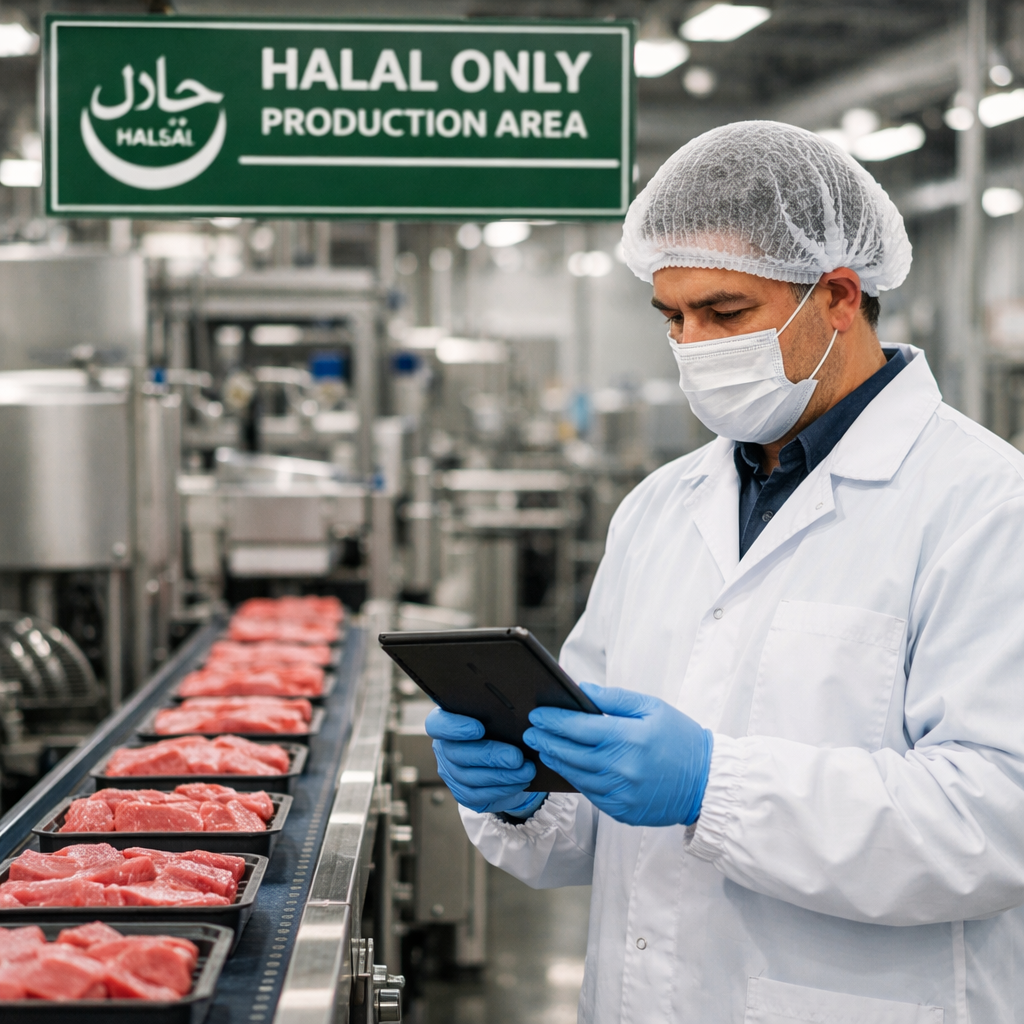
Conduct Physical Audits: Paper documentation isn’t enough. Schedule regular on-site audits of key suppliers. Inspect production facilities to verify segregation of halal and non-halal products. Review cleaning procedures between production runs. Interview staff about their understanding of halal requirements. Check storage conditions and transportation protocols. These audits should be unannounced when possible to ensure you’re seeing actual operational practices rather than prepared presentations.
Implement Ongoing Monitoring: Compliance isn’t a one-time achievement but a continuous process. Establish regular review cycles for supplier certifications, checking expiration dates and renewals. Monitor industry news for reports of fraud or certification revocations. Set up alerts for your suppliers and certifying bodies. Conduct random product testing to verify compliance. This vigilance helps catch problems before they become crises.
Build Redundancy into Your Supply Chain: Don’t rely on single sources for critical products. Maintain relationships with multiple certified suppliers so you can quickly pivot if compliance issues emerge with one. This redundancy also gives you leverage to negotiate better terms and maintain quality standards.
Invest in Cultural and Religious Education: Ensure your procurement team understands halal requirements beyond the technical checklist. Engage with Muslim communities and religious scholars to deepen your understanding. This knowledge helps you ask better questions, spot potential issues, and build authentic relationships with halal certification bodies.
This is where a trade facilitator like Jade Premium adds substantial value. Our expertise in navigating complex international food regulations extends across multiple compliance frameworks, including halal certification. We’ve built relationships with recognized certifying bodies, audited hundreds of suppliers, and helped international buyers avoid costly compliance failures. Our localized presence across major Chinese production centers allows us to conduct on-site verifications that remote importers simply cannot.
When you work with Jade Premium, you’re not just buying products—you’re accessing a comprehensive risk management system built on years of cross-border trade experience. We verify supplier qualifications, audit production facilities, establish transparent traceability, and provide ongoing monitoring because we understand that your reputation depends on the integrity of every product bearing your company’s name.
Building Long-Term Compliance Excellence
The halal compliance landscape will only grow more complex as markets expand and regulations evolve. Forward-thinking importers must invest in education and collaboration to stay ahead of these changes.
Participate in industry associations that focus on halal trade. Organizations like Halal Food Council and Islamic Food and Nutrition Council of America provide valuable resources, training, and networking opportunities. Attend conferences and workshops to learn about emerging standards and best practices.
Build collaborative relationships with regulators rather than viewing them as adversaries. Regulatory bodies want to facilitate legitimate trade while protecting consumers. When you demonstrate commitment to genuine compliance and transparency, regulators become partners who can provide guidance and support.
Invest in technology solutions that enhance visibility and verification. Modern supply chain management systems can integrate halal compliance tracking with broader logistics operations, making compliance less burdensome while improving accountability.
Share knowledge within your organization. Train your procurement, quality control, and logistics teams on halal requirements so everyone understands their role in maintaining compliance. Create cross-functional teams that review compliance risks regularly.
Most importantly, recognize that halal compliance represents more than regulatory box-checking—it’s about respecting the faith and trust of Muslim consumers who rely on halal certification to guide their purchasing decisions. When an importer cuts corners on halal compliance, they’re not just risking penalties—they’re betraying the trust of a global community.
At Jade Premium, this philosophy of respect and authenticity guides everything we do. Our vision of promoting trust and understanding between Eastern and Western food markets through safe and authentic culinary experiences applies directly to halal compliance. We believe that when Chinese food producers and international importers work together with integrity and transparency, everyone benefits—producers gain access to growing markets, importers build sustainable businesses, and consumers receive genuine, high-quality products that honor their values.
The certification gaps draining importers’ budgets aren’t inevitable. With proper systems, expert guidance, and genuine commitment to compliance, importers can confidently serve Muslim consumer markets while building profitable, sustainable businesses. The choice between cutting corners and doing things right is ultimately a choice between short-term savings and long-term success.
In our experience facilitating thousands of international food transactions, we’ve seen that success in global markets comes from embracing complexity rather than avoiding it. Halal compliance is complex, but it’s also manageable with the right approach. By implementing systematic verification processes, building strong supplier relationships, and working with experienced trade partners, importers can turn compliance from a cost center into a competitive advantage—accessing high-growth markets with confidence that their products meet both regulatory requirements and consumer expectations.