
The Label That Used to Be a Liability Is Now a Competitive Advantage
TFor three decades, “Made in China” was the sticker premium food buyers tried to keep off the back of the jar. It signalled cheap, mass, and “fairly or not” questions about provenance. In 2026, that calculation has flipped.
The Economist reported in February 2026 that China now fills the world’s luxury hampers, having quietly become the largest exporter of sturgeon caviar and the largest producer of black truffles on the planet, while expanding aggressively into foie gras, olive oil, matcha, and fine wines. The numbers behind the headline are striking. China makes more than 40% of global caviar output. A single Hangzhou-based producer, Kaluga Queen, accounts for roughly 60% of global production on its own, and supplies caviar served on first-class flights and Michelin-starred tables across Europe, the Middle East, and North America. One Chinese province produces around 300 tonnes of black truffles a year 〞 an estimated ten times the entire French harvest. Linqu County in Shandong alone produces about 20% of the world’s foie gras, and Chinese foie gras output collectively is now estimated at 45% of the global total.
For overseas buyers 〞 distributors, hamper companies, hotel groups, gourmet retailers, private-label brand owners 〞 this is no longer a curiosity. It is a structural shift in where the world’s luxury pantry is actually made.
What’s Actually Driving the Shift
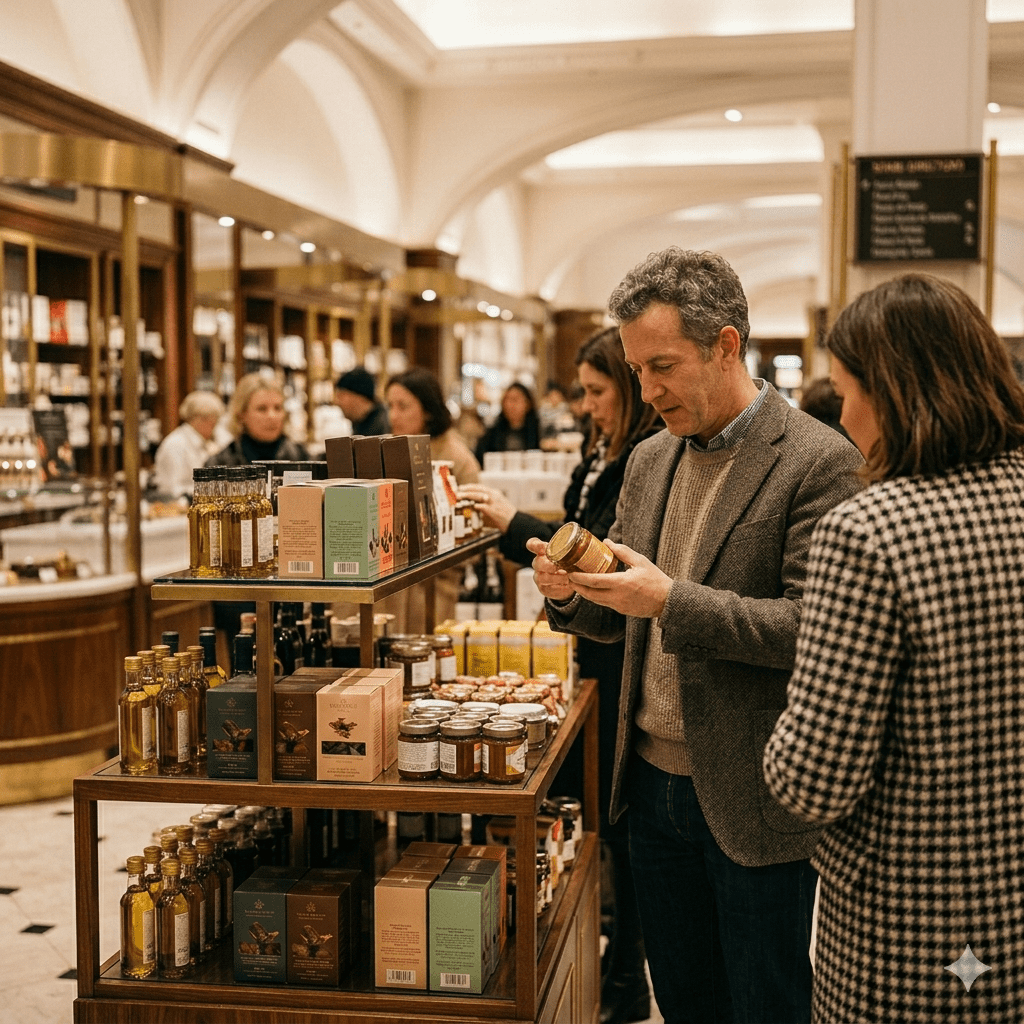
Three forces have come together in the past few years to put Chinese premium food on the shelves of Selfridges, Lafayette Gourmet, and high-end hampers across Asia and the Gulf.
The first is geopolitics. Russia’s invasion of Ukraine in 2022 disrupted the traditional supply of Caspian and Eurasian sturgeon caviar, and Western sanctions made Russian product commercially difficult. Chinese producers, who had spent two decades building sturgeon farms at Qiandao Lake and elsewhere, were ready to step in. Caviar exports that totalled around USD 12 million in 2012 have multiplied many times over, with China taking the place that Russian and Iranian producers once held in the global trade.
The second is industrial maturity. China’s premium food sector is no longer the story of cheap copies. Producers like Kaluga Queen run vertically integrated operations with imported European bloodlines, water-quality monitoring, and food-safety certifications that meet EU, Japanese, and US import standards. Truffle production in Yunnan has moved from being treated as pig feed in the 1990s to being shipped, fresh and frozen, to professional kitchens across France and Italy — sometimes ending up on plates that proudly omit the country of origin.
The third is price-to-quality reset. A Chinese-farmed sturgeon caviar of comparable grade can land in a European warehouse at a fraction of the cost of equivalent Italian or French product. The same applies to foie gras, where Chinese supply is being absorbed by European processors, and to matcha, where Chinese ceremonial-grade leaf is increasingly used in private-label lines that Japan can no longer cost-effectively supply at scale.
The Categories Premium Buyers Should Be Looking At in 2026
Caviar is the most visible story, but it is not the only one. Sturgeon caviar from Zhejiang and Sichuan now anchors many of the world’s luxury hampers, and Chinese producers offer Oscietra, Beluga-hybrid, and Kaluga grades at landed costs that allow gift retailers to hit aggressive shelf prices without compromising on grain size or maturation.
Black truffles (Tuber indicum) from Yunnan and Sichuan are exported fresh, frozen, and as truffle products such as oils, salts, and pastes, with Chinese frozen-truffle exports hitting record highs above 45 tonnes in 2024. Quality varies sharply by harvest window and supplier, which is exactly where sourcing expertise pays for itself.
Foie gras, both whole-lobe and processed (mousses, terrines, parfaits), now comes predominantly from Shandong-based facilities that supply European and Middle Eastern markets — a fact rarely advertised on the front of the pack but well known inside the industry.
High-end Chinese teas remain underexploited by Western premium retailers. China’s tea exports grew 12.1% in 2025 to reach over 419,000 tonnes, but the average export price still sits at USD 4–5 per kilogram, well below the USD 6–8 per kilogram that better-branded competitors achieve. The opportunity for private-label premium tea is significant, particularly in single-origin Longjing, Da Hong Pao, aged white teas, and ceremonial-grade matcha from Guizhou.
Functional and adaptogenic ingredients — lion’s mane mushroom, goji, sea buckthorn, black garlic, aged vinegars — are an emerging premium category that maps onto the global wellness and clean-label trends. Chinese producers in this segment have moved fastest on additive-free, GMP-certified, export-ready formulations.
Specialty sauces, condiments, and gifting confectionery round out the category map. Lunar New Year and Mid-Autumn hampers have become a serious global gifting occasion, not just a Chinese diaspora one, and APAC food gifting is forecast to grow at roughly 6% CAGR through 2029 with China as the dominant force.
What Goes Wrong When Buyers Source Direct
Plenty of overseas buyers have looked at the cost gap and tried to source directly through Alibaba, trade fairs, or a freight forwarder cousin. The pattern of what goes wrong is consistent.
Quality drift between sample and shipment is the most common issue — the gold-standard sample arrives, the bulk container does not match. Documentation gaps cause border holds: missing health certificates, mislabelled allergen panels, non-compliant nutrition declarations under EU 1169/2011 or Singapore’s 2026 SFA amendments. MOQ and packaging mismatches force buyers to either accept Chinese-language retail packs or pay for repackaging on arrival. Counterfeit certification is rarer than it used to be but still happens, particularly with organic and “wild-caught” claims. And cold-chain failures on frozen premium goods (truffles, foie gras, caviar) can write off an entire shipment that looked fine at the factory.
The producers themselves are usually not the problem. The problem is the absence of a layer that vets, verifies, negotiates, and accompanies the product from factory to port — the layer that European and Japanese exporters have built over decades and that Chinese exporters are still building.
Where Jade Premium Fits
Jade Premium is a sourcing partner for overseas buyers of premium Chinese food. We are based in Hong Kong with operations across mainland China, and we work with importers, hamper and gifting companies, hotel groups, gourmet retailers, and private-label brand owners who want access to the producers behind the headlines without the friction of doing it alone.
Our work covers four areas. We identify and audit producers — the actual factories and farms behind the brand names, including the ones that supply household-name European retailers under private label. We negotiate commercial terms, MOQs, and packaging specifications, including bilingual or destination-language labelling that complies with the destination market’s food regulations. We manage quality verification through pre-shipment inspection, sample retention, and cold-chain monitoring on frozen and chilled goods. And we coordinate documentation and logistics, from health certificates and origin paperwork to consolidated shipping that lets smaller buyers access factory-direct pricing without committing to full containers. Our catalogue spans the categories driving the 2026 premium shift: sturgeon caviar, frozen and processed truffles, foie gras products, premium and ceremonial-grade teas, functional plant-based sauces and condiments, and curated gifting assortments suitable for Lunar New Year, Mid-Autumn, and Western Christmas hamper programmes.
How to Start a Sourcing Conversation
If you are evaluating Chinese supply for the 2026/2027 buying cycle — whether that means adding a single SKU to an existing range or building a private-label premium line from scratch — the most useful first step is a short scoping discussion. Categories of interest, target landed cost, destination market, certification requirements, and volume expectations are usually enough to come back with a shortlist of vetted producers and indicative pricing within a week.
Browse the current catalogue at jadepremium.com or jadepremium.com.hk, or send a sourcing brief through the contact form on either site.
The Economist headline was not a one-off feature. It was a status update on a market that has already changed. The buyers who acknowledge that change first — and build the supply relationships now — will be the ones setting category prices in 2027 and 2028, while their competitors are still deciding whether the label on the back of the jar matters.