
- Clean Label Has Become the Defining Food Industry Trend of 2026
- What "Clean Label" Actually Means in 2026
- The Five Forces Driving Clean Label Demand This Year
- Why Bakery and Snacks Lead the Clean Label Movement
- How to Identify a Genuinely Clean Label Product
- Why China Has Become a Strategic Source for Clean Label Food
- Jade Premium: Your Bridge to China's Best Clean Label Manufacturers
- The Bottom Line: Clean Label Is the New Standard, China Is the New Source
- Ready to Develop Your Clean Label Product Range?
Clean Label Has Become the Defining Food Industry Trend of 2026
The phrase “clean label” has officially crossed the threshold from marketing claim to global purchasing standard. Whether a consumer is shopping in a London supermarket, a Dubai hypermarket, a Tokyo convenience store, or a Los Angeles boutique grocer, the same shift is unfolding: ingredient lists are getting shorter, packaging is getting more transparent, and brands that fail to adapt are losing shelf space.
The numbers tell the story clearly. According to Straits Research, the global clean label foods market was valued at approximately USD 53 billion in 2025 and is projected to reach USD 86.58 billion by 2033, growing at a 6.3% compound annual growth rate. Fortune Business Insights forecasts the clean label ingredients market will expand from USD 47.91 billion in 2026 to USD 83.44 billion by 2034, while MarketsandMarkets sees it reaching USD 69.3 billion by 2029. Polaris Market Research expects the clean label ingredients segment alone to hit USD 68 billion by 2026. Different research houses use slightly different definitions, but every credible forecast points the same direction: double-digit billions of additional spend flowing into clean label every single year.
For international food buyers, distributors, importers, and private label retailers, the strategic implication is clear. Clean label is no longer a premium niche reserved for organic boutiques. It is the new baseline that determines whether your product earns shelf space, retains consumer loyalty, and survives the next regulatory wave.
What “Clean Label” Actually Means in 2026
Clean label has no single regulatory definition, yet the working definition is remarkably consistent across markets. A clean label product is built on three pillars: natural ingredients, recipe simplicity, and full transparency from farm to fork. Consumers expect to flip a package over, read the ingredient list, and recognize every item as something they would use in their own kitchen, eggs, flour, milk, cream, sugar, butter, real fruit, real cocoa. Anything they cannot pronounce raises immediate suspicion.
The National Center for Biotechnology Information (NCBI) characterizes clean label products as those made with ingredients that are “natural, harmless, and simple.” Research from Innova Market Insights shows that one in four consumers worldwide are now actively eliminating processed foods from their diets, and clean label claims are growing faster than the broader food market in Australasia, North America, and Europe. Walmart’s own customer research found that 62% of shoppers demand greater ingredient transparency, and 54% read ingredient labels before every purchase.
Crucially, clean label is no longer just about what is in the product. It is increasingly about what is not, no artificial colors, no synthetic preservatives, no hydrogenated fats, no high-fructose corn syrup, no chemical emulsifiers, no flavor enhancers, no GMOs in many markets, and a steadily lengthening list of additives that consumers and regulators have decided do not belong in food.
The Five Forces Driving Clean Label Demand This Year
Five converging pressures are pushing clean label from premium positioning to baseline expectation in 2026.
The first is the ultra-processed food (UPF) backlash. High-profile studies in The Lancet, BMJ, and Nature have linked UPF consumption to obesity, cardiovascular disease, type 2 diabetes, and even certain cancers. The result is a global cultural moment in which “ultra-processed” has become a label brands actively want to escape. The Food Institute reports that clean label initiatives have accelerated specifically as a response to UPF stigma, and Food Navigator notes that front-of-pack UPF labeling schemes are now in development across multiple jurisdictions. Brands are reformulating at record pace.
The second force is regulatory action. The U.S. FDA has updated dietary guidance toward “real food” principles, banned several synthetic dyes including Red No. 3, and is reviewing dozens of additional additives. The European Union is advancing front-of-pack disclosure regulations and tightening rules on emulsifiers and titanium dioxide. The World Health Organization has called on member states to raise sugar-sweetened beverage taxes by at least 50% by 2035. China, India, and several Southeast Asian markets are introducing their own labeling reforms. The cost of non-compliance is rising fast.
The third is generational shift. Gen Z and Millennial shoppers, who together now represent the largest combined buying cohort in the world, are driving the clean label premium. Ingredion research shows these consumers are willing to pay 20 to 30% more for products with clean label, organic, or natural claims, and 78% of consumers overall would pay more for transparent packaging. The Packer reports that 70% of Gen Z supports climate-smart agriculture, and 55% will pay extra for sustainably produced food.
The fourth is retailer leadership. Walmart has announced the removal of eleven synthetic dyes and over thirty other artificial ingredients from its private brand foods. Tesco, Carrefour, Aldi, Lidl, and Whole Foods have all expanded clean label private label lines. When the world’s largest retailers move, suppliers must move with them.
The fifth is the convergence of clean label with adjacent megatrends. Plant-based food has shifted from “meat substitute” positioning to clean label positioning, with consumers rejecting plant-based products that contain long lists of additives in favor of whole-ingredient alternatives. Sustainability, holistic wellbeing, gut health, sugar reduction, mouthfeel and sensory experience, value for money, and even AI-driven supply chain transparency are all converging on the same underlying expectation: real food, made simply, with nothing to hide.
Kline & Company’s Food & Nutrition Trends 2026 report sums it up bluntly. Clean label is “a baseline expectation shaping product development, regulatory compliance, and brand strategy.”
Why Bakery and Snacks Lead the Clean Label Movement
The bakery and confectionery segment commands roughly 35% of the global clean label ingredients market according to Persistence Market Research, making it the largest and fastest-growing application area. The reason is intuitive. Cakes, breads, biscuits, and snacks are everyday indulgences, and consumers increasingly refuse to compromise between enjoyment and ingredient integrity.
For decades, commercial bakery was synonymous with long, intimidating ingredient lists, mono- and diglycerides, sodium stearoyl lactylate, propionates, artificial vanilla, hydrogenated palm oils, synthetic colors, and shelf-life extenders. The clean label movement has overturned that norm. Today’s leading bakery products are built on real eggs, pure animal cream, whole milk, real butter, and quality flour, the same staples a skilled home baker would use, scaled to industrial production.
This is not just a consumer preference story; it is a margin story. Clean label bakery commands premium pricing, generates stronger consumer loyalty, drives higher repeat purchase rates, and aligns naturally with private label strategies. For retailers building or expanding their own brand programs, clean label bakery is one of the highest-ROI categories available in 2026.
The same logic extends across snacks, biscuits, wafers, Swiss rolls, sponge cakes, layer cakes, traditional pastries, frozen desserts, and increasingly into savory snacks and ready-to-eat meals.
How to Identify a Genuinely Clean Label Product
Not every product that markets itself as clean lives up to the promise. As an informed buyer, here are the seven hallmarks of a genuinely clean label product.
A short, recognizable ingredient list, ideally ten or fewer items, every one of which a home cook would understand. Real dairy rather than vegetable oil substitutes, margarine, hydrogenated fats, or “non-dairy creamer” replacements. High-quality eggs from pasteurized, non-antibiotic suppliers. No artificial colors, flavors, or synthetic preservatives. Natural shelf-life management through formulation rather than chemistry. Verified certifications including HACCP, ISO 22000, BRC, IFS, FDA registration, and where relevant Halal, Kosher, organic, or non-GMO. And finally, full traceability, the ability to follow every ingredient back to its origin, supported by laboratory testing for microbiological safety, heavy metals, pesticides, and allergens.
Buyers who apply this seven-point screen avoid the trap of “clean-washing,” products that adopt clean label aesthetics on the front of pack while preserving problematic formulations on the back.
Why China Has Become a Strategic Source for Clean Label Food
For decades, “made in China” food carried mixed perceptions in global markets. That picture has changed dramatically, and clean label is one of the biggest reasons why.
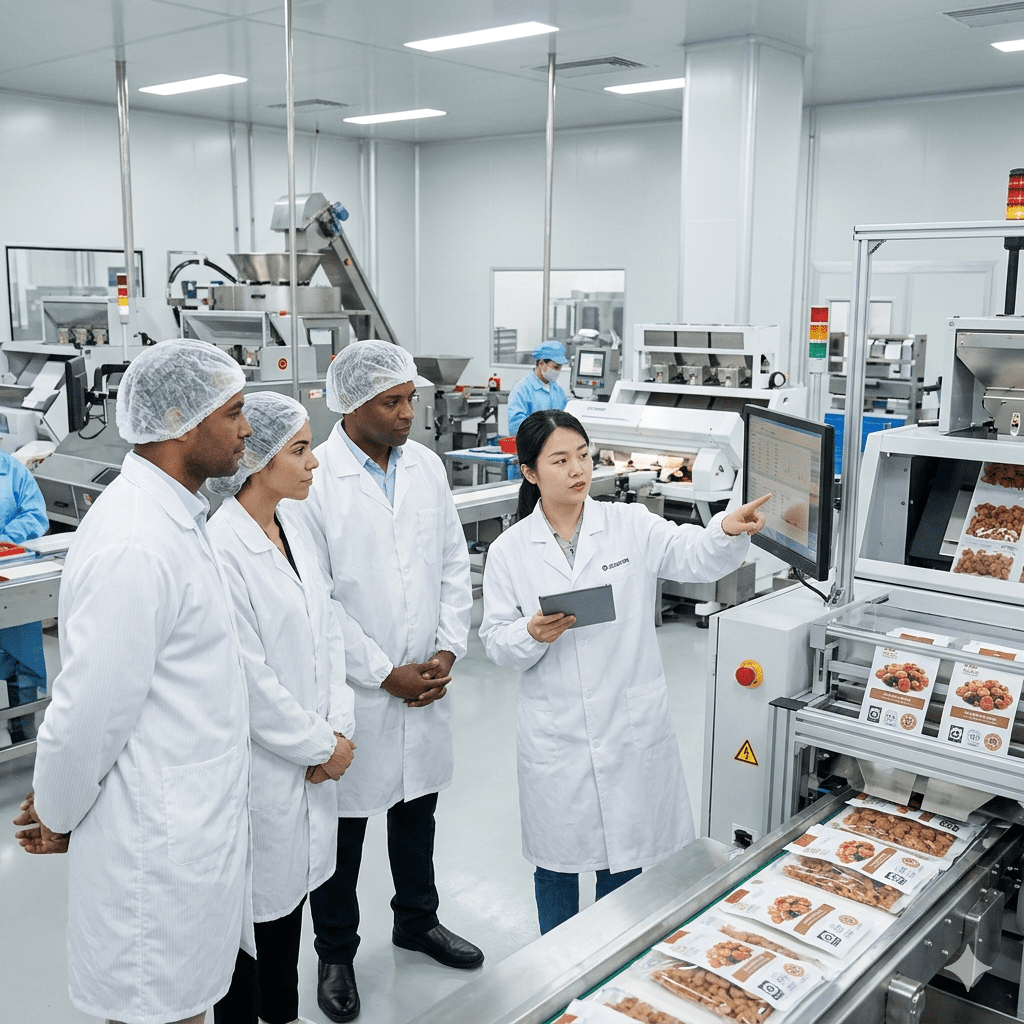
China’s leading food manufacturers now operate at world-class standards. The country’s top bakery, dairy, snack, and confectionery factories hold HACCP, ISO 22000, BRC, IFS, FDA, FSSC 22000, and Halal certifications, export to North America, Europe, the Middle East, and Asia-Pacific, and run production lines that match or exceed European and Japanese benchmarks for hygiene, automation, and quality control. Many of these factories specialize specifically in clean label formulations built on real, single-origin ingredients, with full batch traceability and third-party laboratory verification.
The strategic advantage for international buyers is significant. China combines a vast, integrated ingredient supply chain (eggs, dairy, wheat, rice, cocoa, fruit, nuts, plant proteins), advanced food processing technology, sophisticated R&D capability, and competitive production economics. Together these factors allow premium clean label products to reach global shelves at margins that are simply not achievable through European or North American manufacturing alone.
The challenge, historically, has been access. Many of China’s best clean label factories lack international brand recognition, English-language sales infrastructure, or direct retail relationships. Global buyers know the opportunity exists but are unsure where to start, how to verify, how to manage compliance, and how to negotiate terms that work for both sides.
That is the gap Jade Premium is built to close.
Jade Premium: Your Bridge to China’s Best Clean Label Manufacturers
Jade Premium works exclusively with audited Chinese manufacturers that meet the highest international clean label and food safety standards. Every partner factory holds recognized certifications. Every product undergoes pre-shipment inspection. Every shipment carries full documentation, including third-party laboratory testing for microbiological safety, heavy metals, pesticides, allergens, and nutritional validation, with batch-level traceability from raw material to destination port.
Beyond simple sourcing, Jade Premium offers full ODM and OEM services. If you have a finished concept and need a factory to produce it under your private label, our OEM partners can deliver to your specifications with professional packaging, regulatory compliance, and competitive MOQ structures. If you have a market opportunity but need formulation, recipe development, packaging design, and full product creation, our ODM partners can take you from concept to launch, leveraging proven clean label formulas already validated in demanding international markets.
We support buyers across multiple categories: clean label Swiss rolls, sponge cakes, layer cakes, biscuits, cookies, wafers, traditional Chinese pastries, frozen desserts, snack foods, and increasingly plant-based and functional food products. Our clients include private label retailers, importers, distributors, e-commerce brands, and foodservice groups across North America, Europe, the Middle East, Southeast Asia, Australia, and emerging markets.
The Bottom Line: Clean Label Is the New Standard, China Is the New Source
The clean label movement has fully matured. It is no longer a differentiator, it is the floor. Consumers expect it, regulators are encoding it, retailers are mandating it, and the brands that win in 2026 and beyond will be those that source from manufacturers genuinely committed to ingredient integrity, recipe simplicity, and verifiable transparency.
China’s premium food factories are ready to meet that demand at scale, at quality, and at competitive cost. The question is not whether to source clean label products from China, but how to do it confidently, with the right partners, the right verification, and the right commercial structure.
Ready to Develop Your Clean Label Product Range?
Whether you are looking for ready-to-import clean label bakery and snack products, exploring ODM development with a trusted Chinese manufacturer, or building a complete OEM private label line under your own brand, Jade Premium can match you with the right partner. Our team handles supplier verification, compliance management, quality control, custom packaging, and end-to-end logistics, so you can focus on growing your brand instead of chasing factories.
Visit https://jadepremium.com to start your ODM or OEM clean label sourcing inquiry today, and discover what premium Chinese food manufacturing can do for your next bestseller.