
For decades, the conventional wisdom in global food sourcing has been simple: if you want African ingredients, buy from Africa. Ethiopian coffee from Addis Ababa. West African cocoa from Accra or Abidjan. East African sesame from Dar es Salaam. Direct origin sourcing was considered the gold standard for authenticity, traceability, and cost.
That logic is now being quietly rewritten.
On May 1, 2026, China implemented zero tariffs on 100% of tariff lines for all 53 African countries with diplomatic relations. It is the first time any major economy has opened its entire tariff schedule to an entire continent. The immediate headlines focused on African exporters gaining access to Chinese consumers. But there is a second-order effect that most international buyers have not yet priced in: China is becoming the most cost-efficient processing hub for African-origin food products sold to the rest of the world.
For importers in the Middle East, Southeast Asia, Europe, North America, and even other African countries, this changes the sourcing calculus. The smart question in 2026 is no longer “should I buy African ingredients from Africa or China?” It is “for which products does each route make sense?”
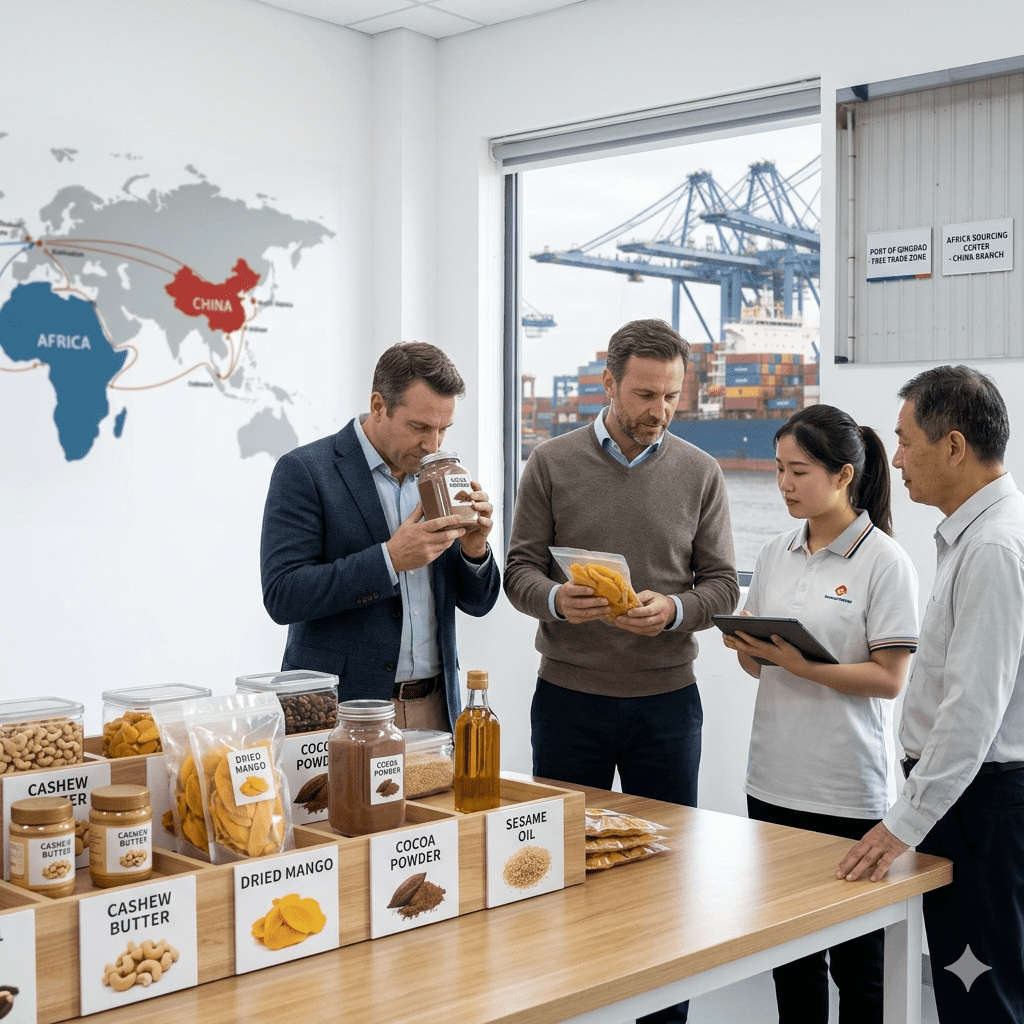
The New Math: African Raw Materials + Chinese Processing + Global Distribution
Three structural advantages now stack in favor of buying African-origin processed foods from China.
First, the tariff arbitrage flows through to finished goods. When an instant coffee plant in Yunnan or a sesame oil refinery in Shandong sources Ethiopian green beans or Tanzanian sesame at zero duty, that cost reduction is embedded in the price of every jar, sachet, and bottle it exports. Chinese manufacturers operate on competitive margins and pass much of this saving through to international buyers. A finished product made with African raw materials in China can now land in Dubai or Rotterdam at a price that direct African processors, burdened by smaller scale and less mature export infrastructure, find difficult to match.
Second, China’s food processing capacity is among the most developed in the world. Chinese factories serve as the OEM and ODM backbone for global brands across coffee, confectionery, snacks, sauces, and bakery ingredients. They hold the certifications international buyers actually need (HALAL, Kosher, BRC, IFS, FSSC 22000, organic), they understand private-label production, and they can flex between small pilot runs and full container loads. Few African processors can yet offer that combination at scale.
Third, supply stability is structurally different. African agriculture is highly seasonal and exposed to weather, logistics, and currency volatility. Chinese processors aggregate raw materials from multiple African origins, maintain buffer inventories, and ship year-round on established ocean routes from Shanghai, Ningbo, Qingdao, and Shenzhen. For a buyer who needs to fulfill a supermarket contract or a Ramadan promotion every single year without fail, this consistency matters more than a marginal price difference.
Four Comparison Dimensions Importers Should Weigh
To make this concrete, here is how the two sourcing routes actually compare across the metrics buyers care about.
On price, direct African sourcing wins on the raw commodity itself — buying green coffee from an Ethiopian cooperative or raw cashews from a Tanzanian exporter cuts out the processor’s margin. But once you move into processed forms — instant coffee, cocoa powder, roasted nuts, sesame paste, vanilla extract — Chinese factories typically beat African processors by 15-30% on landed cost, because of scale, energy costs, packaging vertical integration, and now zero-tariff raw material inputs.
On compliance, this is where the gap is widest. Chinese exporters have spent two decades adapting to the import regulations of the EU, the GCC, ASEAN, and North America. A typical mid-sized Chinese food factory holds simultaneous certifications for multiple destination markets. African processors, even excellent ones, often hold certifications for one or two export markets, which means a buyer in Saudi Arabia or Indonesia may face additional documentation work when sourcing direct.
On supply stability, Chinese suppliers can quote 12-month rolling contracts with fixed monthly volumes. African direct suppliers more often work harvest-to-harvest, with quoted prices that move significantly between seasons. For buyers running annual procurement cycles, this predictability has real financial value.
On flexibility, Chinese OEM and ODM capabilities are in a different league. A Chinese factory will run a 5,000-unit private label trial, redesign packaging for a target market, switch from glass to PET, add Arabic or Spanish labeling, and ship within weeks. Most African processors are not yet set up for that level of customization, especially at low MOQs.
Real Scenarios Where This Is Already Playing Out
The shift is not hypothetical. Several sourcing patterns are visibly accelerating in 2026.
Middle Eastern buyers and sesame products. The Middle East is the world’s largest tahini and sesame paste consumer. China is now one of the world’s largest importers of African sesame seed — roughly 90% of China’s sesame imports come from Africa, with Tanzania, Sudan, and Ethiopia leading. Chinese factories in Shandong and Henan have built efficient sesame paste, sesame oil, and sesame snack production lines, many already HALAL-certified. For UAE, Saudi, and Jordanian importers, sourcing tahini and sesame-based confectionery from Chinese OEM factories using African sesame at zero tariff is now meaningfully cheaper than sourcing from traditional Levantine producers.
Southeast Asian buyers and instant coffee. Instant coffee still accounts for over 60% of China’s coffee market by volume, and Chinese factories have refined three-in-one and freeze-dried coffee production to near-perfection. With Ethiopian, Ugandan, and Rwandan green beans now entering China duty-free, Chinese instant coffee exporters can offer Indonesian, Vietnamese, Filipino, and Malaysian importers an African-origin coffee product at prices that compete directly with their domestic instant coffee. Private-label opportunities for convenience store chains and supermarket house brands are particularly strong here.
European buyers and cocoa-based products. Premium chocolate, cocoa powder, and bakery cocoa for European private-label and food service buyers can be cost-effectively sourced from Chinese manufacturers using Ghanaian and Ivorian cocoa beans. The traceability story — single-origin West African cocoa, processed under EU-compliant standards in China — is increasingly viable as Chinese processors invest in origin certification.
Other African buyers are reverse-importing. Perhaps the most counterintuitive pattern: importers in African countries with limited domestic food processing (parts of Central and Southern Africa) are buying finished products made in China from raw materials originally exported from neighboring African countries. For categories like instant coffee sachets, packaged peanut butter, and biscuit ingredients, this loop is already commercially active.
When You Should Still Source Directly from Africa
A balanced view matters here, because the answer is genuinely “it depends.”
Direct African sourcing remains the right choice when you need single-origin authenticity for storytelling-driven products — a specialty coffee roaster building a brand around a specific Ethiopian cooperative, a craft chocolate maker wanting direct-trade relationships with Ghanaian farmers, a premium vanilla buyer working directly with Malagasy producers. In these cases, the origin story is the product, and Chinese intermediation dilutes that value.
Direct sourcing also makes sense for raw commodities purchased in full container loads by buyers with their own processing capability. If you operate a coffee roastery in Berlin or a cashew packing line in Vietnam, buying green coffee or raw cashews directly from origin remains optimal.
But for processed, packaged, ready-to-retail products — instant coffee, cocoa powder, sesame paste, roasted nut snacks, vanilla extract, chocolate confectionery, bakery mixes, sauce concentrates — the China route has become structurally more competitive in 2026 than it was even twelve months ago.
What This Means for Your Sourcing Strategy
The zero-tariff policy is not a temporary subsidy. China has committed to this framework long-term, and for the 20 newly-included non-LDC African countries, the special tariff treatment runs through at least April 2028. This is enough runway for serious sourcing strategy changes, not just opportunistic trades.
Importers and brand owners who treat 2026 as a procurement reset year — auditing which African-origin SKUs in their portfolio could be more efficiently sourced from China — are likely to see meaningful margin improvement within 12 to 18 months. The buyers moving first will also secure the best Chinese OEM partners, because high-quality factory capacity is finite, and the most capable Chinese food manufacturers will lock into long-term contracts with their earliest international clients.
Working with Jade Premium
This is exactly the corridor where Jade Premium operates. We work with international buyers who want to source African-origin processed food products manufactured in China — whether you need a finished branded product, a private-label OEM run, or a custom ODM development for your market. We help you identify the right Chinese factories, verify their African raw material supply chains, ensure compliance with your destination market’s regulations, and manage the end-to-end logistics.
If you are exploring how the new China-Africa zero-tariff landscape could reshape your sourcing — whether for coffee, cocoa, sesame, nuts, vanilla, or other categories — we would welcome the conversation. Visit https://jadepremium.com and reach us through the Contact Us page to discuss your specific requirements.
The trade corridor has been opened. The factories are ready. The question now is which importers will be first to take advantage of it.