
For international buyers sourcing from China, March 16, 2027 should already be circled on the calendar. That is the day GB 7718-2025, China’s revised national standard for prepackaged food labeling, takes effect — along with the companion nutrition labeling standard GB 28050-2025 and the State Administration for Market Regulation (SAMR) Order No. 100, the Administrative Measures for Food Labeling Supervision.
Most coverage of these rules has focused on what they mean for the Chinese domestic market. But for global importers building clean label product lines around Chinese-manufactured food, the implications are arguably bigger. The new framework is a once-in-a-decade reset of what “clean label” can legally claim in China — and it elevates traceability from a marketing differentiator to a regulatory requirement.
Here is what international buyers need to understand, and why the next twelve months are a critical window for supplier audits.
What Actually Changes on March 16, 2027
Four shifts matter most for clean label importers.
The end of vague “no additive” marketing. Under GB 7718-2025, claims such as “not added,” “no addition of,” “zero added,” and any phrase with essentially the same meaning are no longer permitted on food labels — even when technically true. Claims like “no” or “free from” remain allowed only for ingredients whose content is genuinely zero, and they cannot be applied to food additives at all. This single change wipes out a large category of marketing language that has been used loosely across the Chinese food industry for years.
For international buyers, the message is direct: any Chinese supplier still building product positioning around “no additive” claims will need to overhaul their labels, and likely their formulations, before March 2027. Suppliers who cannot make that transition are not clean label suppliers — they were marketing claim suppliers.
Mandatory allergen labeling for the first time. GB 7718-2025 makes allergen declaration mandatory for eight categories: gluten-containing cereals, crustaceans, fish, eggs, peanuts, soy, dairy (including lactose), and tree nuts. Allergens must be either highlighted in the ingredient list (bold or underlined) or declared in a separate allergen statement. This brings China’s labeling baseline closer to EU, US, and ASEAN allergen requirements, which simplifies dual-market labeling for exporters — but only for suppliers whose ingredient traceability is actually clean enough to make accurate declarations.
Quantitative ingredient declaration (QUID) becomes the default. If an ingredient is named in the product name — “honey oat biscuit,” “almond milk,” “Yirgacheffe coffee blend” — its actual quantity in the finished product must now be declared on the label. Five narrow exemptions exist (allergen warnings, pairing suggestions, single-origin descriptors, sensory descriptors, and ingredients defined by national standards), but the general rule is transparency by default.
This is where clean label and traceability collide directly. A supplier claiming “30% real fruit” or “single-origin Ethiopian coffee” must now be able to prove the exact ratio and origin at the production batch level. Suppliers without robust batch-level traceability systems will struggle to make these declarations defensibly.
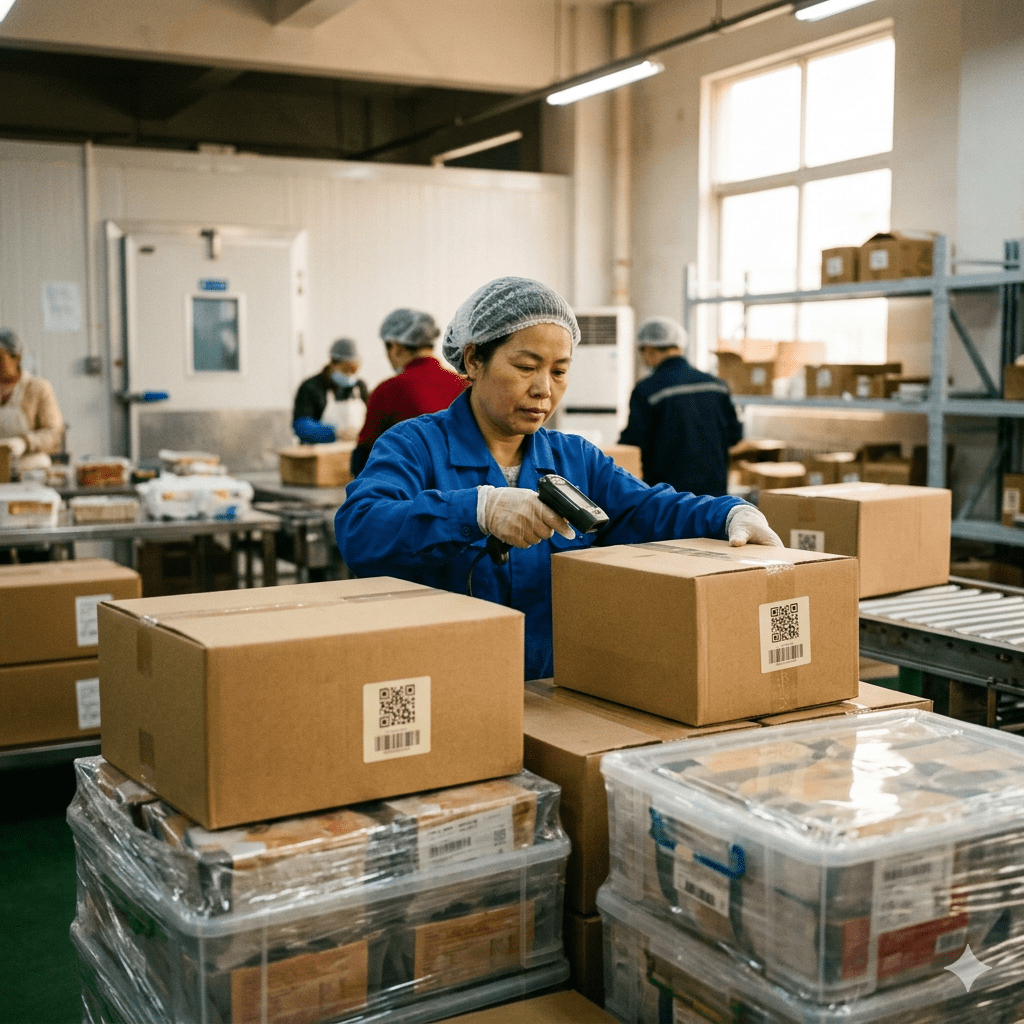
Digital labels enter the standard. GB 7718-2025 formally introduces digital labels — QR codes linking to comprehensive product information in text, audio, or video — as an officially recognized label format. The standard requires that digital label content cannot be altered after publication, effectively building a permanent audit trail of what a manufacturer told consumers about a given product.
For traceability-focused importers, this is significant. Digital labels create infrastructure for batch-level transparency that goes far beyond what static printed labels can carry. Forward-looking Chinese manufacturers are already designing digital label systems that can host origin certificates, third-party test results, batch genealogy, and supply chain documentation.
Why This Is Actually Good News for Clean Label Buyers
It would be easy to read these rules as another compliance burden. The smarter reading is that they create a market sorting mechanism that benefits legitimate clean label sourcing.
For years, the Chinese food market has operated with significant claim inflation. “No additive” claims have been applied to products that contain functional ingredients arguably qualifying as additives. “Natural” and “pure” claims have been used loosely. Origin claims have not always been backed by rigorous supply chain documentation. This noise has made it harder for international buyers to identify genuinely premium Chinese suppliers, because well-run factories with real clean label capabilities were competing on the same shelves as marketing-led products.
GB 7718-2025 and Order No. 100 cut through that noise. After March 2027, a Chinese supplier that maintains compliant labeling — accurate ingredient quantities, properly declared allergens, traceable origin claims, no prohibited “no additive” wording — has effectively cleared a regulatory bar that less serious competitors cannot. The new rules do for clean label what GACC registration did for food safety: they create a credentialing layer.
For international buyers, this means the post-2027 landscape will be easier to navigate, not harder. The factories still standing as clean label suppliers will be the ones that built real systems.
Traceability Becomes the Compliance Backbone
Read carefully, the new rules push traceability from “nice to have” to “required infrastructure.” Three specific provisions make this clear.
First, quantitative ingredient declaration requires batch-level data on ingredient ratios — which is impossible without a working production traceability system that links raw material inputs to finished goods outputs. A supplier who cannot tell you exactly how many kilograms of African cocoa went into a specific lot of chocolate cannot legally make a quantified cocoa claim.
Second, allergen labeling in a multi-product factory requires traceability of shared production lines, cross-contamination risk assessment, and ingredient sourcing documentation. The “may contain” voluntary advisory only carries credibility if it is grounded in real facility-level traceability.
Third, digital labels create a public, permanent record of what a manufacturer claims about each product. Building a digital label that holds up to consumer scrutiny — and potential regulatory audit — requires a back-end traceability system feeding it accurate, version-controlled data.
Suppliers without modern traceability infrastructure simply cannot meet these requirements at scale. The new rules quietly mandate the digital transformation of Chinese food labeling.
What International Buyers Should Do in the Next Twelve Months
The window between now and March 2027 is the audit window. Buyers who use it well will enter the post-2027 market with a stronger supplier portfolio. Buyers who treat it as someone else’s problem will discover, on the day the rules take effect, that some of their suppliers cannot continue producing the SKUs they have been buying.
Practical priorities for the next twelve months: review every Chinese-sourced product in your portfolio for label claims that will become non-compliant after March 2027, especially “no additive,” “zero added,” and similar formulations, and either reformulate, relabel, or replace; request from each supplier their GB 7718-2025 transition plan in writing, including timeline, label redesign status, and any formulation changes; verify that suppliers making origin or quantitative claims have batch-level traceability systems that can document them, ideally with the ability to feed a digital label; check allergen management capability at any facility producing for your market, including shared line documentation; and prioritize suppliers who are already preparing for digital label deployment, because they will have a meaningful capability lead by 2028.
Buyers who run this audit now will identify gaps when there is still time to fix them — or to change suppliers without disrupting their own product launches.
The Strategic Takeaway
March 2027 is not just a Chinese regulatory event. It is a structural upgrade to what “made in China” food can credibly claim in global markets. For international brands building clean label product lines, it makes the Chinese supply base measurably more trustworthy — provided you are working with suppliers who treat the new rules as a capability investment rather than a compliance headache.
The suppliers worth your long-term relationships are the ones who, by mid-2026, are already redesigning labels, implementing batch-level traceability, and piloting digital label content. The suppliers worth removing from your roster are the ones who, asked about GB 7718-2025, do not yet have a plan.
Working with Jade Premium
Navigating the GB 7718-2025 transition while maintaining clean label integrity is exactly the kind of work Jade Premium does for international buyers. We audit Chinese food suppliers for traceability infrastructure, review label compliance ahead of the 2027 deadline, and connect international brands with manufacturers who are genuinely ready for the new regulatory environment — whether you are sourcing finished branded product, OEM, or ODM development.
If you would like to discuss how the 2027 rules affect your specific product portfolio, or want a structured supplier audit before the deadline, visit https://jadepremium.com and reach us through the Contact Us page.
The buyers who move on this in 2026 will have a cleaner, more compliant, more defensible Chinese supply chain in 2027. The ones who wait will be scrambling.