
How Chinese Manufacturers Are Turning a Regional Favourite into an International Snacking Trend
Discover why mala spicy snacks are trending across Southeast Asia. Jade Premium connects buyers with verified suppliers—contact us for reliable sourcing.
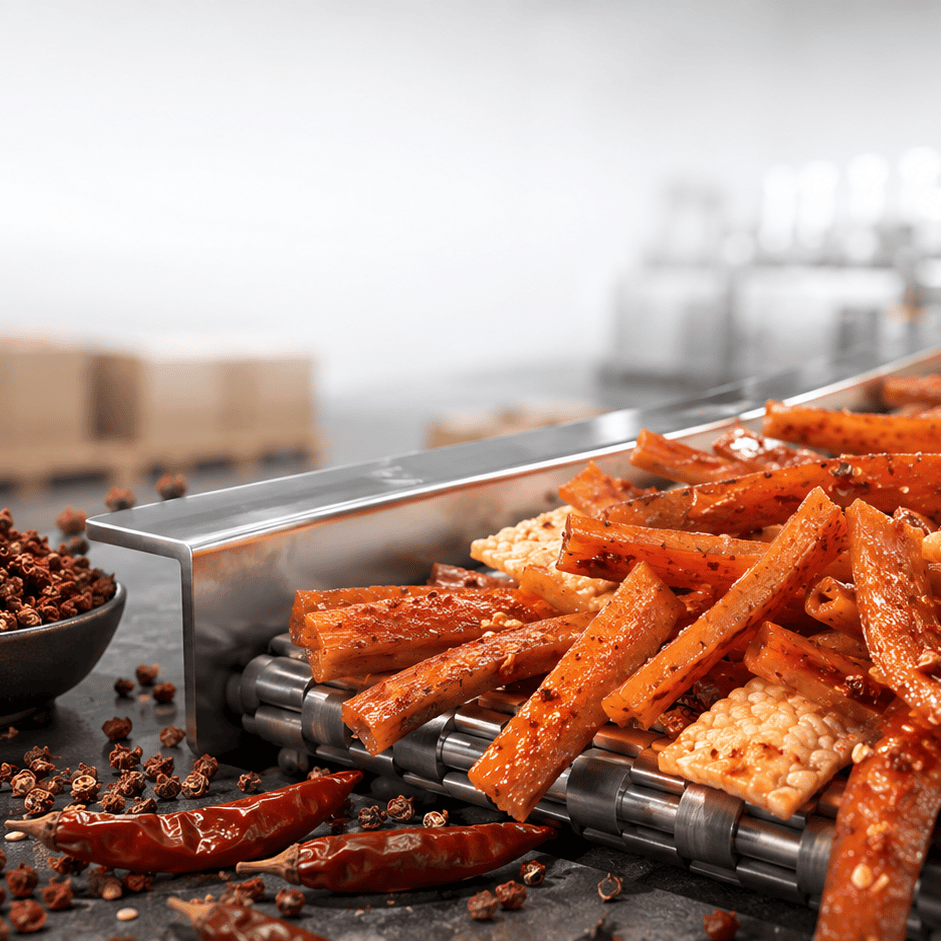
Spicy Snacks Are No Longer a Niche Category
Mala spicy snacks have moved well beyond their origins as a regional Chinese favourite. Spicy strips (latiao), once sold almost exclusively through domestic corner stores, have grown into a genuine export category, now reaching more than 160 countries and regions and appearing on general retail and specialty grocery shelves well outside China. Overseas sales on Tmall’s international platform grew by more than 120% year-on-year in the second half of 2020 alone, and spicy strips have even appeared on a luxury food ranking on Amazon in the United States, commanding prices many times higher than their domestic retail price, a trajectory documented by Chinese business outlet Jiemian. This premium positioning overseas reflects genuine curiosity around authentic Chinese snack flavours, rather than demand limited to price-sensitive niche buyers.
The broader snack category backing this growth is expanding quickly in its own right, with Southeast Asia’s snack food market on track to exceed USD 19 billion in revenue by 2025 and online snack sales growing significantly faster than the category overall, according to market data tracked by Statista. For importers, distributors and retailers, this combination, a distinctive, flavour-forward Chinese snack category entering an already fast-growing regional snack market, represents a meaningful window of opportunity.
Jade Premium, a Hong Kong-based sourcing specialist connecting global buyers with verified Chinese manufacturers, works with producers across this category, from long-established spicy strip makers to newer entrants developing snacks built around Sichuan peppercorn and other signature regional seasonings. Partnering with an experienced spicy snack manufacturer matters here: these producers combine traditional flavour-making techniques with production standards suited to export markets, helping bridge the gap between a beloved domestic snack and the expectations of international buyers.
What’s Driving the Global Appetite for Mala Flavours
Several forces are converging to push mala spicy snacks into international markets, and understanding them helps explain why this category is proving more durable than a passing food trend.
Packaging and flavour signalling play a bigger role than many buyers expect. Academic research on Asian snack packaging, published in the Asian Journal of Business Research, notes that red is strongly associated with good fortune and celebration across Asian cultures, and that marketers can use this cultural association deliberately when designing spicy product packaging. Separate research published in Frontiers in Nutrition found that consistency between packaging colour and food type, such as red or orange tones for spicy foods, measurably increases purchase intention. For manufacturers exporting mala snacks, this underscores that colour and flavour cues need to be considered carefully for each destination market rather than treated as a fixed, one-size-fits-all design choice.
Distribution channels are also shifting in ways that favour newer entrants. Industry analysis from Mordor Intelligence projects that online retail will be the fastest-growing distribution channel for Southeast Asia’s savory snacks market between 2026 and 2031, expanding at close to an 11.5% compound annual rate as quick-commerce platforms make it possible to fulfil impulse snack orders within the hour. This lowers the barrier for a specialty category like mala snacks to reach consumers directly, without first securing space on crowded supermarket shelves.
Health-conscious reformulation is a third driver. Rather than positioning mala snacks purely as indulgent treats, manufacturers are increasingly developing versions built around lighter bases such as konjac, or emphasising reduced-oil preparation methods. This dual positioning, bold flavour paired with a lighter nutritional profile, helps mala snacks reach health-conscious buyers who might otherwise avoid the category altogether.
From Convenience Stores to E-Commerce: A Broader Consumer Base
The consumer base for mala spicy snacks has expanded considerably beyond the diaspora communities and long-time enthusiasts who first drove demand outside China.
Mordor Intelligence’s research on the region’s savory snacks market points to strong “snackification” trends among Gen Z and millennial consumers, who are driving demand for premium, functional and flavour-forward snack innovations, while digital commerce is opening low-barrier routes for both established and newer brands to reach dense urban markets. This shift matters commercially: it moves mala snacks from a limited niche audience toward the much larger pool of everyday convenience and online shoppers.
At the same time, the international footprint of even the category’s largest domestic players remains modest, which points to genuine headroom for new entrants. Reporting by Jiemian noted that one of China’s best-known spicy strip manufacturers worked with fewer than 40 overseas distributors as of its most recent disclosure, despite its dominant position in the domestic market. For buyers, this suggests the mala snack export category is still in its early stages internationally, with meaningful opportunity for well-positioned manufacturers and their sourcing partners to establish themselves before the category becomes saturated.
This broader reach brings real opportunities alongside genuine challenges for different players in the supply chain. Importers benefit from a product category with strong flavour differentiation and built-in social media appeal, but must navigate export documentation, food safety certification and labelling requirements that vary by destination market. Retailers gain access to a fast-growing, youth-skewing category, but need to invest in packaging and merchandising that speaks to local taste expectations rather than assuming a strong flavour alone will carry the product. For distributors evaluating wholesale mala snacks as a new line, the calculus is similar: the category’s flavour differentiation is a genuine advantage, but building a reliable supply relationship matters just as much as the product itself.
As the category matures, buyers who partner with manufacturers already experienced in export standards and regional flavour adaptation are best positioned to capture this growing demand without absorbing the trial-and-error costs of navigating these requirements alone.
Product Spotlight
Mommy’s Spicy Strips
Spicy strips remain the category’s flagship product, and quality raw materials continue to separate premium offerings from mass-market alternatives.
Jade Premium’s Mommy’s Spicy Strips are seasoned using traditional Sichuan chilli powder slow-cooked in soybean oil, delivering the layered mala flavour, numbing and spicy in balance, that defines the category. The product has already reached export markets including Japan, reflecting the manufacturer’s established experience meeting international quality and documentation standards.
Key product advantages include:
- Traditional Sichuan chilli powder and soybean oil seasoning
- Balanced numbing-and-spicy mala flavour profile
- Established export track record to Japan
- Suitable for convenience retail and snack distribution
Hand-Shredded Spicy Strips
Texture has become an important point of differentiation as the spicy strip category matures.
Hand-Shredded Spicy Strips, produced by the same manufacturer, use a hand-shredding technique that creates a more fibrous, layered texture than standard-cut spicy strips, while retaining the same authentic Sichuan chilli seasoning. This textural variation gives buyers a way to offer product variety within the spicy strip category rather than a single standardised format.
Key product advantages include:
- Hand-shredded texture for added bite and variety
- Authentic Sichuan chilli seasoning
- Already exported to Japan
- Complements standard spicy strip offerings in a product lineup
Handcrafted Sichuan Peppercorn Rice Crackers
Beyond spicy strips, rice cracker-style snacks are emerging as a lighter, crisper entry point into the mala flavour category.
Handcrafted Sichuan Peppercorn Rice Crackers are made using a traditional handcrafted rice cracker process, seasoned with signature Sichuan peppercorn for a numbing, aromatic finish. The product is available in three flavour intensities, from mild peppercorn to extra spicy, and its thin, crisp structure gives it a lighter eating experience than oil-based spicy strips. As a spicy rice crackers supplier, the manufacturer already exports to Hong Kong, the United States and Southeast Asia, and holds recognised food safety certifications suited to these markets.
Key product advantages include:
- Traditional handcrafted rice cracker technique
- Three flavour intensities to suit different markets
- Light, crisp texture distinct from spicy strips
- Existing export experience across Hong Kong, the US and Southeast Asia
Whether you are looking to diversify a convenience store snack range, add a distinctive Chinese flavour line to an e-commerce catalogue, or source private-label spicy snacks for retail distribution, Jade Premium connects international buyers with verified manufacturers such as these. From classic soybean-oil spicy strips to lighter peppercorn-seasoned rice crackers, Jade Premium provides reliable sourcing support backed by export documentation and quality assurance expertise. Contact our team to discuss your specific requirements.
Looking Ahead
Mala spicy snacks are following a path familiar from other Chinese food categories that have successfully expanded overseas: an authentic, distinctive flavour identity, paired with manufacturers willing to adapt packaging, formulation and certification to meet the expectations of new markets.
Mommy’s Spicy Strips, Hand-Shredded Spicy Strips and Handcrafted Sichuan Peppercorn Rice Crackers illustrate the range within this single category, from bold, oil-seasoned strips to lighter, crisper cracker formats, giving buyers room to build a varied mala snack offering rather than relying on one signature item.
For importers, distributors and retailers evaluating this category, the opportunity lies not just in riding current demand, but in partnering with manufacturers who already understand the documentation, certification and localisation work required to sell successfully outside China. Working with a trusted Chinese spicy snack supplier removes much of this uncertainty, giving buyers confidence to build mala snacks into a lasting part of their product portfolio rather than a short-lived trend purchase. As Southeast Asia’s snack market continues its rapid growth, suppliers capable of pairing authentic mala flavour with export-ready standards will be best placed to meet rising international demand.