
A value-added seafood dish is no longer a factory shortcut — it is one of the fastest-growing segments in global seafood trade. The global processed seafood market is set to grow by US$76.1 billion between 2023 and 2028, a compound annual growth rate of 8.08%, according to Technavio1.
A large part of that growth sits on top of a specific supply-chain advantage: China has been the world’s top seafood exporter by value every year since 2002, and in 2024 was simultaneously the world’s second-largest seafood importer at US$22.3 billion — a dual position that gives its processing sector unmatched access to both raw material and export infrastructure2.
That combination is pulling in two very different buyers at once:
- 1. The foodservice operator trying to plate a consistent dish with fewer trained cooks.
- 2. The retail category manager stocking a freezer case with something a home cook can finish in minutes.
The shift has been building for a few years, but 2026 is the point where it stopped being a niche foodservice workaround and became a mainstream retail expectation.
- A frozen-and-chilled category buyer in the Bay Area is being asked why the seafood aisle still looks like raw fillets and shell-on shrimp when the snack aisle next to it is full of heat-and-eat options.
- A Chinese restaurant group’s kitchen director standardising output across outlets in Bangkok needs a fish dish that tastes the same whether the cook on shift has five years’ experience or five weeks.
- A foodservice distributor in Singapore is fielding requests from hotel kitchens that no longer have the headcount to prep whole fish to order.
All three are shopping in the same category. None of them is shopping for the same product.
What makes sourcing value-added seafood particularly tricky is that the category isn’t one specification — it’s a spectrum. A dish that only needs ten minutes of steaming asks almost nothing of the receiving kitchen. A dish that needs a controlled fry or a specific bake time asks considerably more of equipment, staff, and buyer risk. Understanding where a product sits on that spectrum — and matching it to a specific kitchen or shelf — is the buying decision most foodservice seafood sourcing conversations skip past on their way to a supplier certification checklist.
Value-Added Seafood Is Splitting into Formats, Not Just Products
Sourcing conversations about value-added seafood should start with the cooking method, not the ingredient. The cooking method is what determines whether a product actually fits the kitchen it’s being sold into. Manufacturers within Jade Premium’s sourcing network are increasingly building ranges around distinct prep formats rather than a single ‘ready meal’ category.
1. Steam-and-Serve Formats (Minimal Overhead)
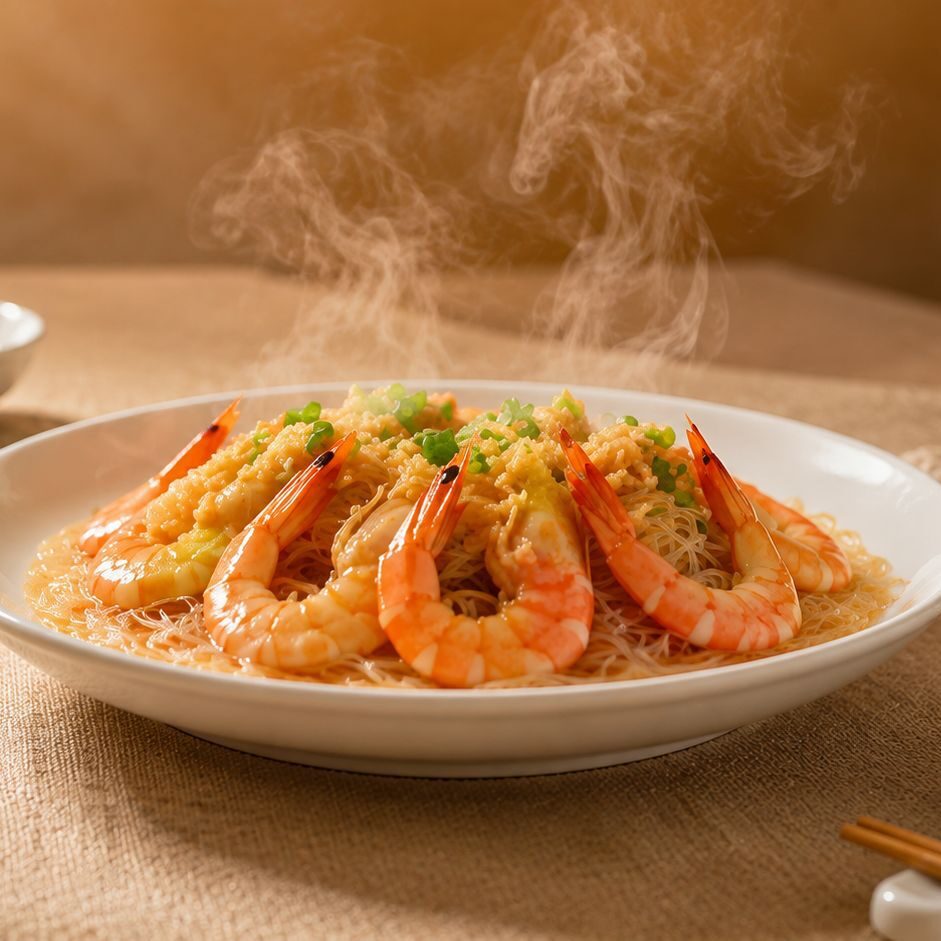
At the simpler end of the spectrum sit steam-and-serve formats: a portioned protein packaged with its own sauce component, designed to go from frozen or chilled straight into a steamer for around ten minutes. These formats travel equally well into a compact restaurant kitchen, a supermarket deli counter, or a household with a rice cooker.
- Fish Head with Chopped Chilli Sauce: Pairs a cleaned, boned silver carp head with a pre-made chilli sauce component, ready to steam in ~10 minutes.
- Prawns with Garlic Paste: Features peeled, butterflied prawns, stir-fried garlic paste, and glass noodles — a single steaming step rather than three separate prep tasks.
2. Fried or Baked Formats (Higher Culinary Impact)
At the more demanding end sit fried or baked formats, where the receiving kitchen takes on a real cooking step — controlled oil temperature, set bake time, or an air-fryer cycle. That additional step is a trade-off, not a downside: it buys a shaped, high-visual dish that a kitchen can present as a signature item rather than an obviously reheated one.
Understanding the 3R Framework
This format spectrum is often categorized under the 3R framework across Asian retail and foodservice channels3:
- Ready-to-Cook (RTC)
- Ready-to-Heat (RTH)
- Ready-to-Eat (RTE)
International buyers often search for a value-added seafood supplier for restaurants or a processed seafood products wholesale importer. Regardless of terminology, the 3R breakdown remains a crucial shorthand for defining how much preparation remains for the end-user. Cold-chain handling is consistent across formats, moving through the same frozen import and storage infrastructure as other frozen retail-ready products.
From Kitchen Shortage to Shopping List: What’s Actually Driving Demand
Two separate pressures are pushing value-added seafood from a foodservice niche into a retail staple:
- Kitchen Labor Shortages: The National Restaurant Association’s 2026 operator report found that 67% of US operators rank rising labour costs and staffing shortages as their leading operational pressure4. This mirrors what Asia-Pacific restaurant groups face when standardising menus across regional branches.
- Retail ‘Restaurant-Quality’ Expectations: China’s ready-to-eat and cooked seafood market alone is projected to reach roughly US$5.3–5.8 billion in 2025 and nearly double by 2034, driven by platforms like JD Fresh and Alibaba Hema5. This trend is rapidly reshaping Western freezer aisles, echoing the rise of imported Asian formats on mainstream retail shelves.
| Channel | The Main Upside | The Key Operational Risk |
| Foodservice | Cuts prep time & skilled labor requirements. | Flavour & presentation rely entirely on product quality; no chef technique to hide flaws. |
| Retail | High-growth, premium freezer-case category. | Products have vastly different home-handling needs; improper fit leads to poor consumer reviews. |
The Three-Check Framework for Choosing a Value-Added Seafood Supplier
To assist procurement teams, this frozen value-added seafood sourcing guide breaks evaluation down into three sequential checks:
Check 1 — Prep-Method Fit
Does the reheat or cook step match your target kitchen’s equipment and skill level?
- Example: Steam-and-serve items (e.g., Fish Head with Chopped Chilli Sauce) need only a basic steamer and ~10 minutes. This fits a 5-seat noodle bar or a supermarket deli.
- Takeaway: Low prep barriers lower training overhead, but differentiation must come from superior seasoning and raw material quality.
Check 2 — Consistency & Compliance Fit
Can the supplier maintain identical quality at scale, backed by verified compliance?
- Multi-unit operators struggle heavily here: 58% of multi-unit operators rank kitchen consistency as their top operational hurdle⁴.
- Certification Verification: Certifications are a baseline. Working with a HACCP certified seafood manufacturer in China requires verifying that the certification covers the specific SKU, not just the facility’s general profile.
- Jade Premium Standard: Featured listings — including the Fish Head, Garlic Prawns, and Pre-Fried Squirrel-Cut Tilapia Fillet — carry SKU-specific HACCP certification and verified export status to Hong Kong, Australia, the EU, and Southeast Asia.
Check 3 — Channel Fit
Does the finished format suit foodservice plating or retail self-serve?
- Example: The Pre-Fried Squirrel-Cut Tilapia Fillet requires a controlled fry (170°C for ~3 mins), a 16–20 minute bake, or an air-fryer cycle, finished with sweet-and-sour sauce.
- Takeaway: This format creates a stunning, scored, fanned signature dish for restaurant plating — but is ill-suited for a quick-prep retail consumer.
| Check | The Buyer Question | Example From This Article |
| 1. Prep-Method Fit | Does the cook step match kitchen equipment/skill? | Fish Head & Garlic Prawns — steam-only, ready in ~10 mins |
| 2. Consistency & Compliance Fit | Can the supplier maintain output with SKU-level compliance? | HACCP verified across specific product listings |
| 3. Channel Fit | Does the format suit foodservice plating or retail shelf? | Pre-Fried Tilapia — high-visual plating, requires fry/bake step |
| Considering a value-added seafood range for your next listing? Jade Premium verifies prep format, certification coverage, and shelf-life data against your target channel before you commit to a first order. 👉 Contact Jade Premium’s Sourcing Team to discuss custom requirements or request full product specifications. |
The Jade Premium Approach: Verified Sourcing from China
How do buyers verify all three checks before a product reaches their port?
Established in 2014 as part of Yuhu Group (Hong Kong), Jade Premium is headquartered in Hong Kong with regional offices in Shenzhen, Guangzhou, Shanghai, Chengdu, Wuhan, and Changsha. We work directly with qualified manufacturers across HALAL, HACCP, ISO22000, and FDA certification frameworks.
As your dedicated value-added seafood supplier and sourcing partner, we go beyond paperwork — the same on-the-ground verification we’ve set out for what an end-to-end certified exporter should handle beyond paperwork alone:
- 1. On-Site Factory Audits: Inspecting processing lines on the factory floor rather than relying on digital certificates.
- 2. SKU-Specific HACCP Checking: Confirming that certifications explicitly cover the exact SKU being ordered.
- 3. Lab-Validated Specifications: Testing manufacturer claims for prep times, yield loss, and shelf-life stability.
Whether you are a processed seafood products wholesale importer or managing a global restaurant chain, we align kitchen requirements with factory capabilities across our wider Jade Premium product range.
| Ready to Upgrade Your Seafood Sourcing? The value-added seafood opportunity isn’t just about saving ten minutes of kitchen prep — it is about establishing chain-of-trust from factory floor to end consumer. Speak with a Jade Premium Sourcing Specialist Today |
Related Articles
- Sourcing Chinese Snacks for Export: The 3 Risk Factors That Separate Confident Buyers from Costly Missteps
- End-to-End Partner: What a Certified Chinese Food Exporter Should Handle Beyond Paperwork
References & Data Sources:
- Technavio, “Processed Seafood Market Growth Analysis” report, 2024. Market growth and CAGR figures (2023–2028). ↩︎
- FAO GLOBEFISH, “World Fish Trade Fall in 2024” (fao.org), 2025; FAO State of World Fisheries and Aquaculture (SOFIA) 2024/2025 report. ↩︎
- ScienceDirect, “Smart screening, detection, warning, and control of 3R food hazards,” 2024. ↩︎
- National Restaurant Association, 2026 Operator Report / State of the Restaurant Industry survey. ↩︎
- statsmarketresearch.com / Grand Research Store, “Ready-to-Eat and Cooked Seafood Market” report, 2026. ↩︎