
Executive Summary: Navigating the 2027 Festive Overlap
In 2027, Chinese New Year (6 February 2027) and Ramadan (expected to begin around 8 February 2027) fall just two days apart, with Eid al-Fitr projected for 9–10 March. This convergence turns two distinct festive seasons into a single compressed festive food import planning window.
According to DinarStandard’s State of the Global Islamic Economy Report 2024/25, Muslim consumer spending on halal food reached USD 1.43 trillion in 2023 and is projected to reach USD 1.94 trillion by 2028. For importers in Southeast Asia and Australia, managing this high-stakes demand peak requires early action. Because many Chinese factories close for the Lunar New Year holiday, international buyers asking when to order Ramadan stock from China must place orders by November 2026 to ensure pre-shutdown shipment.
Why the 2027 Overlap Redefines Ramadan Food Sourcing from China
The 2027 calendar overlap creates a unique challenge: two distinct retail demand peaks depend entirely on a single production and shipping window in China.
- Chinese New Year: Drives high demand for reunion dinner ingredients, visiting snacks and festive gift boxes.
- Ramadan & Eid: Drives demand for iftar meals, night bazaar supplies and Eid hamper lines.
While many food formats serve both occasions, entry requirements vary dramatically by destination market:
Southeast Asia: Halal Compliance Is the Essential Gate
In Malaysia and Singapore, buyers require strict halal certification recognised by JAKIM (Malaysia) or MUIS (Singapore). In Indonesia, requirements are even stricter: under Government Regulation No. 42 of 2024, mandatory halal certification for imported food and beverages takes effect on 17 October 2026, with enforcement starting on 18 October. Ramadan 2027 will be the first Ramadan under full BPJPH enforcement.
Australia: Two Festive Communities in Peak Summer
Australia’s 2021 Census recorded 813,392 people affiliated with Islam (3.2% of the population), while 5.5% of residents reported Chinese ancestry, according to the Australian Bureau of Statistics. For a halal Chinese food importer in Australia, the primary barrier is biosecurity, managed through the Department of Agriculture, Fisheries and Forestry’s (DAFF) BICON system. Furthermore, February coincides with the peak of the Australian summer, placing strict demands on cold-chain logistics for frozen stock.
The 2027 Festive Sourcing Calendar for Southeast Asia and Australia
To secure on-shelf availability by early February 2027, product specifications and compliance checks must be completed by October 2026. Below is the recommended Chinese New Year stock planning and Ramadan sourcing timeline:
| Timeline | Southeast Asia Market (Malaysia, Singapore, Indonesia) | Australia Market |
| Oct 2026 | Confirm SKUs; verify SKU-level halal recognition (JAKIM, MUIS, BPJPH) ahead of the 17 October Indonesian deadline. | Confirm SKUs; verify DAFF BICON import conditions and apply for any necessary import permits. |
| Nov 2026 | Place orders with your halal food supplier in China; lock in factory production slots before pre-CNY cut-offs. | Place orders; secure factory slots and book refrigerated container (reefer) shipping space. |
| Dec 2026 | Complete quality control checks; ship exports by late December. | Finalise production; ship in early to mid-December to allow for longer shipping routes and inspection protocols. |
| Jan 2027 | Vessel arrival, customs clearance and inland distribution to warehouses. | Vessel arrival, DAFF biosecurity inspection, clearance and distribution. |
| Feb 2027 | Products on shelf for Chinese New Year (6 February) and Ramadan (from around 8 February). | Products on shelf for both festive communities; maintain strict summer cold-chain management. |
Risk Scenario: If an Australian distributor confirms a supply order in mid-December, factory shutdowns and biosecurity delays could push arrival past 6 February. Chinese New Year lines will miss the sales window, and Ramadan items will succeed only if designed with versatile packaging.
Three Essential Compliance Checks for Dual-Festive Stock
To maximise sell-through across both holidays, importers should evaluate products against three criteria:
Check 1: Market Access & Certificate Scope
- Southeast Asia: Ensure halal certificates cover specific SKUs and production lines, not just the facility. For example, a plant certified for chicken lines may still be awaiting coverage for seasoned beef products.
- Australia: Check BICON conditions for ingredient-level compliance (especially meat and dairy content) before quoting clients.
Check 2: Dual-Occasion Formats
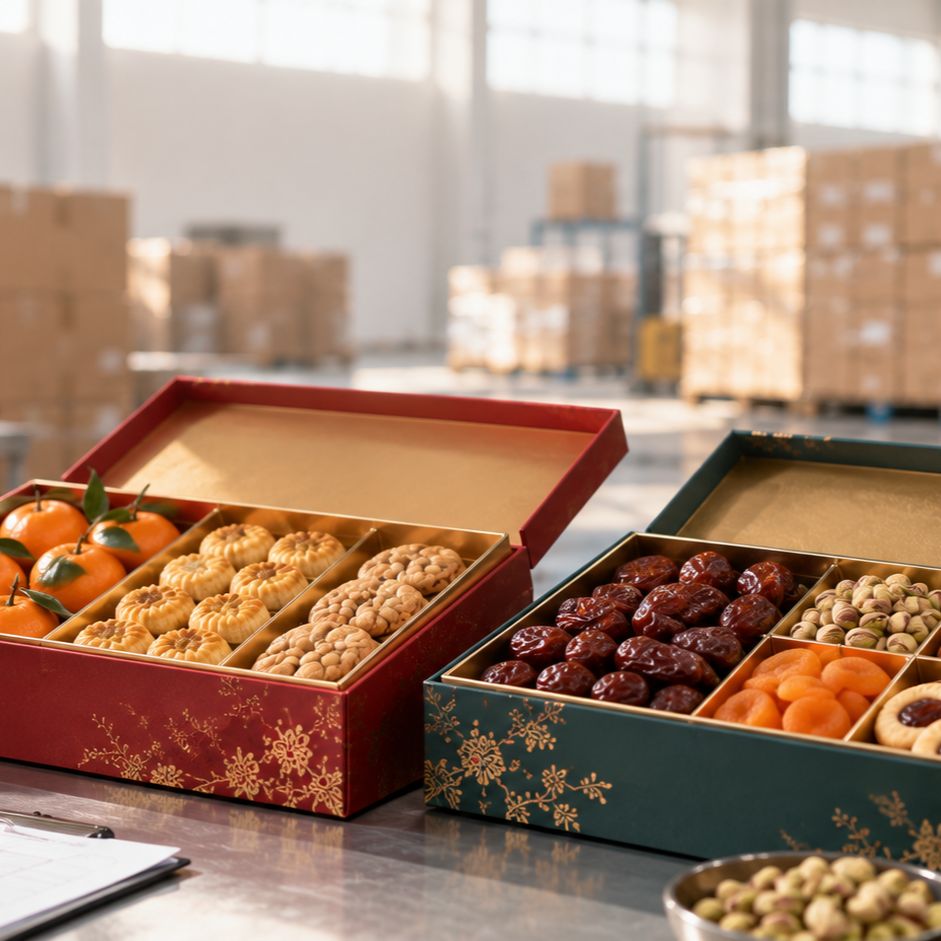
- Select versatile packaging (e.g. premium red-and-gold gift boxes without year-specific or single-holiday branding) that works equally well as a CNY visiting gift and an Eid hamper item.
- Halal-certified sauces, hot pot bases and shared snack platters naturally cross over between CNY reunion dinners and Ramadan iftar meals.
Check 3: Demand Curves & Sell-Through Windows
- Chinese New Year Demand: Peak sales conclude shortly after the Lantern Festival (20 February 2027).
- Ramadan Demand: Continues through late February until Eid al-Fitr in early March 2027.
- Action: Size festival-specific SKUs to clear by mid-February, and ensure multi-occasion Ramadan lines carry sufficient remaining shelf life into March.
Summary Checklist
| Compliance Check | Southeast Asia Focus | Australia Focus |
| 1. Market Access | SKU-level halal certificates recognised by JAKIM, MUIS or BPJPH. | DAFF BICON compliance; halal status is voluntary. |
| 2. Dual-Occasion Formats | Multi-festival packaging, shared sauces and neutral gift packs. | Mainstream retail-friendly packaging suitable for multicultural crossover. |
| 3. Sell-Through Window | CNY sales to 20 February; Ramadan and Eid sales through early March. | Same demand timeline, plus peak-summer cold-chain management. |
The Jade Premium Approach: Secure Your 2027 Sourcing Window
Executing a compressed sourcing calendar requires early verification and reliable coordination with supply chain partners in China.
Established in 2014 as part of Yuhu Group (Hong Kong), Jade Premium is headquartered in Hong Kong with operational offices in Shenzhen, Guangzhou, Shanghai, Chengdu, Wuhan and Changsha. We connect international importers with qualified Chinese food manufacturers operating under HALAL, HACCP, ISO22000 and FDA quality frameworks.
As your trusted halal food supplier and sourcing partner in China, Jade Premium delivers:
- SKU-Level Halal Verification: Verifying that product scope, ingredient sources and manufacturing lines comply with target destination standards (JAKIM, MUIS, BPJPH).
- Production Slot Reservation: Booking production runs early with manufacturers to avoid pre-Lunar New Year factory logjams.
- End-to-End Export Documentation: Preparing market-specific regulatory paperwork and biosecurity documentation prior to export, mitigating customs clearance risks in Southeast Asia and Australia.
In 2027, festive sourcing success is not just about identifying products; it is about verifying compliance and securing production early. Contact Jade Premium today to plan your 2027 Ramadan and Chinese New Year food import strategy.