
What a Hong Kong Selection Event Reveals About Demand in Singapore and Southeast Asia
- Why Hong Kong Is a Bellwether for Chinese Food Suppliers in Asia
- From Spec Sheet to Tasting Table: What Is Driving the Shift
- Beyond Hong Kong: How the Trend Maps to Singapore and Southeast Asia
- Category Spotlight: Three Mainland Categories with Cross-Market Appeal
- Looking Ahead: One Tasting Table, Several Markets
On 12 September 2026, nearly 20 handpicked suppliers and buyers gathered at the Yuhu Cold Chain (Guangzhou) Trading Centre for the invitation-only Jade Premium Product Selection Event for the Hong Kong Market. The tasting tables ran from har gow and salted egg custard buns to garlic crayfish, steamed jade perch and caviar served on crackers with soft cream cheese. Each item was presented by its supplier, tasted by buyers and assessed on the spot.
What those buyers chose is more than a shopping list for one city. Hong Kong is often where mainland Chinese food products are tested before they travel further across Asia. The categories that drew the most serious interest were Qianjiang crayfish, signature dim sum and Chinese caviar. Together, they point to where Chinese food suppliers are likely to find demand next: Singapore, Malaysia and the wider Southeast Asian region.
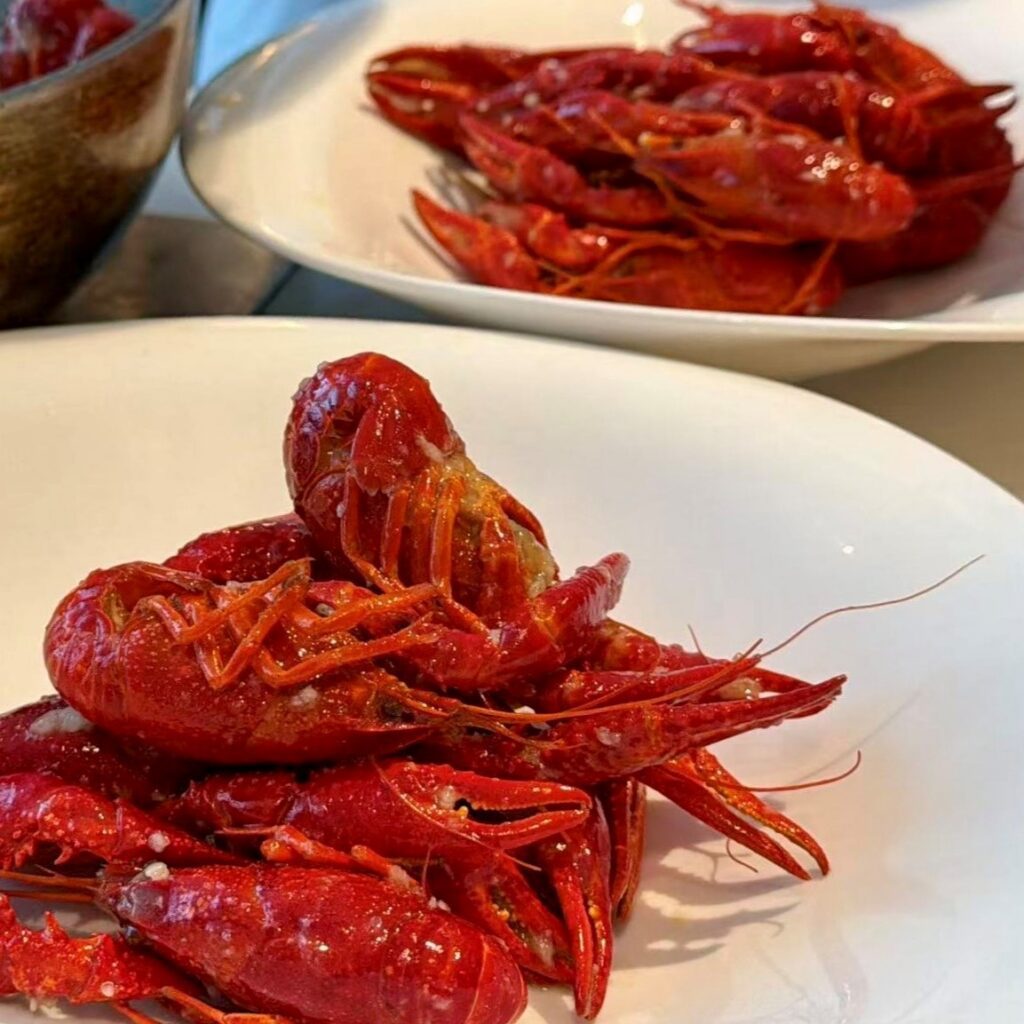
Freshly cooked whole crayfish piled on white plates at the Jade Premium Product Selection Event in Guangzhou, representing the regional Chinese seafood categories drawing buyer interest.
Why Hong Kong Is a Bellwether for Chinese Food Suppliers in Asia
Hong Kong works as an early signal for Asian demand because it combines near-total import dependence, long familiarity with mainland flavours and a role as a regional re-export hub. According to the US Department of Agriculture’s Agricultural Trade Office in Hong Kong, the city’s 7.5 million residents rely on imports for over 90% of their food. Hong Kong’s agricultural imports reached USD 24 billion in 2024, with mainland China the largest supplier at USD 7.6 billion. Around USD 10 billion of that total was re-exported to nearby markets, including Vietnam.
Singapore shares the same structural profile. The Singapore Food Agency reports that Singapore imports more than 90% of its food, drawn from 187 countries and regions. Both cities therefore depend on suppliers who can deliver consistent quality at scale, across a border and through a cold chain.
The palate overlaps too. Cantonese dim sum is everyday food in Hong Kong, Singapore, Kuala Lumpur and Penang. Chilli-forward and numbing-spicy flavours from central and western China have also moved well beyond specialist restaurants across the region. A product that earns its place with a Hong Kong buyer has already passed a test that buyers elsewhere in Asia would apply in much the same way.
That is the logic behind the Guangzhou event. Jade Premium, a Hong Kong-based food sourcing and export company within Yuhu Group (Hong Kong), matched every invitation to an active buyer brief rather than filling the room with general exhibitors.
From Spec Sheet to Tasting Table: What Is Driving the Shift
Two shifts are driving mainland regional foods into Asian import channels. Suppliers can now deliver them in consistent, export-ready formats, and buyers increasingly want to judge them in person before committing.
On the supply side, processing and farming technology have removed much of the variability that once kept regional dishes local:
- Standardised seasoning means a garlic or mala sauce tastes the same in every batch.
- Quick-freezing holds texture through long-distance shipping.
- Year-round supply is replacing seasonal harvests. According to People’s Daily, Qianjiang held its first winter crayfish harvest in December 2024, marking a shift from a seasonal product to year-round supply.
On the buying side, the way products are selected is changing. The Guangzhou event reflected three practices that are becoming more common:
- Curating the guest list against live buyer briefs, so every conversation starts with a genuine requirement.
- Evaluating product experience in person, because texture, aroma and portion size rarely survive translation into a specification sheet.
- Compressing negotiation, turning weeks of samples and emails into one decisive conversation.
Governments in the region recognise the value of this approach. The Singapore Food Agency lists sourcing trips and business matching for local importers among its tools for diversifying food supply. Tasting-led selection does not replace due diligence, however. Buyers still need the factory verification and documentation checks set out in our risk framework for sourcing Chinese food products.
Beyond Hong Kong: How the Trend Maps to Singapore and Southeast Asia
The categories that performed in Guangzhou travel best to markets with a large Cantonese or Chinese-heritage dining culture, but each market carries its own entry conditions.
| Market | Taste Affinity | Strongest-Fit Categories | Key Consideration |
| Hong Kong | Cantonese staples plus growing appetite for mainland regional flavours | Dim sum, crayfish, spicy seafood, caviar | Import documentation under Centre for Food Safety rules; retail freezer space is at a premium |
| Singapore | Mature yum cha culture and an established mala dining scene | Dim sum, crayfish, caviar for hotels and gifting | Import licensing through the Singapore Food Agency, with accredited sources required for higher-risk categories |
| Malaysia | Strong Chinese-heritage dining in Kuala Lumpur, Penang and Johor | Seafood-based dim sum, crayfish | Pork-containing items are restricted to non-halal channels; JAKIM halal certification widens reach |
| Wider Southeast Asia | Varies by market; Vietnam already receives Hong Kong re-exports | Crayfish, caviar, premium frozen seafood | Labelling language and registration rules differ market by market |
Two practical points follow from the table:
- Dim sum ranges need market-specific versions. Pork-based items such as siu mai suit Hong Kong and Singapore, while seafood or plant-based versions reach further in Malaysia.
- Cold chain continuity decides whether a product arrives as tasted. Frozen and chilled goods moving through Hong Kong or directly from southern China must hold temperature at every handover. This is the kind of end-to-end scope a certified exporter should be handling.
Category Spotlight: Three Mainland Categories with Cross-Market Appeal
Qianjiang Crayfish and Spicy Regional Seafood
Qianjiang, in Hubei province, is China’s best-known crayfish origin.
According to People’s Daily, Qianjiang is home to 48 crayfish processing companies above designated size, with an annual processing capacity of 800,000 tonnes and an output value of RMB 27 billion. That scale supports export-ready formats such as mala crayfish tails and garlic crayfish tails, both liquid-nitrogen frozen at -190°C — a process the manufacturer states preserves over 97% of the product’s original texture and nutritional profile after thawing. Both are pre-seasoned and ready to heat by microwave or stir-fry, and are already certified for export to Hong Kong and the EU. The Qianjiang crayfish presented in Guangzhou is already set to enter the Hong Kong market.
The tasting tables also showed how far the flavour family stretches:
- Buckwheat noodles tossed with mala crayfish tails
- Butterflied fish belly and steamed fish head, both finished with chopped chillies
- Garlic crayfish
Formats like these suit supermarket freezers, online grocery and casual dining in Hong Kong and Singapore alike. Buyers weighing peak-season timing can find more detail in our wholesale guide to sourcing certified frozen crayfish.
Signature Dim Sum and Cantonese Bakery
Dim sum was the most familiar category on the tables and, for exactly that reason, one of the most commercially reliable. Har gow, siu mai, lo mai gai, salted egg custard buns, chicken feet in black bean sauce and rose and red date cake need no introduction to shoppers in Hong Kong, Singapore or Kuala Lumpur.
What buyers are testing now is execution. The questions are how well a frozen har gow wrapper holds after steaming, and whether a custard bun flows as it should. Several signature dim sum lines moved from tasting into serious commercial discussion at the event. Buyers serving halal or flexitarian customers can look at plant-based Chinese dim sum as a way to extend the same format into new channels. The wider ready-to-cook Chinese bakery category is growing alongside it.
Chinese Caviar
Caviar is the category where perceptions of Chinese supply have shifted furthest.
China Daily, citing the Chinese Academy of Agricultural Sciences, reported in January 2026 that China’s output accounts for more than half of global farmed caviar production. For Asian buyers, that means premium roe from a supply base close to home rather than from Europe.
In Guangzhou, caviar was served on crackers with soft cream cheese. The format shows how it can move beyond fine dining into hotel banqueting, festive gifting and premium retail. The category drew strong buyer interest at the event, particularly for seasonal gifting windows in Hong Kong and Singapore. Buyers should confirm species, grade and chilled-storage requirements for each product, since caviar is far less forgiving of temperature variation than frozen seafood.
Looking Ahead: One Tasting Table, Several Markets
The Guangzhou event was designed for Hong Kong buyers, but its lessons carry further. The categories that held attention in the room share a palate with Singapore, Malaysia and much of Southeast Asia: crayfish with regional heat, dim sum executed well, and caviar at an accessible price point.
As more mainland regional foods reach export-ready consistency, the competitive question for Asian importers shifts from finding products to selecting the right ones and landing them intact.
Business matching is only as valuable as what happens after the handshake. For buyers across the region, the advantage will sit with verified Chinese food suppliers and partners who can carry a product from the tasting table through compliance and cold chain into more than one market. A broader range of premium Chinese food is following the same path.
Related Articles
Continue exploring the market trends shaping the global food industry.
Frozen Vegetarian Dumplings and Vegan Steamed Buns: Plant-Based Chinese Dim Sum