
How New Formats Are Giving International Vegetarians More Ways to Eat
- From Temple Kitchens to the Global Freezer Aisle
- Beyond Salad and Tofu: The Authentic Asian Alternative to Meat Analogs
- A Broader Buyer Base: Retail, Foodservice, and Regional Momentum
- Product Spotlight: Export-Ready Frozen Vegetarian Dumplings & Buns
- Looking Ahead: Where Vegetarian Dumplings and Buns Go Next
From Temple Kitchens to the Global Freezer Aisle
Vegetarian dumplings and steamed buns, long associated with Buddhist temple kitchens and festival tables, are now finding a place on mainstream frozen retail shelves alongside conventional dim sum. For decades, the category served a narrow, largely domestic audience of religious vegetarians and diaspora shoppers who already knew what they were looking for. That audience still exists, but it is no longer the only one buying.
The shift mirrors a much larger movement in global food retail. The global plant-based food market was valued at USD 238.25 billion in 2025 and is projected to grow to USD 256.64 billion in 2026, reaching USD 491.24 billion by 2034 at a compound annual growth rate of 8.47%.1 That growth is no longer concentrated in the meat-analogue and dairy-alternative segments that first defined the plant-based conversation. It is spreading into staple, format-driven categories — the kind of everyday convenience foods that do not need to explain what “plant-based” means, because the format itself is already familiar.
Why frozen vegetarian dumplings and buns fit this shift:
- Universal familiarity — a dumpling or steamed bun uses the same folded-dough format found in Italian ravioli, Polish pierogi and Latin American empanadas, so the format itself needs no introduction even where the cuisine does.
- No format education required — only the filling is new to most Western shoppers; the eating format itself is already trusted.
- Advanced freeze-format engineering — cooked-dough and cooked-skin techniques keep the wrapper intact and glossy through freezing, shipping and reheating.
Jade Premium works with vegetarian food producers across its Fujian-based sourcing network to bring that product quality, alongside proper documentation, to international buyers evaluating the category for the first time.
Beyond Salad and Tofu: The Authentic Asian Alternative to Meat Analogs
For a large share of the world’s vegetarians and flexitarians, the everyday problem is not a lack of commitment to eating less meat — it is a lack of variety in what “vegetarian” actually offers to eat. Committed vegetarians and vegans remain a minority of the global population, but the audience actively reducing meat is far larger: 27% of Europeans and 37% of Americans now identify as flexitarian, while 48% of people in the UK and 51% across Europe say they are actively cutting back on meat.2 That is a substantial addressable market, and consumer research consistently points to the same complaint: vegetarian diners are often limited to the same one or two dishes on a menu, night after night, rather than lacking the desire to eat this way.
| Category | The Value Proposition for International Shoppers |
| Western Meat Substitutes | Aims to replicate meat’s taste and texture as closely as possible. |
| Plant-Based Chinese Dim Sum | A distinct eating occasion drawing on centuries of naturally vegetarian culinary craft — no meat imitation required. |
That distinction is what lets Chinese vegetarian dim sum earn the word “new” rather than simply joining a crowded meat-analogue category — it draws on an entirely different, already-vegetarian culinary tradition rather than trying to imitate one.
Key formulation advances making this possible internationally:
- Cooked-dough and cooked-skin technology — keeps wrappers glossy and intact through steaming or boiling, eliminating splitting.
- Zero-defrost preparation — select formats go straight from freezer to steamer, cutting preparation time to around ten minutes.
A Broader Buyer Base: Retail, Foodservice, and Regional Momentum
The buyer base for vegetarian dumplings and buns is no longer limited to religious vegetarian consumers and Asian grocery specialists — it now spans mainstream retail, foodservice and diaspora-focused channels, each finding a different reason to list the category.
- Retail buyers are responding to a frozen aisle that has broadened considerably in recent years. Supermarket chains across Europe and Australasia have moved plant-based frozen products out of small, dedicated vegan sections and into general frozen aisles, positioning them alongside conventional convenience food rather than as a separate diet category — a shift already reshaping how ready-to-cook Chinese snacks and other frozen Asian formats are merchandised internationally.
- Foodservice operators are drawn to the speed advantage. A steamed dumpling that goes from freezer to plate in around ten minutes with no thawing step fits quick-service breakfast and light-meal formats far more easily than a product requiring overnight defrosting.
- Distributors serving diaspora and Asian grocery channels are seeing renewed cultural momentum behind the category. Taiwan’s Ministry of Agriculture, for example, has been running a four-month plant-based festival in Singapore through September 2026, pairing Taiwanese producers with local chefs to introduce Asian plant-based formats to a wider regional audience — a reminder that Southeast Asia’s demand for authentic vegetarian Chinese staples is being actively cultivated, not just assumed.
| Merchandising tip for Western retailers: Steamed buns (bao) may need a small amount of on-pack preparation guidance for first-time buyers — a modest merchandising cost, and considerably lower than introducing an unfamiliar meat-analogue product from scratch. |
Product Spotlight: Export-Ready Frozen Vegetarian Dumplings & Buns
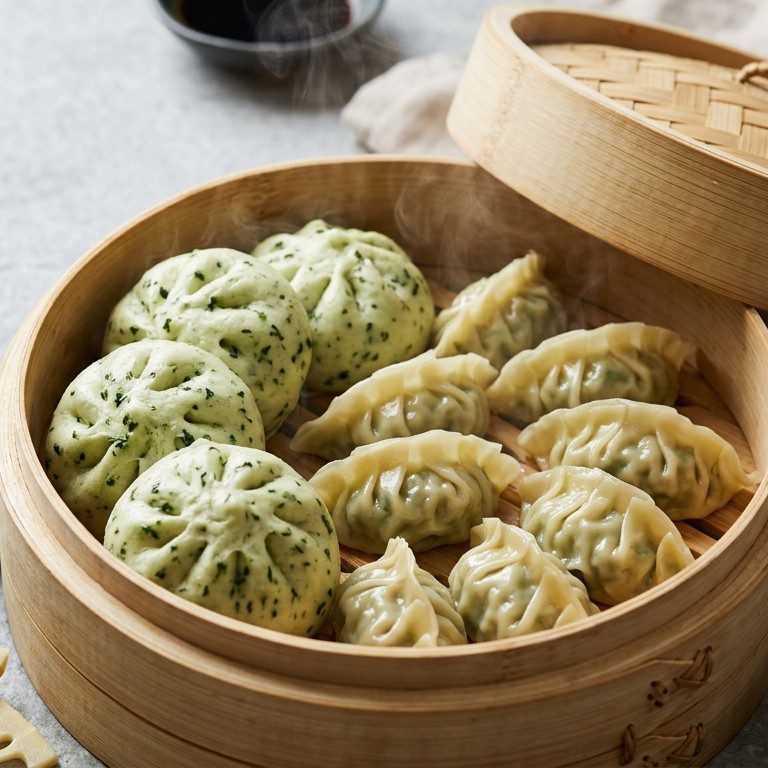
Jadeite Vegetarian Dumplings
Built for buyers who want flavour complexity rather than a plain vegetable filling, the Jadeite Vegetarian Dumplings combine three types of mushroom with four types of vegetable for a filling described by the manufacturer as rich in mushroom aroma and layered in texture. Extra virgin olive oil is added to keep the filling light rather than greasy, and the dumplings are made using a cooked-dough process with premium wheat flour, which helps the wrapper hold together during steaming or boiling rather than splitting, resulting in a smoother, glossier finish. The producer behind this range holds HACCP certification and is based in Fujian province.
Key product characteristics include:
- Three-mushroom, four-vegetable filling for a layered flavour profile
- Extra virgin olive oil for a lighter, less greasy finish
- Cooked-dough technique for a smoother, more resilient wrapper
- 235g per pack, 30 packs per carton
Kale & Bamboo Shoot Steamed Bun
Where the dumplings above lead with flavour, the Kale & Bamboo Shoot Steamed Bun leads with ingredient sourcing. The filling combines fresh kale with crisp bamboo shoot, seasoned with an organic condiment made from 100% organic, non-GMO, vegan ingredients. Kale itself needs little introduction for Western buyers: it has been a familiar fixture of fresh produce aisles and salad ranges for over a decade, valued for its vitamin K, vitamin C and fibre content, which gives this bun a recognisable health halo before a shopper even reads the ingredient panel. The flour is stone-ground from whole wheat using a traditional slow-milling process intended to preserve more of the grain’s natural aroma. The same HACCP-certified, Fujian-based producer states the product is non-detectable for 400 pesticides and five heavy metals, with zero additives.
Key product characteristics include:
- Non-detectable for 400 pesticides and 5 heavy metals, per manufacturer testing
- Zero additives
- Stone-ground whole wheat flour and organic seasoning
- 300g per pack, 30 packs per carton
Whole Wheat Kale & Bamboo Shoot Dumplings
Where the steamed bun above leads with ingredient sourcing, the Whole Wheat Kale & Bamboo Shoot Dumplings lead with convenience. Built on the same pairing of kale and crisp bamboo shoot, they use a cooked-skin technique that lets the dumplings go straight from freezer to steamer — no thawing required — and reach a fully cooked, chewy texture in around ten minutes. The filling is positioned as high-fibre and comparatively low-calorie, suited to quick breakfast or light-meal-replacement occasions rather than a traditional sit-down dim sum service.
Key product characteristics include:
- Cooked-skin technology; no thawing required
- Ready to eat in around 10 minutes
- High-fibre, comparatively low-calorie filling
- 235g per pack, 30 packs per carton
At a Glance: Product Comparison
| Product Name | Key Ingredients | Technical Feature | Packaging |
| Jadeite Vegetarian Dumplings | 3 mushrooms + 4 vegetables, extra virgin olive oil | Cooked-dough technique (crack-resistant) | 235g/pack; 30 packs/carton |
| Kale & Bamboo Shoot Steamed Bun | Fresh kale, bamboo shoot, stone-ground whole wheat | Zero additives; tested for 400 pesticides & 5 heavy metals | 300g/pack; 30 packs/carton |
| Whole Wheat Kale & Bamboo Shoot Dumplings | Kale, bamboo shoot, whole wheat wrapper | Cooked-skin tech; no thawing needed | 235g/pack; 30 packs/carton |
| Sourcing vegetarian dumplings or steamed buns for your market? Contact Jade Premium’s team today to discuss sourcing options and request documentation for this category. |
Looking Ahead: Where Vegetarian Dumplings and Buns Go Next
Vegetarian dumplings and steamed buns were never really a niche product — they were a mainstream, universally recognised format that happened to be sold through a narrow set of channels. What has changed is the range of genuine choice now available inside that format: fillings and flavour combinations that give the world’s growing flexitarian and vegetarian audience something to reach for beyond the same handful of dishes, backed by freezing technology that finally lets a frozen product match a fresh one on texture.
Turning that choice into a shelf-ready listing is a separate discipline from finding it. Jade Premium supports that step with SKU-level certification, pesticide and heavy-metal screening, and cold-chain verification across its Fujian-based sourcing network — the documentation that lets a buyer move from sample to purchase order with confidence. Working with a supplier who can produce that verification, not just the product, is what will separate a listing that performs from one that quietly gets delisted at the next range review.
Related Articles
Continue exploring the latest market trends shaping the global food industry.
The New Generation of Plant-Based Foods: More Variety, More Flavour, More Possibilities
Vegan Food Trends 2026: What Asia’s Biggest Vegetarian Expos Reveal About Your Next Grocery Aisle