
Executive Summary for US Importers
- FD&C Red No. 3 can no longer be used in US food from 15 January 2027; Red 40, Yellow 5, Yellow 6, Blue 1, Blue 2 and Green 3 remain legal under a voluntary phase-out.
- California bans Red No. 3 from 1 January 2027; West Virginia and Arizona bar seven dyes from school food; Texas’s warning-label law is partly on hold in court.
- On every Chinese label, check that each certified colour is named in full, is on FDA’s permitted lists and comes from an FDA-certified batch
In the United States, an artificial colour is now a labelling liability. In late September 2026, PepsiCo began recalling 122,021 cases of 28-ounce Gatorade bottles because the drinks contained Yellow No. 5 and/or Yellow No. 6 that the labels did not declare; FDA classified the recall as Class II on 2 October, according to the agency’s Enforcement Report1. Both dyes are legal in US food. The recall happened because the label did not name them.
As federal and state deadlines converge on 2027, that distinction plays out differently for each importer of Chinese food:
- Retail importers in California must clear Red No. 3 stock from shelves by 1 January 2027, two weeks before the federal food deadline.
- Foodservice distributors in Arizona can no longer supply school campuses with products containing any of seven synthetic dyes.
- Importers building a national range of private label food sourced from China need one formula that works in their strictest market.
What makes artificial colours hard to manage is that three kinds of rule move at different speeds: a federal ban, a federal request with no force of law, and state laws partly paused by the courts. As our analysis of why clean label is not a regulation showed, buyer expectations and legal obligations differ; this article works from the legal texts.
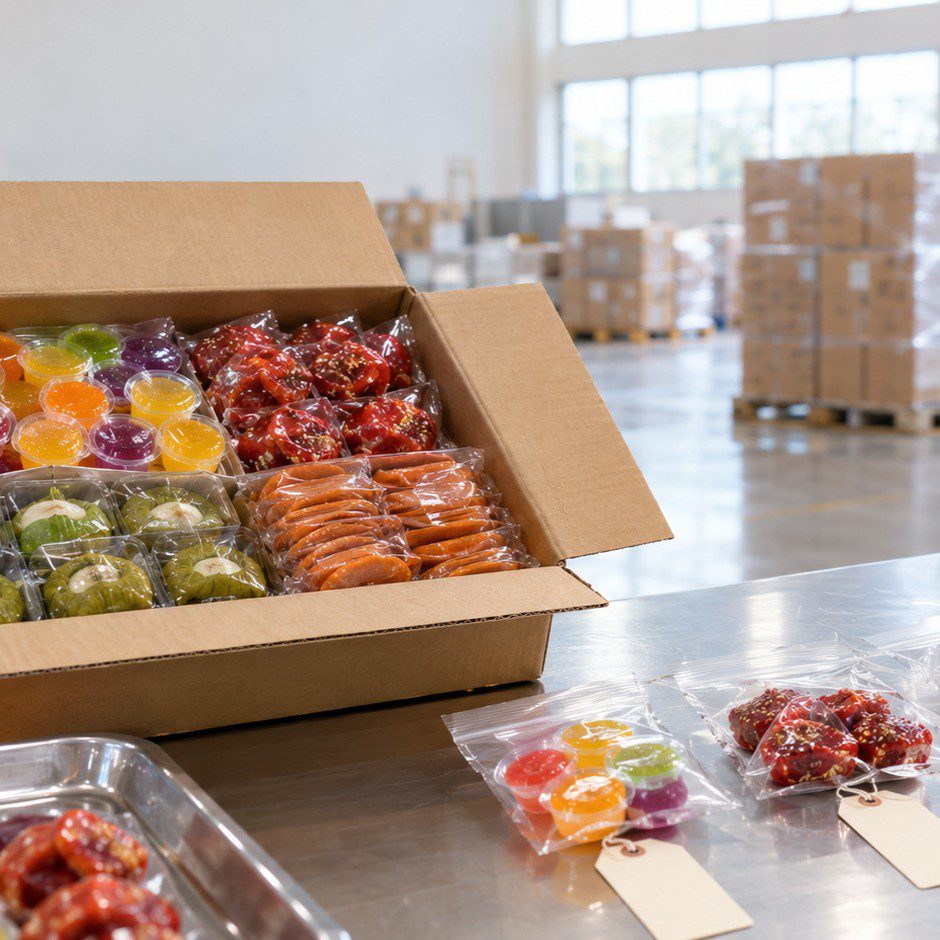
Three Legal Statuses for Artificial Colors That Importers Should Never Confuse
Only one widely used synthetic dye, FD&C Red No. 3, is being removed from US food by law; the six other petroleum-based dyes remain legal and are the subject of a voluntary phase-out. Confusing the two leads either to needless reformulation or to unsellable stock.
| Legal status | Colours | Key date |
| Revoked by FDA order | FD&C Red No. 3 | Food: 15 January 2027. Ingested drugs: 18 January 20282 3 |
| Revoked by FDA order | Orange B (sausage casings only) | Final order issued July 20264 |
| Proposed revocation | Citrus Red No. 2 (orange peel only) | Comment period closed 24 August 2026 |
| Voluntary phase-out | Red 40, Yellow 5, Yellow 6, Blue 1, Blue 2, Green 3 | Target: end of 2026. No legal deadline5 |
An objection stayed the Red No. 3 order in 2025, but FDA lifted the stay on 5 August 2026 and confirmed the original dates. One detail matters for stock planning: the order states that food coloured with Red No. 3 while the colour’s certificate was still effective will not be treated as adulterated for that reason. Federally, the production date counts. The six-dye phase-out, by contrast, is only a request to industry.
Federal Rules vs the State-by-State Patchwork on Artificial Colors
Four states have enacted synthetic dye laws, but as of October 2026 only California’s Red No. 3 ban and the school-food rules in West Virginia and Arizona are certain to apply.
| State and law | What it does | Key date | Status, October 2026 |
| California, AB 418 | Bans making, selling or holding food containing Red dye 3 | 1 January 2027 | Applies from that date; penalties up to USD 10,000 per repeat violation6 |
| West Virginia, HB 2354 | Seven dyes barred from school meals, then statewide | Schools: 1 August 2025. Statewide: 1 January 2028 | School rule in force; statewide rule paused by a December 2025 injunction7 8 |
| Arizona, HB 2164 | Seven dyes barred from food sold or served on school campuses | 2026–27 school year | In force9 |
| Texas, SB 25 | Warning label for 44 ingredients, including all FDA-certified colours | Labels developed or copyrighted from 1 January 2027 | Enforcement barred against members of four trade associations since February 2026; under appeal10 11 |
Texas matters most for importers. Its statute covers any manufacturer offering food for sale in Texas, regardless of where the food was produced, with civil penalties of up to USD 50,000 per day per product. The injunction protects only members of the plaintiff associations.
Consider a New Jersey importer selling one jelly candy coloured with Red 40 into California, Texas and West Virginia. Federal law and California both allow it, but a new Texas label from 2027 could need a warning, and a West Virginia school customer could not take it at all. In practice, the strictest channel an importer sells into sets the formula for every channel.
What a Compliant US Label Must Say About Artificial Colors
Under 21 CFR 101.22(k)(1), every FDA-certified colour must be listed in the ingredient statement by its regulatory name, such as “Red 40” or “Yellow 5 Lake”; a generic term such as “Artificial Color” is not enough12. The “FD&C” prefix and “No.” may be dropped, but “Lake” must stay.
Generic wording is allowed only under paragraph (k)(2), for colours exempt from certification such as beet or turmeric. And because 21 CFR 101.22(a)(4) defines “artificial color” as any color additive, even a product coloured with vegetable juice is not automatically entitled to a “no artificial colours” claim. Beyond our guide to how a Chinese ingredient list is rewritten for the US market, the recurring colour errors are:
- E-numbers or foreign designations (E129, E102) instead of US names
- Trade names alone, such as “Allura Red” without “Red 40”
- Colours hidden in sub-ingredients such as sprinkles, glazes or fillings
- Lake pigments listed without the word “Lake”
Non-Permitted Food Colors to Watch in Chinese Imports, and the Products That Carry Them
For importers of Chinese food, the larger border risk is not Red No. 3 but colours the US does not permit at all, and permitted dyes made outside FDA’s certification system. FDA’s Import Alert 45-02, revised on 8 October 2026, tells inspectors to detain foods labelled with EU-style or other foreign colour designations, because certified colours in imported food must come from FDA-certified batches13. The same molecule as Red 40, from an uncertified batch, is still an illegal colour.
| Colours | US status | Products where buyers should ask |
| Ponceau 4R, amaranth, Orange II, Red 2G | Not permitted in US food | Red melon seeds and haw (hawthorn) products from China are named on the import alert; also red candies |
| Red 40, Yellow 5, Yellow 6, Blue 1 or Blue 2 from uncertified batches | Permitted only from FDA-certified lots | Hard and jelly candies, flavoured drinks and drink powders, puffed snacks |
| Red yeast rice (monascus) red, gardenia yellow, safflower yellow | Not listed in 21 CFR Part 73 | Barbecue-style glazes, red fermented bean curd, Chinese-style sausages, coloured fillings14 |
| Sodium copper chlorophyllin | Permitted only in citrus-based dry beverage mixes, up to 0.2% | Green pastries and fillings, green tea-style sweets |
“Natural” is not a US legal category: a plant-derived colour is usable only if 21 CFR Part 73 lists it for that food. Separately, dried preserved fruit from Hong Kong, mainland China, Taiwan and Singapore faces detention under Import Alert 21-04 for illegal and undeclared colours. Importers of preserved fruit and vegetable products or Chinese snack products should request a full colour declaration before approving samples.
The US Importer’s Pre-2027 Checklist for Artificial Colors
Before 2027, US importers of Chinese food should be able to answer five questions for every SKU.
- Which colours does the full recipe contain? Get a written declaration covering every sub-ingredient, not just the finished label.
- Is each certified colour from an FDA-certified batch? Request the lot numbers, which FDA’s Color Certification Branch can confirm.
- Which states and channels will it reach in 2027? Map California retail, school foodservice and new Texas labels before the next print run.
- Does the label name each colour as 21 CFR 101.22 requires? Replace E-numbers and trade names, and avoid unsupported “no artificial colours” claims.
- If a colour is replaced, has shelf life been retested? Natural colours can fade faster, a trade-off covered in our analysis of clean label shelf life.
How do importers turn a moving regulatory target into a label that holds up at the border? Jade Premium, established in 2014 as part of Yuhu Group (Hong Kong), works with Chinese manufacturers across HALAL, HACCP, ISO22000 and FDA certification frameworks. For buyers importing Chinese snacks to the US, that means checking colour declarations and label drafts against destination rules before a purchase order is raised, part of the end-to-end scope a certified exporter should handle and of our risk framework for sourcing Chinese snacks.
The 2027 deadline is not really about one red dye. It is about whether every colour on a label can be traced, named and defended in each market a product reaches.
Disclaimer: This article is for general information only and does not constitute legal advice. Positions are summarised as of 9 October 2026 and may change, particularly where court proceedings are ongoing. Confirm requirements with qualified regulatory counsel before making labelling or formulation decisions.
Related Articles
Continue exploring the insights shaping global food sourcing decisions.
Clean Label Shelf Life: How Much Is Left When Your Product Reaches the Shelf
- NBC News, “More than 122,000 cases of Gatorade recalled across the country”, October 2026, reporting FDA’s weekly Enforcement Report. https://www.nbcnewyork.com/news/recall-alert/gatorade-recalled-undeclared-food-dye-what-to-know/6555741/ ↩︎
- FDA, Color Additive Petition from Center for Science in the Public Interest et al.; Request to Revoke Color Additive Listing for Use of FD&C Red No. 3 in Food and Ingested Drugs, 90 FR 4628, 16 January 2025. https://www.federalregister.gov/documents/2025/01/16/2025-00830/color-additive-petition-from-center-for-science-in-the-public-interest-et-al-request-to-revoke-color ↩︎
- FDA, Micro-Tracers, Inc.; Response to Objections and Requests for a Public Hearing, 91 FR 50475, 5 August 2026. https://www.federalregister.gov/documents/2026/08/05/2026-15920/micro-tracers-inc-response-to-objections-and-requests-for-a-public-hearing ↩︎
- FDA press release, “FDA Takes Further Steps to Remove Outdated Authorizations for Color Additives in Food”, 22 July 2026 (Docket FDA-2026-N-6304). https://www.biospace.com/press-releases/fda-takes-further-steps-to-remove-outdated-authorizations-for-color-additives-in-food ↩︎
- FDA press release, “HHS, FDA to Phase Out Petroleum-Based Synthetic Dyes in Nation’s Food Supply”, 22 April 2025. https://www.fda.gov/news-events/press-announcements/hhs-fda-phase-out-petroleum-based-synthetic-dyes-nations-food-supply ↩︎
- California Assembly Bill 418, California Food Safety Act (Chapter 328, Statutes of 2023), chaptered text. https://leginfo.legislature.ca.gov/faces/billTextClient.xhtml?bill_id=202320240AB418 ↩︎
- West Virginia Legislature, Enrolled Committee Substitute for House Bill 2354 (2025 Regular Session), amending §16-7-2 and adding §18-5D-3A. https://www.wvlegislature.gov/Bill_Status/bills_text.cfm?billdoc=hb2354%20sub%20enr.htm&yr=2025&sesstype=RS&i=2354 ↩︎
- Preliminary injunction granted on 23 December 2025 by the US District Court for the Southern District of West Virginia, as reported by Venable LLP, “Federal Court Pauses West Virginia’s Plan to Ban Artificial Food Dyes”, 23 January 2026. https://www.venable.com/insights/publications/2026/01/federal-court-pauses-west-virginias-plan-to-ban ↩︎
- Arizona Legislature, House Bill 2164 (Arizona Healthy Schools Act), adding A.R.S. §15-242.01. https://www.azleg.gov/legtext/57leg/1R/bills/HB2164H.htm ↩︎
- Texas Legislature, Senate Bill 25 (89th Legislature), enrolled text, Section 9 (Health and Safety Code §§431.0815–431.0817) and Section 19. https://capitol.texas.gov/tlodocs/89R/billtext/html/SB00025F.htm ↩︎
- Preliminary injunction granted on 11 February 2026 by the US District Court for the Western District of Texas, as reported by Covington & Burling LLP, February 2026; appeal to the Fifth Circuit filed 5 March 2026, as reported by Haynes Boone, 7 March 2026. https://www.cov.com/news-and-insights/insights/2026/02/court-enjoins-texas-sb-25-food-label-warning-requirement ↩︎
- 21 CFR 101.22 (Foods; labeling of spices, flavorings, colorings and chemical preservatives), eCFR. https://www.ecfr.gov/current/title-21/chapter-I/subchapter-B/part-101/subpart-B/section-101.22 ↩︎
- FDA Import Alert 45-02, “Detention Without Physical Examination and Guidance of Foods Containing Illegal and/or Undeclared Colors”, revised 8 October 2026. https://www.accessdata.fda.gov/cms_ia/importalert_118.html ↩︎
- 21 CFR Part 73, Subpart A (Listing of Color Additives Exempt from Certification: Foods), eCFR. https://www.ecfr.gov/current/title-21/chapter-I/subchapter-A/part-73/subpart-A ↩︎