
- The Chinese Bakery Wave Hits Singapore
- Why Singapore? The Gateway Effect
- What Makes Chinese Bakery Different? The Texture Revolution
- The Ingredient Factor: Why Quality Matters More Than Ever
- Beyond the Storefront: The Untapped Opportunity in Packaged Chinese Bakery
- A Ready-to-Ship Example: Beryoocook Classic Original Swiss Roll Cake
- Going Further: Custom Chinese Bakery Products Built for Singapore
- How Jade Premium Bridges the Gap
- What Comes Next for Chinese Bakery in Singapore
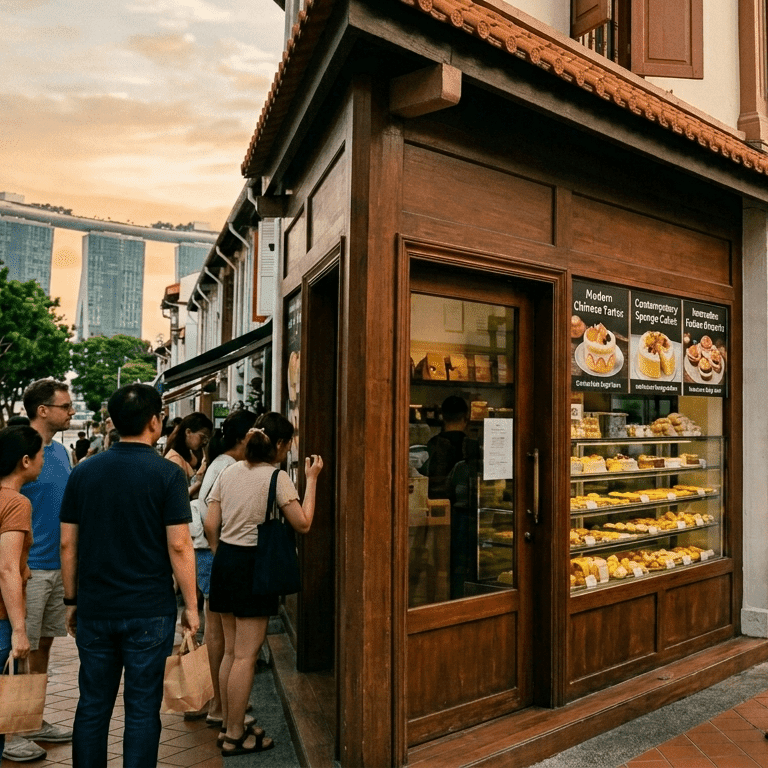
Singapore has long been celebrated as one of Asia’s greatest food capitals—a city where Michelin-starred restaurants coexist with hawker stalls, and where culinary traditions from across the continent converge on a single island. In recent years, however, a new force has been quietly transforming the city’s dessert landscape: Chinese bakery and pastry brands. From viral pork floss cakes at Paya Lebar to cloud-like soufflé pancakes in Somerset and Cantonese tong sui at Funan, Singapore is experiencing an unprecedented wave of Chinese bakery culture, and it is changing what Singaporeans expect from their sweet treats.
The Chinese Bakery Wave Hits Singapore
The numbers tell a compelling story. According to Reuters, approximately 85 Chinese food and beverage brands were operating around 405 outlets in Singapore as of August 2025—more than double the count from just a few years earlier. While much of the media attention has focused on bubble tea giants like Mixue and Chagee, or coffee challenger Luckin Coffee, the bakery and dessert segment has been staging its own remarkable invasion.
In May 2025, Bao’s Pastry, one of China’s most talked-about bakery chains, opened its first-ever overseas outlet inside Scarlett Supermarket at Paya Lebar Square. The brand’s signature Xiao Bei Crispy Seaweed Floss Cake—a pillowy chiffon-style bun stuffed with sweet cream and generously coated in pork floss and seaweed strips—immediately drew queues and went viral across TikTok and Instagram. Around the same time, Moe Moe’ Soft Soufflé, a chain with over thirty locations in China, launched at 111 Somerset with jiggly, impossibly fluffy soufflé pancakes in Hokkaido milk and matcha flavours that embodied the soft, airy textures Chinese and Japanese bakeries are famous for.
The momentum continued into late 2025 and early 2026. RUXU, a beloved Guangzhou dessert and bakery concept, chose Funan as its first international outpost, bringing modern Cantonese tong sui alongside small-batch bakes like caramel croissant tarts. Chan Susu, a heritage-style Chinese dessert brand, opened at Orchard Gateway in January 2026, offering a menu of slow-simmered pastes, shaved ice, and reimagined traditional sweets that had the Xiaohongshu community buzzing within days.
These are not isolated openings. They represent a structural shift: Chinese bakery is now a permanent and growing part of Singapore’s food ecosystem.
Why Singapore? The Gateway Effect
Singapore’s appeal as a launchpad for Chinese food brands goes beyond its ethnic Chinese majority. According to a March 2026 report by FoodNavigator Asia, Chinese brands view Singapore as a strategic testing ground for international expansion, thanks to the city-state’s diverse population, robust tourism flows, high per-capita spending on food, and stringent food safety standards that serve as a credibility benchmark for entering other markets.
Scarlett Supermarket, which has expanded to 41 outlets across Singapore since its founding in 2020, has become a particularly important partner in this ecosystem. The chain serves as a one-stop platform for Chinese brands seeking overseas shelf space, carrying products from major names like Yili, Nongfu Spring, Genki Forest, and Wanglaoji. In 2025, Kang Shi Fu (Master Kong) opened its first overseas brand pavilion at Scarlett’s Suntec City branch—a clear signal that Singapore has become the default first step for Chinese food brands looking beyond their home market.
Euromonitor’s data reinforces this trajectory: Southeast Asia is forecast to record the fastest packaged food compound annual growth rate in the Asia-Pacific through 2029, ahead of China, Japan, and South Korea. With a population exceeding 650 million, a median age of 31, and rising average incomes, the broader region represents enormous potential—and Singapore is the gateway.
What Makes Chinese Bakery Different? The Texture Revolution
To understand why Chinese bakery products are resonating so powerfully with Singaporean consumers, it helps to understand a fundamental difference in baking philosophy between East and West.
Western baking traditions tend to prize richness, density, and sweetness. A classic American layer cake is thick with buttercream; a French pastry showcases butter-laden laminated dough. Chinese and broader Asian baking, by contrast, has evolved around a different set of values: lightness, softness, moisture, and restrained sweetness. The ideal Chinese sponge cake is cloud-like in texture, barely sweet, and so tender that it practically dissolves on the tongue.
This is not a compromise or a lesser version of Western baking. It is a distinct aesthetic with deep roots in Chinese and Japanese confectionery traditions, where the texture of food—what the Chinese call “kǒugǎn”—is as important as flavour itself. A great Chinese bakery product should feel effortless to eat: soft, moist, airy, and never cloying.
This philosophy explains why products like soufflé pancakes, chiffon-style floss cakes, and cream-filled Swiss rolls have become the breakout stars of Singapore’s Chinese bakery boom. They deliver the sensory experience that Asian palates crave—indulgent enough to feel like a treat, light enough to enjoy any time of day, and sweet enough to satisfy without overwhelming.
The Asia-Pacific cakes market, valued at USD 11.72 billion in 2025, is expected to reach USD 18.78 billion by 2034 according to Market Data Forecast. Singapore’s own baked cake market, estimated at approximately SGD 250 million, is growing at a CAGR of around 6%. Within these figures, Asian-style soft cakes and light bakery products are among the fastest-growing sub-segments, driven by the very texture preferences that Chinese bakery brands are so skilled at delivering.
The Ingredient Factor: Why Quality Matters More Than Ever
As Chinese bakery gains mainstream acceptance in Singapore, discerning consumers are paying closer attention to what goes into these products. Singapore shoppers—especially younger, health-aware millennials and Gen Z consumers—are increasingly reading ingredient lists, questioning the use of artificial additives, and seeking products made with recognisable, high-quality components. This aligns with the broader global clean label movement, which has seen the clean label bakery market grow from USD 5.2 billion in 2025 to a projected USD 8.25 billion by 2031.
In the context of Chinese bakery, the most telling quality indicators are straightforward. The type of cream used matters enormously: pure animal cream (also known as fresh cream or whipping cream derived from real milk) delivers a smooth, naturally rich flavour that melts instantly on the palate, while plant-based cream substitutes—often made from hydrogenated vegetable oils—tend to leave a waxy, artificial aftertaste. The egg content matters too: bakeries using a high proportion of real eggs produce sponges that are genuinely moist and tender, while those that skimp on eggs and rely on emulsifiers and stabilisers produce cakes that feel rubbery or dry.
For Singaporean consumers who have grown up with high food standards and a sophisticated palate shaped by access to the best of multiple culinary traditions, these differences are immediately noticeable. The Chinese bakery brands that are winning in Singapore—the ones generating queues, social media buzz, and repeat visits—are overwhelmingly those that lead with ingredient quality.
Beyond the Storefront: The Untapped Opportunity in Packaged Chinese Bakery
While the spotlight has been on brick-and-mortar outlets, the larger commercial opportunity may lie in packaged Chinese bakery products distributed through supermarkets, convenience stores, and online retail channels. Not every consumer lives near a Bao’s Pastry or RUXU outlet. Not every moment calls for a trip to a dessert café. But the craving for soft, high-quality Chinese-style baked goods is constant—for office snacks, for children’s lunchboxes, for tea-time treats at home, and for the kind of convenient indulgence that fits into a busy Singaporean lifestyle.
The success of Scarlett Supermarket’s packaged snack sections—where TikTok haul videos and Lemon8 recommendation posts regularly go viral—proves that Singapore consumers are already enthusiastic buyers of imported Chinese bakery and confectionery through retail channels. The gap in the market is not demand; it is supply of products that match the quality standard set by the best storefront bakeries. A packaged Swiss roll or sponge cake purchased from a supermarket shelf must deliver the same softness, moisture, and genuine dairy flavour that consumers now benchmark against freshly baked alternatives. Anything less—dry texture, artificial cream, a synthetic aftertaste—and the product fails the expectation that Singapore’s Chinese bakery boom has created.
For Singapore-based retailers, distributors, and food importers, this creates a clear sourcing imperative: find manufacturers in China that can produce at commercial scale while maintaining the artisanal quality that defines the category’s best products. And beyond simply sourcing existing products, there is a growing opportunity to develop custom Chinese bakery lines—private label Swiss rolls, branded sponge cakes, or exclusive flavour variants tailored to local Singaporean preferences like pandan, gula melaka, or salted egg yolk—directly with Chinese manufacturers who have mastered the craft.
A Ready-to-Ship Example: Beryoocook Classic Original Swiss Roll Cake
For buyers looking to move quickly, the Beryoocook Classic Original Flavor Swiss Roll Cake offers a compelling proof of concept for what premium packaged Chinese bakery looks like.
Produced by Fujian Beryoocook Food Co., Ltd. and available for international procurement through Jade Premium, this Swiss roll is built around the same quality-first philosophy that drives Singapore’s favourite Chinese bakery outlets. The sponge contains over 37% high-quality pasteurized, non-antibiotic liquid egg—a proportion significantly higher than most commercial alternatives—resulting in the soft, tender, moist texture that defines great Chinese-style baking. The filling uses pure animal cream rather than plant-based substitutes, delivering the authentic dairy richness that melts smoothly on the palate without the cloying sweetness or waxy residue of cheaper formulations. An exclusive-formula wheat flour produces a fine-textured crumb with high elasticity and an optimal bubble ratio, making the roll noticeably lighter and fluffier than the stiff, coarse Swiss rolls that crowd many supermarket shelves.
What sets this product apart for Singapore buyers is its market readiness. It is produced at commercial scale with full food safety compliance, yet it delivers an eating experience that feels closer to a freshly baked bakery product than a factory-made snack. For importers looking to stock a premium Chinese-style Swiss roll alongside the wave of Chinese bakery brands sweeping Singapore, the Beryoocook roll represents a low-risk entry point with immediate shelf appeal.
Going Further: Custom Chinese Bakery Products Built for Singapore
The Beryoocook Swiss roll is one example, but the broader opportunity for Singapore buyers extends well beyond a single product. China is home to a vast and sophisticated bakery manufacturing base—over 50 certified partner factories in Jade Premium’s network alone—capable of producing virtually any style of Chinese bakery product at scale, from cream-filled sponge rolls and chiffon cakes to egg tarts, pork floss buns, and modern fusion pastries.
What many Singapore retailers, café chains, and distributors may not realise is that these manufacturers increasingly offer full OEM and private label services. This means a Singapore business does not have to sell someone else’s brand; it can work with a Chinese factory to develop its own exclusive product line. Imagine a local Singaporean brand launching a pandan-cream Swiss roll, a gula melaka soufflé cake, or a salted egg yolk floss bun—produced with the same world-class Chinese bakery technique and quality ingredients, but packaged under the buyer’s own brand, with custom packaging designed for the Singapore market.
The challenge, of course, is navigating this process from 8,000 kilometres away. Identifying the right factory, verifying its certifications, negotiating pricing, managing recipe customisation, overseeing quality control, handling SFA compliance documentation, and coordinating cold-chain logistics across borders—each step carries risk for a buyer working independently.
How Jade Premium Bridges the Gap
This is precisely the role that Jade Premium is designed to fill. As a specialised Chinese food export trade services provider with over a decade of experience and strategic offices across Hong Kong, Shenzhen, Guangzhou, Shanghai, Chengdu, Wuhan, and Changsha, Jade Premium acts as the on-the-ground partner that Singapore buyers need to source or custom-develop Chinese bakery products with confidence.
For buyers who want to source existing products, Jade Premium provides access to a curated catalogue of over 500 verified products from 50-plus certified partner factories, including bakery items like the Beryoocook Swiss roll. Every manufacturer in the network holds internationally recognised certifications—HACCP, ISO 22000, FDA, and IFS—and every product undergoes a rigorous quality assurance process: factory audits, pre-shipment inspections, laboratory testing for microbiological safety, heavy metals, and pesticide residues, allergen verification, nutritional validation, and full batch traceability from production line to Singapore port.
For buyers who want to go further and create their own branded Chinese bakery line, Jade Premium offers comprehensive brand development support. This includes custom packaging design, private labelling, recipe customisation with the factory, and end-to-end project management from initial concept through to first shipment. The company’s compliance management team handles the documentation complexity—import permits, SFA requirements, labelling regulations, and customs clearance—so that Singapore buyers can focus on what they do best: selling to their customers.
Whether the goal is to stock a proven product like the Beryoocook Classic Original Flavor Swiss Roll Cake as a quick market entry, or to build an entirely new private label range of Chinese-style baked goods tailored to Singapore’s unique palate, Jade Premium provides the infrastructure, expertise, and China-side presence to make it happen.
What Comes Next for Chinese Bakery in Singapore
The trajectory is clear. Chinese bakery is not a passing novelty in Singapore—it is becoming woven into the city’s food culture alongside its established Cantonese, Hokkien, Teochew, and Peranakan culinary traditions. As more brands arrive, as Scarlett Supermarket and other Chinese retail channels expand their packaged food offerings, and as Singaporean consumers develop deeper familiarity with regional Chinese baking styles from Guangdong to Fujian to Sichuan, the appetite for high-quality Chinese bakery products—both in-store and on supermarket shelves—will only intensify.
The winners in this market will be those who move decisively: securing supply of products that honour the core principles driving the trend—genuine softness over artificial fluffiness, real cream over cheap substitutes, high egg content over chemical emulsifiers, and flavour that comes from quality ingredients rather than synthetic additives. For Singapore retailers and distributors ready to capture this moment, the sourcing infrastructure and the products already exist. The question is simply who will get there first.
Explore the Beryoocook Classic Original Swiss Roll Cake as a starting point, or visit Jade Premium to discuss custom sourcing and private label Chinese bakery solutions for the Singapore market.