
Hot pot is no longer just a flavour category chasing bigger heat and richer broth — it is a supply chain problem measured in certification audits and hours of unbroken simmering. The global hot pot condiment market is on track to grow from USD 8.12 billion in 2025 to USD 13.1 billion by 2035[1], while the broader hot pot soup base segment is already valued at roughly USD 12.6 billion and climbing at a 5.9% CAGR[2]. Growth is no longer concentrated in mainland China alone — it is increasingly Halal-observant Southeast Asia and the Gulf doing the heavy lifting, markets where a missing certificate can keep an entire shipment off the shelf regardless of how good the broth tastes.
That shift has a timeline. As Chinese hot pot and mala tang chains such as Yang Guo Fu (now operating 200-plus stores outside mainland China) and Zhang Liang Malatang (over 160 overseas stores across more than 20 countries) pushed into Southeast Asia, North America, the Gulf, and Europe over the past few years, sourcing teams inherited a much narrower margin for error. A procurement manager at a self-service hot pot chain in Singapore now has to clear MUIS Halal review before a base ever reaches a pot. An importer in Dubai stocking ethnic grocery chains needs paperwork that satisfies both UAE and wider GCC Halal frameworks. A ready-meal brand in London reformulating a mala tang kit for retail shelves has to prove the same base holds its texture through a microwave reheat that a restaurant kitchen would never put it through. Three very different cities, one shared demand: the ingredient has to survive contact with the real world, not just a spec sheet.
What makes sourcing hot pot and mala tang ingredients particularly hard right now is that two separate risks get bundled into one purchase order — certification risk and cooking-performance risk — and buyers often only test for one of them. A base can carry a HALAL logo and still cloud into an unappetizing gray broth after three hours on a buffet burner. A noodle can be marketed as “premium” and still turn to mush the moment a table refills the pot for a second round. Getting a Sichuan hotpot pack wholesale order right means verifying both halves before the container ships, not after a customer complaint arrives.
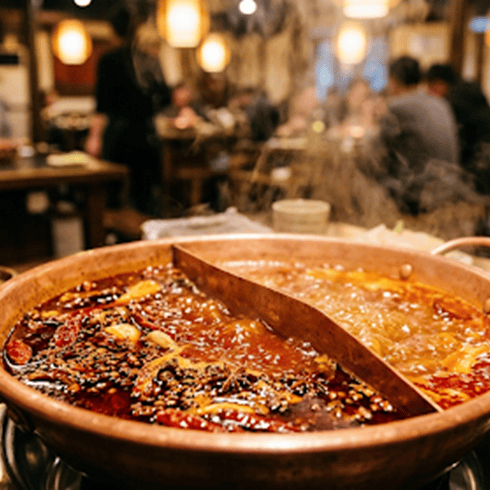
Why HALAL Certification and Simmer-Stability Are the Two Non-Negotiables
For buyers serving Muslim-majority or Halal-conscious markets, certification is not a marketing nice-to-have — it is the gate that determines whether a product can legally appear on a menu or a retail shelf at all. Singapore’s MUIS certification, Malaysia’s JAKIM standard, and the UAE/GCC Halal frameworks each involve their own audit trail covering raw material sourcing, processing lines, and cross-contamination controls. A hot pot base built around beef tallow — one of the most commonly used fats in Sichuan-style broths — carries particular scrutiny, since the certifying body needs to trace the animal’s slaughter method and the entire rendering process, not just confirm that pork is absent. For a distributor building out a Halal hot pot programme in Singapore or the Gulf, a base that already carries HALAL certification alongside HACCP and ISO22000 removes one of the longest lead-time items in a supplier qualification process — audits and paperwork that can otherwise stall a launch for months.
The second non-negotiable is less about compliance and more about what actually happens on a burner. Hot pot and mala tang are, structurally, foods that get cooked far longer and far harder than almost any other category a foodservice buyer sources. A self-service hot pot restaurant does not simmer a base for the 15-20 minutes of a typical home meal — each table’s sitting can run close to the industry-standard two-hour limit, and the same base often stays on the burner across back-to-back turns throughout a full evening service, while diners cycle through course after course of meat, vegetables, and noodles. A base engineered without that use case in mind will start to separate, cloud, or turn bitter well before the last table of the night orders their final refill. Noodles face a parallel test: a starch-based noodle that has not been engineered to resist prolonged heat exposure will absorb liquid until it disintegrates, turning a bowl of hot pot into a starchy, gluey mess that no amount of seasoning can rescue.
Buyers who treat these two factors as a single “quality” checkbox tend to discover the gap only after a shipment has already reached the restaurant floor. A base that passed a lab taste test in a 20-minute trial run can still fail in a real six-hour service window; a certificate that was valid at the point of manufacture can still lapse or fail to transfer cleanly through a multi-step export chain. Treating HALAL compliance and simmer-stability as two separate line items to verify — rather than assuming one implies the other — is what actually protects a buyer’s margin and reputation.
From Certificate to Service Bar: What Buyers Actually Need to Verify
Let me paint a practical picture. A 120-seat self-service hot pot restaurant in Singapore opens at 5 p.m. and keeps its burners running until close. Each table’s pot gets topped up repeatedly rather than replaced, meaning the broth at 10 p.m. has effectively been simmering, in stages, since service began. If the base has not been engineered to resist that kind of prolonged, repeated heating — what suppliers increasingly describe as a multi-stage stewing or “slow-braising” process rather than a single quick blend — the broth turns cloudy and the fat separates out visibly, which for many diners reads as a sign the food is old or poorly made, even when it isn’t. A base built around a genuine slow-rendering process, where beef tallow is cooked down gradually rather than blended in at the end, is far more likely to hold a clear, bright colour through the same six-hour window.
On the certification side, the practical verification work looks different but is just as concrete. A buyer should be asking a supplier for the actual certificate number and issuing body — MUIS, JAKIM, or the relevant GCC national authority — and confirming it covers the specific product SKU and manufacturing site being ordered from, not just the supplier’s company profile in general. It is common for a manufacturer to hold Halal certification for one production line while a newer product line is still in the certification queue. For a Singapore or Gulf-bound order, that distinction determines whether an entire container clears customs and retail compliance review on the first attempt or gets held for additional documentation, a delay that can cost a distributor an entire selling season if it happens close to a peak period like winter hot pot demand or a festival calendar.
Noodles carry their own version of this same “certificate versus reality” gap. A sweet potato noodle marketed as resistant to overcooking should be judged the way it will actually be used: dropped into an already-simmering pot for a second or third round of the meal, not tested fresh out of the package. Buyers sourcing for buffet-style operations do well to ask suppliers directly how the product performs after 30-40 minutes of continuous simmering and repeated reheating — the real-world equivalent of a busy Friday night table — rather than relying on packaging language alone.
Clean-Label Is the Third Checkbox, Not the Whole Story
Ingredient transparency deserves a place on this checklist, even if it is no longer the headline differentiator it once was — clean-label sourcing has become table stakes across the broader food import trade rather than a standalone selling point. For hot pot and mala tang specifically, the practical version of this checkbox is simple: does the noodle or base rely on gelatin, alum, or artificial colourants to hit its texture and appearance, or does it get there through the raw material itself? A wide noodle made from purple sweet potato that gets its colour naturally from the root’s own anthocyanin content, without added gelatin or alum, is doing with ingredients what a lesser product does with additives — and it is a detail Halal-market buyers in particular tend to ask about, since additive sourcing can itself raise certification questions. The sensible order of operations for a buyer building out a hot pot base, Sichuan mala sauce, or noodle line in bulk is to confirm HALAL status first, verify simmer performance second, and treat a clean ingredient list as the supporting evidence that rounds out the file — not the first or only thing checked.
The Jade Premium Approach
This brings us to a practical question: how does a buyer actually verify certification validity and real-world cooking performance before a purchase order goes out, rather than after a shipment has already landed? Jade Premium, part of Yuhu Group and headquartered in Hong Kong with a sourcing network across mainland China, works directly with manufacturers in Sichuan and Chongqing to pre-verify exactly this combination — certification scope and documented cooking performance — before introducing a supplier to a buyer, drawing on in-house HALAL, HACCP, ISO22000, and FDA compliance review capability.
The Beef Tallow Hot Pot Base No. 1 is a working example of the certification-first approach: it carries HALAL certification alongside HACCP and ISO22000, is already cleared for export to Hong Kong and the Middle East, and is built on a proprietary multi-stage stewing process — slow-rendered beef tallow paired with Sichuan peppercorn — specifically engineered to hold a clear, bright broth through extended simmering rather than clouding or separating over a long service window.
For the noodle side of the pot, the Hot Pot Sweet Potato Noodles (wet noodle), made from select sweet potatoes sourced from the 30th-parallel growing belt across the Sichuan-Chongqing region and stone-ground into fresh starch, are built to resist overcooking through repeated reheating cycles, arrive ready to cook without pre-soaking, and hold a bouncy, springy texture rather than turning starchy after extended time in a simmering pot. Buyers looking to round out a line with a naturally coloured, ingredient-forward option can also look at the Purple Sweet Potato Wide Noodles, which get their colour from the root itself rather than added gelatin or alum and are similarly designed for a quick, pre-soak-free cook.
The three products above are a starting point, not the full catalogue. Jade Premium’s supplier network also carries additional hot pot base flavours — including mushroom, tomato, rapeseed oil, and Sichuan pepper beef tallow variations — alongside a wider range of hot pot and mala tang noodles beyond the two featured here. For buyers building out a multi-SKU programme rather than placing a single order, that breadth matters just as much as any individual product’s certification file.
Sourcing any one of these categories in isolation is manageable. Sourcing a full hot pot or mala tang programme — bases, noodles, and the certification file that lets all of it clear a Halal market without delay — is where a buyer typically needs a partner who has already done the verification work upstream. Contact our team today to explore our full range of hot pot base flavours and hot pot ingredient products and find the right combination for your target market.
Every hot pot base and every noodle in this category still lives or dies on the same old test: does the bowl in front of the diner taste, look, and hold up the way it did the day the sample was approved. What has changed is how many separate things now have to be true at once for that bowl to reach the table at all — a valid certificate for the exact market it is entering, and a formula that survives the hours of real service most lab trials never simulate. Buyers who verify both, rather than assuming one guarantees the other, are the ones building supply chains that hold up as well as the broth does.