
A Noodle Assumption Worth Questioning
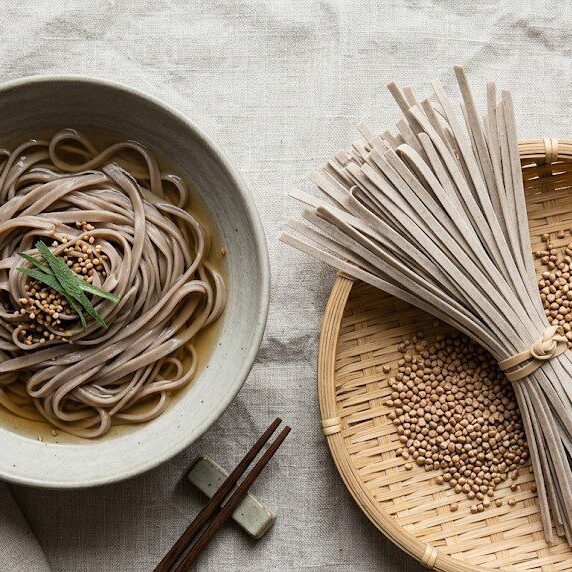
Ask most international buyers to name a buckwheat noodle and the answer comes quickly: soba, Japan’s dark, nutty noodle enjoyed hot in broth or chilled on a bamboo tray. It is a fair association — soba has been part of Japanese food culture since the Edo period. What is less well known is that Japan grows only a fraction of the buckwheat it needs. Domestic self-sufficiency for the wheat and buckwheat used in the country’s noodles and bread has been estimated at just 10 to 20 percent, with the remainder imported, historically from China and, more recently, also from Russia and the United States1.
In other words, the noodle most closely associated with Japan is, to a significant degree, built on buckwheat grown somewhere else — and China has long been one of the main sources. This is not a story about one country overtaking another. It is a reminder that China’s role in the global buckwheat trade already runs deeper than most buyers assume, and that the country is now building on that position rather than simply supplying raw grain. In late June, Liangshan Yi Autonomous Prefecture in Sichuan Province hosted the 16th International Buckwheat Symposium, drawing nearly 300 researchers and industry figures from 15 countries to discuss exactly this shift — buckwheat moving from a subsistence crop grown on poor mountain soils into a processed, branded, internationally traded health food2. For importers, retailers and foodservice operators, the opening this creates is not a novelty product tied to one culture, but a broader, better-supplied category of noodle worth taking seriously in its own right.
Why Buckwheat Noodles Are Earning a Place in Everyday Diets
Much of the renewed interest in buckwheat noodles as a healthy noodle alternative has less to do with any single national cuisine and more to do with what buckwheat itself brings to the plate. Unlike wheat, buckwheat is a broadleaf plant rather than a grass, and it carries a nutritional profile that has drawn attention well beyond specialist health circles: a fuller amino acid balance than most cereal grains, meaningful dietary fibre, and rutin and other flavonoid compounds associated with antioxidant activity3. It is worth being precise here rather than reaching for the broadest possible claim. Most commercial buckwheat noodles, including classic Japanese soba, are not made from buckwheat alone — pure 100 percent buckwheat dough is notoriously difficult to bind, since buckwheat contains no gluten. The everyday “ni-hachi” soba (literally “two-eight,” after its 20:80 wheat-to-buckwheat ratio) found in most Japanese noodle shops is easier to prepare and less prone to breaking than a pure buckwheat dough. Blending buckwheat with a wheat-based flour is therefore standard practice across the category, not a shortcut specific to any one producer — and it does not undo the benefits of the buckwheat portion itself. Research on buckwheat-supplemented products has found they produce a more moderate rise in blood glucose after eating than plain wheat products, an effect linked to buckwheat’s fibre content and to compounds that slow the release of sugars during digestion4. For health-conscious consumers, that combination — familiar noodle texture, added fibre, a gentler effect on blood sugar, and a grain-based protein source — has proven a more durable selling point than any single dietary label.
China’s Supply Advantage: Two Buckwheat Traditions, One Complete Chain
China’s position in this market rests on more than scale, though the scale itself is considerable: the country is one of the world’s largest buckwheat producers, alongside Russia, within a global harvest that the UN Food and Agriculture Organization puts at roughly 2.2 million tonnes a year5. What distinguishes China is that it cultivates both principal types of buckwheat at meaningful volume, in two distinct regions, each feeding a different part of the noodle category.
In the north, provinces such as Hebei, Inner Mongolia and Shanxi have long grown common buckwheat (Fagopyrum esculentum) — the type most familiar internationally, since it is the same species used in Japanese soba — often on the cooler, higher-altitude farmland the crop favours. In the south-west, the mountainous terrain of Sichuan’s Liangshan prefecture has become one of China’s principal centres for tartary buckwheat (Fagopyrum tataricum), a bitter, more intensely flavoured variety with a documented cultivation history stretching back centuries.
Liangshan alone now farms around 1 million mu (roughly 67,000 hectares) of tartary buckwheat, producing about 180,000 tonnes a year — close to a third of China’s total output6. Tartary buckwheat has drawn particular academic interest for its comparatively high flavonoid content, positioning it as a distinct, largely China-associated ingredient story that sits alongside, rather than in competition with, the common buckwheat used in soba-style noodles.
Just as importantly, China has paired this dual growing base with a processing infrastructure that much of the rest of the world’s buckwheat-growing regions still lack. Symposium delegates noted that buckwheat grown across the Himalayan belt — including India, Nepal and Bhutan — remains largely close to subsistence farming, with limited milling or manufacturing capacity7. China’s producers, by contrast, have built export-oriented mills, noodle lines and quality systems capable of meeting food safety requirements in regulated overseas markets, giving international buyers assessing a Chinese buckwheat noodle manufacturer a rare combination: dual-region raw material sourcing and a mature, auditable supply chain behind it.
A Growing Global Appetite
The customer base for buckwheat noodles is also broadening well past its traditional core. Historically, demand for buckwheat products clustered around a handful of regions with long-standing culinary traditions, but interest is now spreading among health-conscious consumers, flexitarians and people managing their carbohydrate intake more generally, regardless of geography or cultural background.
Symposium participants pointed to visible signs of this shift outside East Asia’s usual buckwheat strongholds. In the Republic of Korea, one academic noted that buckwheat noodle restaurants now see queues at peak dining hours — a marked change from a market where buckwheat was once mostly associated with pastries and rice balls8. Delegates from Russia and Switzerland described a similar re-evaluation under way in their own markets, with buckwheat increasingly framed as a functional food rather than an old-fashioned staple. For retailers, foodservice operators and private-label developers, this points to a category that no longer needs to be sold on novelty — it is being adopted on its everyday merits, alongside rice, wheat and other noodle staples.
Product Spotlight
As demand widens, product variety is becoming one of the clearest ways for suppliers to stand out. Longhe Flour Industry, a Hebei-based flour and noodle manufacturer established in 1998, sources its buckwheat from a dedicated 1,300-metre-altitude organic grain base in Zhangjiakou alongside its own wheat-growing operations, giving its buckwheat noodle range a traceable, dual-sourced foundation — a useful credential when vetting a buckwheat noodle supplier for import.
Yaomu Buckwheat Noodles
Made from 30 percent high-altitude buckwheat blended with high-gluten flour, this buckwheat noodle is worked through a lengthy kneading and slow-pressing process that gives it a firm, chewy bite.
- Cooks in three to five minutes
- Holds up equally well in cold dressed-noodle preparations and in hot soups
- A versatile addition to a retailer’s or foodservice operator’s noodle range
Yaomu Buckwheat Knife-Cut Noodles
Knife-cut noodles — daoxiao noodles, traditionally hand-shaved from a block of dough into boiling water — are a Shanxi speciality rarely paired with buckwheat in current retail or export markets, which makes this knife-cut buckwheat noodle a genuine point of difference rather than a routine line extension.
- Blends the technique with alpine buckwheat for added dietary fibre and a thicker, chewier profile than straight-cut buckwheat noodles
- Wide, uneven surface that holds sauce and broth well
- Cooks in five to seven minutes
- Suits soup noodles, dry-mixed dishes, quick stir-frying and hot pot alike
Both noodles are produced on Swiss Bühler processing lines, carry HACCP certification, and are already exported to Hong Kong — giving buyers a supplier with an established export track record rather than an unproven start-up.
Looking Ahead
Buckwheat noodles are no longer a single-country story. As health-conscious eating habits spread and buyers look past the assumption that “buckwheat noodle” means “Japanese soba,” China’s dual growing regions, established processing capacity and expanding product range put it in a strong position to supply this broadening market — including, as the figures suggest, some of the very markets long thought to define the category.
Turning that opportunity into a reliable product line still depends on finding a supplier who can back up the story with certification, traceability and consistent export experience. Jade Premium connects international buyers with verified Chinese manufacturers such as Longhe Flour Industry, handling the due diligence, documentation and export logistics that make sourcing Chinese buckwheat noodles — and other emerging Chinese health-food categories — straightforward for importers, retailers and foodservice operators. If buckwheat noodles, knife-cut noodles or other healthier noodle options are on your sourcing list, get in touch with the Jade Premium team to talk through certification, minimum order quantities and what fits your market.
Related Articles
Continue exploring the latest market trends shaping the global food industry.
Buckwheat Noodle Benefits: Why This Gluten-Free Alternative to Chinese Knife-Cut Noodles Is Taking Over Health-Conscious Kitchens
Sourcing Clean Label Chinese Noodles: The Importer’s Guide to Additive-Free Staples
- Japan for Sustainability, “Japanese Food Self-Sufficiency and Local Initiatives to Improve It,” japanfs.org; supplier-country context (China, Russia, United States) from Tridge, “Buckwheat Japan: Suppliers, Export Data, and Price Trends — Market Overview 2026,” tridge.com. ↩︎
- Xinhua, “Economic Watch: China’s Mountain Buckwheat Moves from Margins to Global Health Food Chain,” 2 July 2026, english.news.cn. ↩︎
- Xinhua (2026) op. cit., citing Zhou Meiliang, Institute of Crop Sciences, Chinese Academy of Agricultural Sciences. ↩︎
- “Effect of Buckwheat-Containing Bread on Postprandial Glycemia, Appetite, Palatability, and Gastrointestinal Well-Being,” PMC, National Library of Medicine. ↩︎
- Xinhua (2026), op. cit., citing UN Food and Agriculture Organization (FAO) buckwheat production data. ↩︎
- Xinhua (2026), op. cit., citing Qiu Yonghong, Deputy Head, Liangshan Agriculture and Rural Affairs Bureau. ↩︎
- Xinhua (2026), op. cit., remarks from delegates at the 16th International Buckwheat Symposium, Liangshan. ↩︎
- Xinhua (2026), op. cit., citing Prof. Sun-Hee Woo, Chungbuk National University (Republic of Korea), and delegate remarks from Russia and Switzerland. ↩︎