
- Understanding MOQ in Chinese Food Manufacturing Context
- Matching MOQs to Market Realities Across Different Scales
- MOQ's Hidden Costs: Lead Times and Cash Flow Implications
- Structuring Tiered MOQs for Market Testing and Scaling
- Leveraging Co-Packer Capacity and Selecting the Right Partners
- Negotiation Levers: Beyond Just Lowering MOQ Numbers
- Building Long-Term Partnership Around MOQ Evolution
- Jade Premium's Role: Your Strategic Partner in Chinese Food Export
When international buyers explore private label food production in China, one number stops them cold: the Minimum Order Quantity (MOQ). That four-figure or five-figure threshold isn’t arbitrary—it represents the intersection of manufacturing efficiency, cost economics, and market reality. For buyers sourcing authentic Chinese food products, understanding MOQ isn’t just about meeting a supplier’s requirement. It’s about aligning production scale with your actual market capacity, cash flow constraints, and growth trajectory.
At Jade Premium, we’ve guided countless international importers, retailers, and food service operators through this critical decision point. Our offices across China—from Guangzhou’s manufacturing heartland to Shanghai’s innovation hubs—give us front-row insight into how producers set MOQs and, more importantly, how buyers can structure orders that match their real market size without overcommitting capital or warehouse space.
The truth is straightforward: MOQ exists to protect manufacturer margins while ensuring quality consistency. But the buyer’s challenge is equally clear: order too much, and you tie up cash in slow-moving inventory; order too little, and your per-unit economics make retail pricing uncompetitive. This article walks you through matching production scale to market reality, whether you’re testing a new product category or scaling an established line.
Understanding MOQ in Chinese Food Manufacturing Context
Chinese food manufacturers set MOQs based on production line changeover costs, ingredient sourcing minimums, and packaging tooling economics. A dim sum factory in Guangdong, for example, might require 10,000 units minimum because their production line efficiency drops significantly below that threshold. Switching from one product specification to another involves cleaning protocols, equipment adjustments, and quality testing—costs the factory must amortize across the order volume.
For private label buyers, this means MOQ directly correlates with three factors: product complexity, customization level, and packaging requirements. A standard frozen dumpling with stock packaging might carry a 5,000-unit MOQ. Add custom branding, modified filling recipes, and specialized portion sizes, and that minimum could double or triple. The factory isn’t being difficult—they’re ensuring the order generates enough margin to justify the setup investment.
Understanding this dynamic empowers negotiation. When you approach a Chinese supplier through partners like Jade Premium, who maintain established relationships and cultural fluency, you’re not just requesting lower MOQs. You’re demonstrating order predictability, payment reliability, and long-term partnership potential—factors that make manufacturers more flexible on initial minimums.
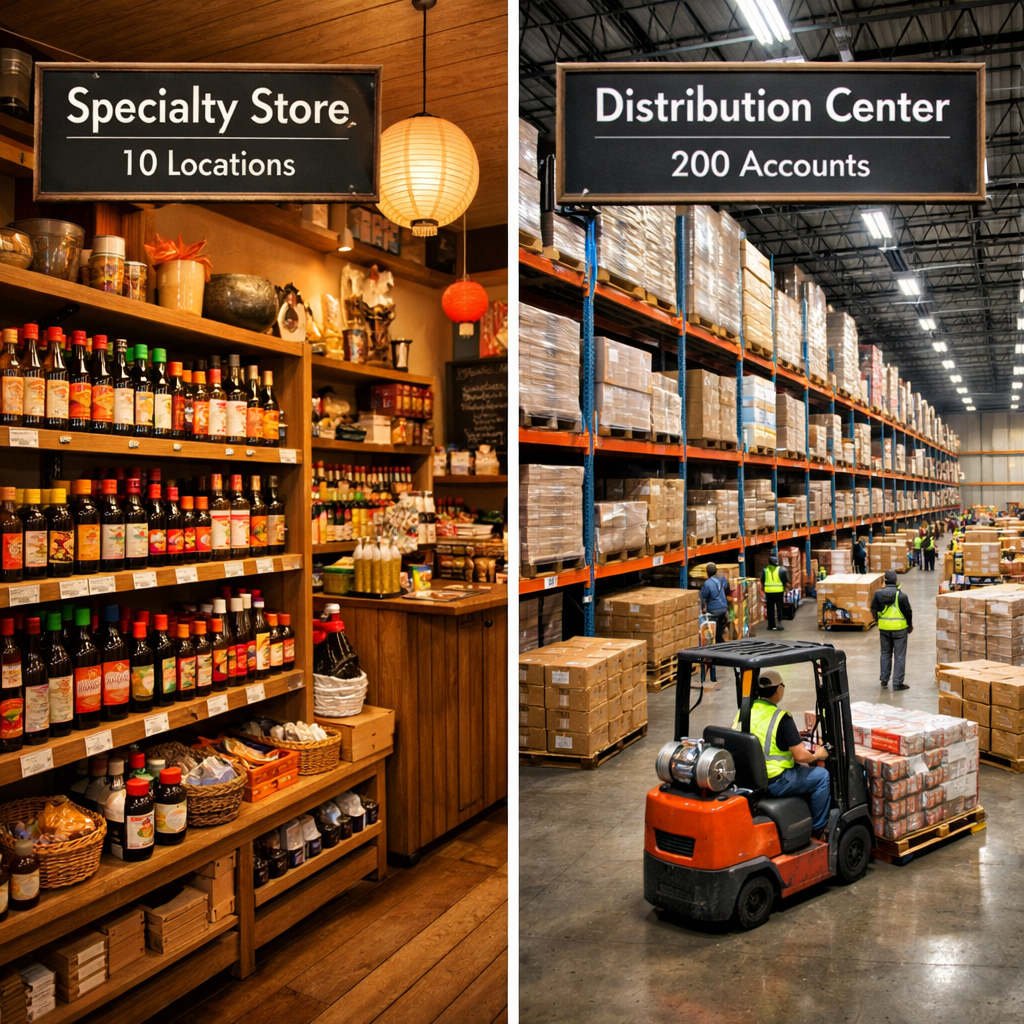
Market size directly determines whether an MOQ makes financial sense. A European retailer entering the Asian sauce category with ten store locations faces different economics than a North American distributor serving 200 food service accounts. The retailer might sell 50 units weekly across those stores—meaning a 10,000-unit MOQ represents a 20-week supply. The distributor could move that volume in three weeks.
Matching MOQs to Market Realities Across Different Scales
Small market entry requires surgical precision. You’re testing consumer response, refining positioning, and validating pricing assumptions. Committing to a 50,000-unit MOQ at this stage creates existential risk. If the product underperforms, you’re stuck with dead inventory. If it overperforms, you’ve tied up capital that could fund expansion.
Smart buyers in this position pursue tiered MOQ strategies. Start with a 3,000 to 5,000-unit test order, even if per-unit costs run 15-20% higher than volume pricing. A Middle Eastern importer we worked with launched Chinese hot pot ingredients this way—small initial order across five retail partners, premium positioning to absorb the higher landed cost, rapid sell-through data to justify the next order tier. Within six months, they scaled to 25,000-unit orders with dramatically improved economics.
The key metric here isn’t cost per unit—it’s cost per validated customer. That first small order generates market intelligence worth multiples of the price premium. You learn which SKUs move fastest, which packaging sizes resonate, and which customer segments show repeat purchase behavior. These insights inform your scaled order with precision, reducing waste and improving cash velocity.
Mid-sized markets present the goldilocks challenge. Your MOQ needs are substantial enough for decent pricing but not so large that a single order strains working capital. A 15,000 to 30,000-unit order might represent a quarter’s worth of inventory—manageable but requiring careful demand forecasting.
Here, co-packer relationships become crucial. Manufacturers with diversified product portfolios often run production in batches that serve multiple buyers. A noodle manufacturer might produce 100,000 units of a base product, then customize packaging and minor formulations for three different private label clients. By timing your order to align with these production runs, you access better pricing without bearing the full setup cost burden.
We’ve seen this work brilliantly for ASEAN food service buyers sourcing Chinese dim sum. Rather than ordering custom-made products with high MOQs, they select from manufacturer-maintained SKUs with slight customization—branded steamer baskets, custom sauce sachets, or specific piece counts per package. MOQs drop to 10,000 units instead of 25,000, and lead times compress because base production is already scheduled.
The demand planning discipline at this scale determines success. Use historical sales data, seasonal adjustment factors, and channel-specific sell-through rates to forecast accurately. Build in a 15-20% buffer for promotional lift or unexpected demand spikes. Remember that Chinese manufacturers typically require 45-60 day lead times for production plus shipping transit—your forecast needs to project three to four months ahead, not just the immediate quarter.
Large-scale buyers face different challenges: maintaining supply continuity, managing SKU proliferation, and optimizing container utilization. When you’re ordering 100,000+ units per SKU, MOQ becomes less about minimums and more about production scheduling, quality consistency across batches, and logistics optimization.
At this scale, annual volume commitments often replace order-by-order MOQs. A North American retail chain might commit to 500,000 units annually across multiple SKUs, with quarterly production runs scheduled in advance. This gives the Chinese manufacturer production visibility to invest in dedicated equipment, secure ingredient contracts, and staff appropriately.
The risk shifts from “can we sell this volume?” to “can we maintain quality and delivery reliability at this scale?” This is where Jade Premium’s end-to-end quality control and supply chain management become invaluable. Our team conducts on-site inspections across production batches, verifies compliance with international standards, and manages logistics to ensure products arrive in specification and on schedule.
MOQ’s Hidden Costs: Lead Times and Cash Flow Implications
MOQ doesn’t just determine how much you order—it governs when you must order and how much capital sits in inventory. These second-order effects often matter more than per-unit pricing, especially for growing businesses with constrained working capital.
Chinese food manufacturers typically operate on 30% deposit, 70% before shipment payment terms. A 20,000-unit order at $2.50 per unit means $50,000 total, with $15,000 due upfront and $35,000 due before the container ships. If your current market size supports 1,000 units monthly in sales, you’re committing five months of revenue to secure four months of inventory. The cash conversion cycle extends significantly.
Smart buyers structure their growth to match MOQ economics. Rather than launching nationally with one massive order, they pursue regional rollouts that align with MOQ thresholds. A buyer might launch in the western United States with a 10,000-unit order, validate demand over two months, then expand eastward with a 25,000-unit order that covers both regions at improved pricing. Each order matches current market capacity while building toward volume discounts.
Lead time planning requires equal sophistication. Chinese New Year shuts down production for three to four weeks annually. Summer months often see capacity constraints as manufacturers handle peak seasonal demand. Buyers who understand these cycles place orders strategically—securing production slots during slower periods and planning inventory buffers around these disruptions.
We advise international buyers to maintain a lead time buffer equivalent to one MOQ cycle. If your MOQ represents three months of sales and production plus shipping takes two months, you should reorder when you have five months of inventory remaining. This buffer absorbs unexpected delays—port congestion, customs holds, or quality issues requiring re-production—without stockouts that damage retail relationships.
Structuring Tiered MOQs for Market Testing and Scaling
Progressive MOQ structures allow buyers to test efficiently and scale confidently. Rather than committing to volume pricing on unproven products, negotiate staged minimums that reward order growth.
A practical framework structures three MOQ tiers: market entry, validation, and scale. Entry tier might be 5,000 units at a 20% price premium to volume pricing—expensive per unit but minimal total capital commitment. Validation tier drops to 15,000 units at a 10% premium once initial sell-through proves demand. Scale tier reaches 50,000+ units at full volume pricing after market validation is complete.
Chinese manufacturers increasingly embrace this approach, particularly when working through trade partners like Jade Premium who bring buyer credibility and relationship continuity. The factory sees a clear growth path: accept tighter margins on the initial order knowing that successful products generate substantial follow-on volume.
Build trial clauses into your initial MOQ negotiations. One European buyer we supported negotiated a 7,500-unit initial order with a contractual commitment to 30,000 units within six months if the product hit defined sell-through targets. The factory accepted because the commitment reduced uncertainty. The buyer gained flexibility to test without overcommitting capital.
Forecasting accuracy determines whether tiered MOQs succeed. Use point-of-sale data, not shipment data, to track actual consumer demand. A product might ship steadily to distributors while languishing on retail shelves. POS data reveals true velocity, informing accurate reorder timing and quantities.
Incorporate demand planning tools that account for lead time, safety stock requirements, and promotional lift. Your reorder point should trigger when current inventory equals forecasted sales during replenishment lead time plus safety stock. If lead time is 60 days, you forecast 5,000 units in sales during those 60 days, and you maintain 2,000 units safety stock, your reorder point is 7,000 units remaining.
Risk management in tiered MOQ strategies focuses on obsolescence risk versus stockout risk. Food products have shelf life constraints—typically 12-24 months for frozen items, 6-12 months for ambient products. Over-ordering risks waste through expiration. Under-ordering risks lost sales and damaged customer relationships.
Calculate your maximum order quantity by dividing remaining shelf life (in months) by monthly sales velocity, then multiplying by a 0.7 safety factor. If a product has 18 months remaining shelf life and you sell 3,000 units monthly, your maximum prudent order is 18 ÷ 1 × 3,000 × 0.7 = 37,800 units. This leaves buffer for demand variability while protecting against obsolescence.
Leveraging Co-Packer Capacity and Selecting the Right Partners
Chinese food manufacturing capacity varies enormously—from small-scale artisan producers perfect for niche products to massive industrial facilities serving multinational brands. Matching your market size to appropriate co-packer scale determines MOQ flexibility, quality consistency, and long-term partnership viability.
Small to mid-sized manufacturers (annual output $5-20 million) often provide the best fit for international buyers in early growth stages. These facilities maintain 5,000-15,000 unit MOQs, offer greater formulation flexibility, and provide more attentive service than massive factories focused on container-load orders. A Sichuan sauce producer we work with maintains relationships with 30+ international buyers, each ordering 10,000-50,000 units quarterly—the factory’s sweet spot for operational efficiency.
These manufacturers value stable, predictable partners over occasional large orders. Demonstrate commitment through consistent ordering patterns, prompt payment, and clear communication. One Australian retailer we supported built such strong partnership with a dumpling manufacturer that the factory now maintains buffer inventory specifically for their rush orders—effectively creating zero MOQ for refill orders because the relationship justifies the inventory investment.
Large manufacturers (annual output $50 million+) serve buyers operating at scale—container loads monthly, multiple SKU families, and standardized production requirements. MOQs here might start at 50,000 units, but per-unit costs can be 30-40% lower than small factory pricing. Quality systems are typically more robust, with ISO certifications, HACCP protocols, and dedicated export compliance teams.
The challenge with large manufacturers is maintaining attention and flexibility. You’re competing with major international brands for production slots and service priority. This is precisely where Jade Premium’s local presence and relationship capital matter. Our team conducts regular factory visits, maintains communication during production runs, and ensures your orders receive appropriate priority regardless of size.
Evaluating co-packer fit requires assessing five dimensions: technical capability, quality systems, financial stability, communication effectiveness, and cultural alignment. Technical capability means more than equipment—it’s formulation expertise, process control, and innovation capacity. Can they reformulate products to meet specific nutritional targets or dietary requirements? Do they maintain R&D capabilities for product innovation?
Quality systems should include third-party certifications relevant to your target markets—BRC, IFS, FSSC 22000, or country-specific requirements like HACCP for EU markets or FDA registration for U.S. exports. Request factory audit reports, customer references, and documentation of their corrective action processes when issues arise.
Financial stability protects your supply continuity. A factory struggling financially might cut corners on ingredient quality, delay maintenance, or suddenly change ownership. Jade Premium conducts financial due diligence on manufacturing partners, reviewing registration records, business licenses, and conducting discreet market inquiries about reputation and payment history.
Communication effectiveness and cultural alignment often determine long-term partnership success. Chinese manufacturers operate in different business cultural contexts—relationship-oriented rather than transaction-focused, indirect communication styles, and different expectations around contract flexibility. Misunderstandings here derail partnerships despite perfect technical fit.
This is where working with trade facilitators who bridge cultural contexts becomes invaluable. Jade Premium’s bilingual teams translate more than language—we interpret business expectations, communication nuances, and relationship norms. When a factory says “maybe possible” to a rush order, we know whether that means “yes if you push” or “absolutely no chance.” This cultural fluency prevents costly miscommunications.
Negotiation Levers: Beyond Just Lowering MOQ Numbers
Sophisticated buyers don’t just negotiate lower MOQs—they structure deals that align incentives across the supply chain. The goal isn’t the smallest possible minimum order but rather the most favorable total economics considering price, payment terms, exclusivity, and quality assurance.
Volume commitments represent the most powerful negotiation lever. Rather than requesting lower MOQ on a single order, commit to annual volume across multiple orders. A manufacturer might maintain 15,000-unit MOQ for spot orders but reduce it to 8,000 units for buyers committing to 100,000 units annually. The factory gains production visibility and scheduling efficiency; you gain flexible ordering while accessing volume pricing.
Structure these commitments with realistic terms. Include force majeure clauses covering market disruptions, quality escape provisions if products fail specifications, and reasonable quarterly minimum takedown requirements rather than rigid monthly schedules. A well-drafted volume commitment protects both parties while facilitating favorable MOQ terms.
Payment term adjustments can offset higher MOQs. Standard terms of 30% deposit, 70% before shipment might shift to 20% deposit, 50% before shipment, 30% after arrival for buyers accepting higher MOQs. This improves cash flow, allowing you to commit to larger orders without equivalent capital strain. The manufacturer accepts slightly elevated payment risk in exchange for order certainty.
One North American importer we advised negotiated 45-day payment terms after shipment by providing a bank letter of credit and committing to quarterly orders. The improved cash flow allowed them to increase order sizes by 40%, accessing better per-unit pricing that more than offset the letter of credit costs.
Exclusivity arrangements warrant careful consideration. Manufacturers sometimes offer reduced MOQs in exchange for exclusive rights—you become the sole buyer for a product in specific markets. This protects your market positioning but creates supply dependency. Evaluate whether the product’s uniqueness justifies exclusivity risk. For truly differentiated products, exclusivity plus reasonable MOQs create defensible market positions. For commodity-like products, maintain multiple sourcing options despite slightly higher MOQs.
Quality assurance provisions should feature prominently in MOQ negotiations. Specify inspection protocols, acceptance criteria, and remediation processes for non-conforming products. Buyers accepting higher MOQs carry greater quality risk—a 50,000-unit order with 5% defect rate means 2,500 unusable units. Build quality guarantees and remake provisions into contracts, and insist on pre-shipment inspection rights.
Jade Premium’s quality control services integrate seamlessly here. Our teams conduct factory audits before production begins, in-process inspections during manufacturing, and pre-shipment final inspections before goods leave China. This three-stage verification catches issues early, when they’re correctable, rather than after containers arrive at your warehouse. For buyers managing larger MOQs, this assurance is essential.
Building Long-Term Partnership Around MOQ Evolution
The most successful international buyers view MOQ not as a fixed constraint but as an evolving parameter that changes with relationship maturity. Your first order establishes credibility. Your third order proves reliability. And your tenth order makes you a valued partner who receives preferential treatment.
Track your MOQ progression over time. A buyer we’ve supported entered the Chinese soy sauce market with a 5,000-unit test order in 2019. By 2023, they were ordering 75,000 units quarterly at 35% lower per-unit cost, with 60-day payment terms and dedicated production runs. The manufacturer invested in custom packaging equipment specifically for this buyer because order predictability justified the capital investment.
This progression didn’t happen accidentally. The buyer communicated transparently about growth plans, met delivery commitments consistently, and involved the manufacturer in product development discussions. When market challenges emerged—COVID-19 disruptions, shipping container shortages—they worked collaboratively on solutions rather than leveraging competition between suppliers.
Maintain transparent communication about market performance. Share sell-through data with manufacturing partners, not just order forecasts. When products perform well, explain why—which markets, customer segments, and positioning strategies are working. When products underperform, discuss honestly and seek collaborative solutions. This openness builds partnership that transcends transactional MOQ negotiations.
Invest in relationship development through factory visits, regular video conferences, and cultural exchange. Chinese business culture values relationship depth and long-term commitment. Buyers who demonstrate genuine interest in the manufacturing partner’s business—understanding their challenges, celebrating their successes, and showing respect for their expertise—receive preferential treatment that purely transactional buyers never access.
Jade Premium facilitates these relationship-building efforts through cultural guidance, translation services, and in-market support. Our teams arrange factory visits with appropriate business protocols, facilitate technical discussions with accurate translation of specialized food terminology, and help international buyers navigate Chinese business etiquette. These seemingly soft factors often matter more than contract terms in determining actual partnership experience.
Jade Premium’s Role: Your Strategic Partner in Chinese Food Export
At Jade Premium, we understand that MOQ decisions determine market success or failure for international food buyers. Our comprehensive trade services specifically address the challenges outlined in this article—matching production scale to market reality, structuring tiered growth strategies, and building manufacturer relationships that evolve with your business.
Our offices across China’s key food production regions provide unparalleled access and oversight. When you’re evaluating a dumpling manufacturer in Guangzhou, our local team conducts on-site assessments of production capacity, quality systems, and MOQ flexibility. When you’re scaling orders in Shanghai, our logistics experts optimize container utilization and shipping routes to maximize your MOQ economics.
Beyond operational support, we provide the cultural bridge that transforms challenging MOQ negotiations into collaborative partnership development. Our bilingual teams don’t just translate words—we interpret business context, relationship dynamics, and communication nuances that determine negotiation outcomes. We’ve guided hundreds of international buyers through the MOQ matching process, from initial market testing to scaled production relationships.
Our commitment is simple: bringing authentic Chinese cuisine to global tables requires more than identifying products and negotiating prices. It demands deep understanding of production realities, sophisticated supply chain management, and genuine partnership development. When you work with Jade Premium, you’re not just accessing Chinese food products—you’re gaining strategic partners committed to your success in global markets.
Whether you’re launching your first private label product or scaling an established line, matching MOQ to your real market size determines capital efficiency, quality consistency, and competitive positioning. The strategies outlined here—tiered structures, co-packer selection, negotiation sophistication, and relationship investment—create sustainable advantage in increasingly competitive food markets.
Contact Jade Premium to discuss how we can support your Chinese food sourcing strategy with MOQ structures matched precisely to your market reality. Let’s build your success story together.