
When your shipment of frozen dumplings, fresh garlic, or vacuum-sealed hot pot ingredients arrives at the destination port, one question dominates: Will they still be safe to sell? For international buyers sourcing perishable goods from China, that answer hinges almost entirely on one piece of equipment—the reefer container.
A reefer container isn’t just a metal box with a cooling unit attached. It’s the difference between premium-quality product that commands top shelf placement and spoiled inventory that ends up in the dumpster. At Jade Premium, we’ve watched countless shipments make this journey from Chinese production facilities to global markets, and we’ve learned this: the cold chain either works perfectly, or it fails catastrophically. There’s rarely middle ground with perishables.
Understanding how reefer container food export actually works—and more importantly, where it breaks down—isn’t just useful knowledge. For buyers investing in Chinese perishables, it’s essential business intelligence that protects your investment and your brand reputation.
The Foundation: Temperature Control Isn’t One-Size-Fits-All
The rookie mistake many international buyers make is treating “refrigerated shipping” as a single category. In reality, different perishable products from China require dramatically different temperature management strategies.
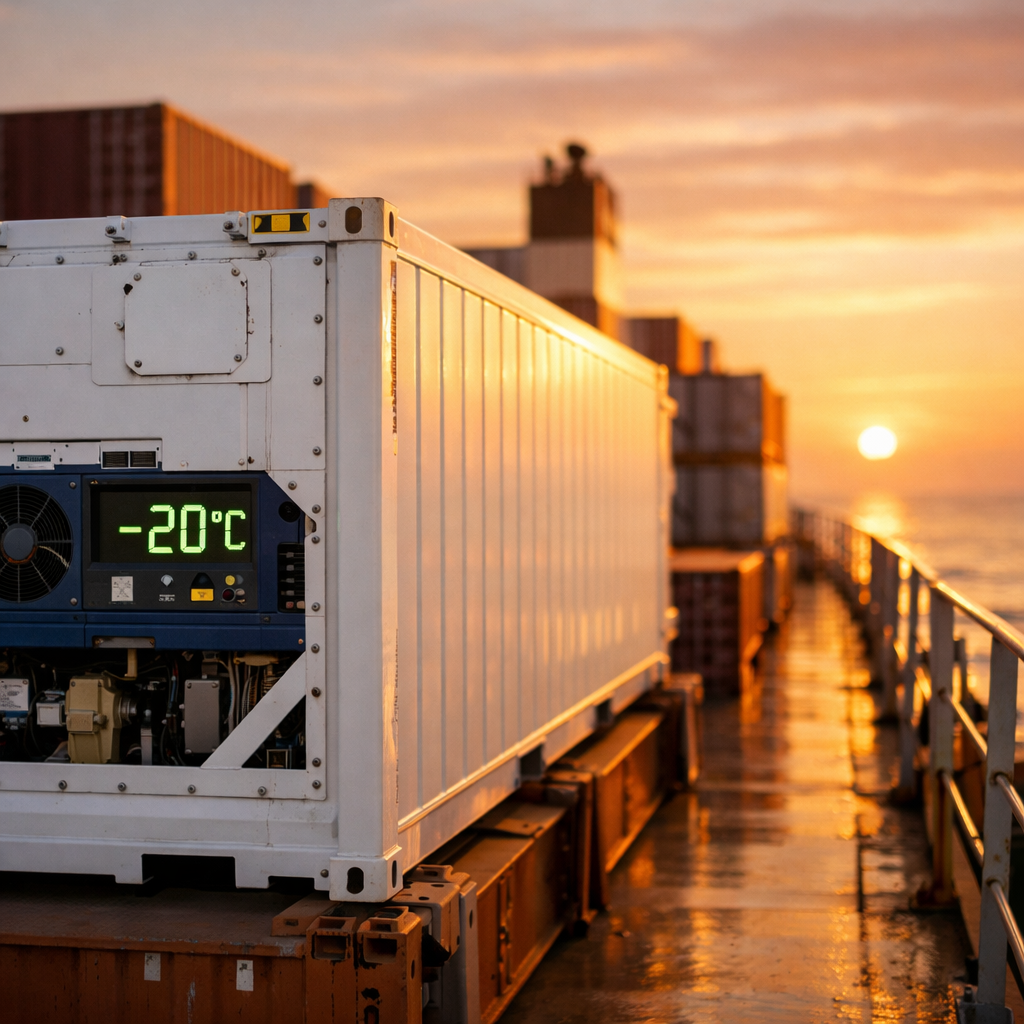
Frozen seafood exports leaving ports like Qingdao typically require consistent temperatures of -18°C to -25°C throughout the entire journey. Even a brief temperature spike to -15°C can cause ice crystal formation that degrades texture and visual quality—something your retail customers will notice immediately upon thawing. Understanding quality control systems helps prevent these costly failures.
Fresh produce shipments—like the garlic and ginger exports that PIL ships in massive volumes from Qingdao to Brazil—operate in a completely different thermal zone. These products typically travel between 0°C and 4°C, with precise humidity control being equally critical. Too dry, and your produce shrivels. Too humid, and you’re cultivating mold.
Frozen dim sum and ready-to-eat meals present yet another complexity. These products don’t just need cold—they need consistent cold. Temperature fluctuations cause moisture migration within the packaging, leading to freezer burn and compromised wrapper texture. When we source frozen dumplings for European retailers, we specify maximum allowable temperature variance of ±2°C throughout transit.
The critical insight here is that temperature specification alone doesn’t guarantee freshness. Your Chinese supplier might load products at the correct temperature, but if the reefer unit cycles temperature to save energy, or if the container loses power during transshipment, your entire shipment is at risk.
This is where cold chain integrity becomes non-negotiable. Jade Premium’s approach emphasizes pre-shipment verification: we confirm not just that the reefer is set to the right temperature, but that it can maintain that temperature consistently under load, that backup systems are functional, and that monitoring equipment is calibrated and recording properly.
Beyond temperature, packaging solutions must be designed specifically for long-distance reefer transport. Chinese exporters sometimes use packaging perfectly adequate for domestic cold chain transport—typically 24-48 hours—but inadequate for the 25-35 day ocean journey to Europe or North America. Your vacuum-sealed packages need redundancy. Your frozen products need packaging that assumes some thermal cycling will occur.
And then there’s regulatory compliance—the unsexy but absolutely critical component that determines whether your container even clears customs. Different markets have different temperature documentation requirements. The EU demands continuous temperature records with specific calibration standards. The U.S. requires validated cold chain processes under FSMA. Australia has quarantine requirements that interact with cold storage protocols.
Jade Premium has observed that successful Chinese exporters treat compliance as an ongoing process, not a one-time checklist. They build relationships with regulatory bodies, invest in proper documentation systems, and understand that a missing temperature log can be just as devastating as a temperature failure.
When Reality Hits: Operational Challenges in Reefer Shipping
Here’s what the shipping brochures won’t tell you: reefer containers fail. Not always, not even frequently—but often enough that every experienced buyer has a disaster story.
Equipment reliability is the first vulnerability. A reefer container is essentially a sophisticated refrigeration unit powered by ship’s electricity or a diesel generator, running continuously for weeks while being bounced around by ocean waves. The compressors fail. The sensors drift. The power connections corrode in salt air.
The global reefer plug capacity is actually ample—the industry isn’t capacity-constrained overall. But as market research indicates, equipment positioning is the primary constraint. Your perfectly good reefer container might be sitting empty in Hamburg when you need it in Shanghai. This positioning problem means buyers sometimes face equipment shortages at critical harvest times, forcing uncomfortable choices between using older equipment, accepting delays, or switching to more expensive air freight.
Port delays compound every other risk. When your reefer container sits for three extra days waiting for customs clearance, that’s three extra days of generator fuel consumption, three extra days of mechanical stress, and three extra days where a power failure could occur. Chinese ports like Shanghai and Shenzhen have vastly improved their handling efficiency, but transshipment ports—particularly in Southeast Asia—can still create exposure.
The solution isn’t hoping for the best; it’s building redundancy and monitoring into your process. Real-time temperature monitoring systems using IoT sensors now provide continuous data streams from inside the container, implementing best practices in cold chain management. These aren’t just fancy technology—they’re early warning systems. When we manage shipments for international buyers, we set temperature alert thresholds that trigger immediate investigation before product degradation occurs.
Contingency planning is equally critical. What happens if your reefer fails mid-Pacific? Having pre-established relationships with shipping lines that maintain reefer technicians at major ports can mean the difference between saving a shipment and writing it off. Some of our most successful European importers include “hot shot” provisions in their shipping contracts—guaranteeing emergency response for equipment failures.
Yes, proper reefer shipping costs more. The container rental premium is typically 3-4 times standard dry container rates. The power consumption adds another layer of expense. Monitoring systems and backup generators increase investment.
But consider the alternative. A container of frozen dim sum worth $150,000 USD, completely unsaleable because the temperature rose to -8°C for six hours somewhere in the Indian Ocean. That single failure costs far more than the premium for proper cold chain management across dozens of successful shipments.
More importantly, the benefits extend beyond spoilage prevention. Properly managed reefer shipping preserves product quality at a level that commands premium pricing. When your Chinese hot pot ingredients arrive in perfect condition while competitors’ products show quality degradation, you capture the high-value segment of the market.
European retailers sourcing ready-to-cook Chinese food have learned this lesson definitively. They’ve discovered that reduced spoilage rates of 2-3% versus industry averages of 8-12% completely transform the economics of Chinese perishable imports. The savings from eliminating waste far exceed the incremental cold chain investment.
The Logistics Evolution: Faster, Smarter, More Reliable
The China-to-Europe perishable food export landscape is undergoing a dramatic transformation, and savvy international buyers are already adapting their strategies.
Rail-based cold chains are disrupting traditional ocean freight dominance for certain product categories. The China-Europe Railway Express now offers reefer rail containers that can move frozen goods from Chongqing to Duisburg in approximately 16-18 days—nearly half the ocean transit time. For high-value frozen products where freshness window is critical, this faster transit justifies the typically 30-40% cost premium over ocean freight.
We’ve watched Chinese exporters in Chengdu leverage local logistics efficiency and cold-chain technology to get frozen Sichuan specialties to European markets faster than previously thought possible. The combination of controlled-atmosphere packaging, multi-modal reefer logistics, and streamlined customs pre-clearance is collapsing traditional timeline assumptions.
For international buyers, this creates strategic options. Ocean freight remains the most economical choice for high-volume, frozen products with 18-month shelf life. But for fresh products, limited-edition seasonal items, or rapid response to market demand, the rail option increasingly makes commercial sense.
Shipping line selection has never been more critical. Not all carriers treat reefer cargo with equal diligence. PIL’s dominance in the garlic and ginger export trade from Qingdao to Brazil didn’t happen by accident—it resulted from consistent equipment maintenance, reliable scheduling, and proven cold chain management.
When Jade Premium evaluates shipping options for clients, we look beyond published rates to examine reefer performance metrics: equipment failure rates, average repair response times, port handling procedures, and historical temperature excursion data. A shipping line with 15% lower rates but 8% higher failure rates destroys value rather than creating it.
The emerging trend is toward long-term carrier partnerships rather than transaction-by-transaction rate shopping. The most successful importers we work with establish preferred carrier relationships, provide volume commitments, and in return receive priority equipment allocation, enhanced monitoring, and expedited problem resolution.
Technology integration is transforming visibility and control. IoT-enabled reefer containers now provide real-time data not just on temperature, but on humidity, door openings, location, and mechanical system performance. This data doesn’t just help you monitor shipments—it creates a continuous improvement feedback loop.
When we analyze temperature data across multiple shipments for a European buyer, patterns emerge. Certain routes consistently show temperature variability at specific transshipment points. Particular times of year create systematic challenges. This intelligence allows proactive intervention rather than reactive crisis management.
For international buyers considering Chinese perishable imports, the message is clear: collaborate with experienced cold-chain providers. The complexity of maintaining quality from a factory in Guangzhou to a retail shelf in Amsterdam requires specialized expertise that goes far beyond basic freight forwarding.
Jade Premium’s value proposition isn’t moving boxes—it’s ensuring that the frozen dumplings, fresh ginger, or vacuum-sealed hot pot ingredients that leave China in premium condition still command premium prices when they arrive at your warehouse. That requires understanding Chinese production realities, international regulatory requirements, equipment capabilities, and the thousand small details that collectively determine whether your cold chain succeeds.
Market Implications: Building Trust Through Temperature Control
The global demand for Chinese perishable exports is accelerating. According to industry research, the China reefer container market, valued at $6.34 billion in 2025, is projected to grow at a 16.27% CAGR through 2033, reaching $15.66 billion. This isn’t just industry statistics—it’s evidence of a fundamental shift in how international markets view Chinese food exports.
Consumer expectations for fresh food quality and safety continue to rise across all markets. European consumers increasingly demand authentic Asian ingredients for home cooking. North American foodservice operators seek genuine Chinese flavors. Middle Eastern retailers want reliable access to Asian produce.
These market opportunities only convert to profitable business, however, when robust cold-chain systems deliver consistent quality. The international buyer who can reliably source premium Chinese perishables and deliver them fresh builds competitive advantage that transcends price competition.
This is where Jade Premium’s philosophy directly intersects with operational reality. We believe that bringing authentic Chinese cuisine to global tables isn’t just about logistics—it’s about building trust between Chinese producers and international buyers through transparency, compliance, and quality control.
When we conduct supplier qualification verification for international clients, cold chain capability is a primary qualification criterion. A factory might produce exceptional frozen dim sum, but if their loading procedures don’t maintain temperature integrity, or their documentation doesn’t meet international standards, they can’t serve our clients’ needs.
Clear communication about cold chain requirements creates value for everyone. Chinese exporters understand precisely what international buyers need. International buyers receive detailed verification of cold chain capabilities. This transparency reduces risk, prevents misunderstandings, and creates foundation for long-term partnerships.
The future of Chinese perishable food exports belongs to buyers who understand that reefer containers are business tools, not just shipping equipment. When you invest in proper temperature-controlled logistics, you’re not paying a premium—you’re protecting your investment, preserving your brand reputation, and capturing market segments that value quality above commodity pricing.
For international buyers ready to enter or expand in Chinese perishable imports, the question isn’t whether to invest in proper cold chain management. The question is whether you’re working with partners who understand that your success depends on products arriving as fresh as they departed—and who have the expertise, networks, and commitment to make that happen consistently.
At Jade Premium, we’ve built our business on a simple premise: authentic Chinese cuisine deserves to reach global tables in perfect condition. The reefer containers, temperature monitoring systems, compliance documentation, and logistics expertise aren’t ends in themselves—they’re tools for delivering on that promise. When your customers taste fresh, safe, premium-quality Chinese ingredients, that’s when the cold chain has truly succeeded.