
- Chili Crisp Is the Hottest Chinese Condiment in the World Right Now
- The Clean Label Revolution Inside the Chili Crisp Jar
- Why This Matters for Global Importers and Distributors
- What to Look for When Sourcing Clean Label Chili Crisp from China
- How Jade Premium Helps You Build a Clean Label Chili Crisp Program
- The Bottom Line
- Ready to explore OEM and private label clean label chili crisp sourcing from China?
From a Sichuan pantry staple to the fastest-growing condiment in America and Europe, chili crisp has become the unlikely ambassador of Chinese cuisine. And in 2026, the story is no longer just about heat — it is about what is on the ingredient list.
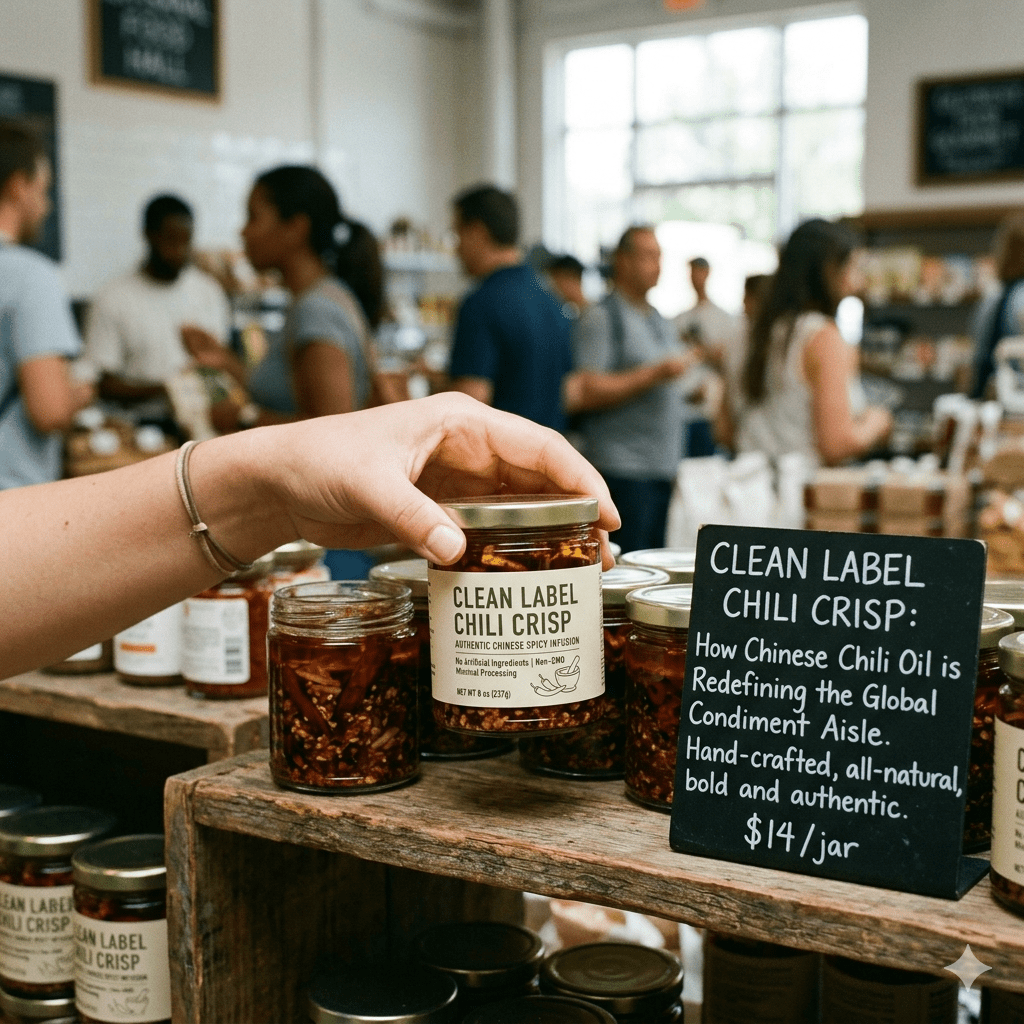
Chili Crisp Is the Hottest Chinese Condiment in the World Right Now
Chili crisp — also known as Chinese chili oil, la jiao you, or Sichuan chili crunch — has quietly become one of the most influential condiments in global retail. What used to be a niche jar hidden on the bottom shelf of Asian supermarkets is now a permanent fixture in mainstream chains from Whole Foods to Sainsbury’s.
The numbers back it up. The global chili crisp market is projected to reach USD 2.64 billion by 2033, growing at a compound annual growth rate of 7.1% from 2025 (Growth Market Reports). The broader chili oil market is even larger, valued at USD 12.25 billion in 2025 and expanding at an 8.16% CAGR through 2033 (LinkedIn Market Research). SIGEP’s 2026 Global Flavor Trends report identifies the “mala” profile — Sichuan’s signature numbing heat — as a defining flavor for a new generation of adventurous eaters, inspiring not just sauces, but snacks, noodles, and even ice cream.
Sitting at the center of this boom is China’s best-known culinary export: Lao Gan Ma (老干妈). According to China Daily, the iconic brand is now sold in more than 160 countries and sits on the shelves of roughly one-third of mainstream supermarkets in the United States and Europe. Its overseas revenue growth now consistently outpaces its domestic business.
But in 2026, Lao Gan Ma is no longer alone — and the battlefield has shifted.
The Clean Label Revolution Inside the Chili Crisp Jar
Walk into any Whole Foods today and you will find premium chili crisps priced at USD 12 to USD 16 per jar — three to five times the price of traditional imports. Brands like Fly By Jing, Momofuku Chili Crunch, and Ruby Crunch have captured enormous market share by positioning themselves around one core idea: clean label.
So what exactly does clean label chili crisp mean?
At its core, a clean label product is made with simple, recognizable ingredients, free from artificial colors, synthetic preservatives, and unnecessary additives. Consumers expect to turn the jar around, read every ingredient, and understand what each one is.
For chili crisp specifically, the clean label standard has crystallized around a few clear attributes:
• Non-GMO oils — typically rapeseed, soybean, olive, or sesame oil instead of cheap refined vegetable blends
• No added MSG or artificial flavor enhancers
• No artificial preservatives, colors, or TBHQ
• No added sugar, or very minimal natural sugar
• Real, whole-ingredient solids — chili peppers, Sichuan peppercorns, fermented soybeans, garlic, shallots — not flavor concentrates
• Transparent sourcing of signature ingredients, especially chilis and peppercorns
Fly By Jing’s Original Sichuan Chili Crisp is a textbook example. Its label lists non-GMO rapeseed and soybean oil, dried chili pepper, fermented soybeans, garlic, shallots, and Sichuan peppercorns — and the brand markets itself explicitly as “No sugar. No preservatives. No artificial flavors.” Ruby Crunch takes the same philosophy further with extra virgin olive oil and organic ingredients, positioning as a premium specialty-grocery clean label condiment.
This is where the Western market is moving. And for international food buyers, it signals a major shift in sourcing priorities.
Why This Matters for Global Importers and Distributors
The clean label chili crisp trend is not just a marketing story — it is a commercial opportunity for distributors, specialty retailers, and private-label brands.
Consumers are willing to pay premium prices. Research consistently shows that shoppers pay 15–30% more for products with transparent, clean ingredient lists. In chili crisp, that premium is often 3x or more.
Retailers are actively hunting for the category. Specialty grocers in North America, Europe, the Middle East, and Australia are building out “modern Asian pantry” sections — and clean label chili crisp is the anchor SKU.
Food service is catching on. Ramen shops, burger concepts, pizza chains, and even fine dining restaurants are using chili crisp as a signature finishing condiment, and they increasingly ask for clean-label versions that align with their menu’s brand story.
Private label is exploding. Supermarket chains and digital-native brands want to create their own chili crisp line — but very few have the manufacturing knowledge, sourcing network, or regulatory expertise to do it well.
This is where the gap opens up. Most premium clean label chili crisps sold in the US and EU are manufactured in China or made with Chinese-sourced ingredients — because Sichuan peppercorns, erjingtiao chilis, and traditional fermented black bean pastes simply cannot be authentically replicated elsewhere. The real question for global buyers is not whether to source from China, but how to source clean label chili crisp from China with the quality, compliance, and consistency Western markets demand.
What to Look for When Sourcing Clean Label Chili Crisp from China
Not every Chinese chili crisp manufacturer is ready for a clean label export program. If you are sourcing for international retail or food service, here is what a genuinely export-ready, clean label supplier should offer:
A clean ingredient deck with verifiable sourcing. Look beyond the label. Ask where the chilis come from (Guizhou, Sichuan, Henan all produce different profiles), whether the Sichuan peppercorns are from verified Hanyuan or Maowen regions, and whether the oil is genuinely non-GMO and cold-pressed where claimed.
No MSG, no TBHQ, no artificial preservatives — confirmed by third-party testing. Lab reports should confirm the absence of synthetic additives. “Natural” claims on a Chinese spec sheet mean nothing without documentation that holds up to FDA, EU, or BRC scrutiny.
International certifications. Minimum baseline: HACCP and ISO 22000. For export-ready programs, also look for FDA registration, IFS, BRC, Halal, or Kosher certifications depending on your target market.
Flexible OEM and private label capability. A clean label export program typically means custom recipe tuning (heat levels, spice profiles, oil choice), custom fill sizes, and custom packaging — all produced at commercial scale without compromising ingredient integrity.
Full supply chain traceability. Batch coding, raw material traceability, temperature-controlled logistics, and complete export documentation are non-negotiable for clean label claims to hold up in Western regulatory environments.
How Jade Premium Helps You Build a Clean Label Chili Crisp Program
This is exactly where Jade Premium’s OEM and private label sourcing service fits in.
As a Hong Kong–headquartered Chinese food export specialist, Jade Premium works with a vetted network of Chinese condiment manufacturers — including regional chili oil and dipping sauce producers such as the Yunnan-style specialty brand 抖抖辣 featured on our B2B product platform — that hold HACCP, ISO 22000, FDA, IFS, and BRC certifications. Our team handles the entire process so you can launch a clean label chili crisp line without navigating cross-border sourcing alone:
• Verified supplier sourcing — we identify manufacturers capable of producing genuine clean label formulations, not just cheap commodity chili oil
• Factory verification and audits — every partner undergoes on-site audits and certification validation before any sample leaves the door
•Custom OEM formulation support — tune heat level, aroma profile, oil base, fermentation notes, and texture to match your brand vision
• Private label and custom packaging — build your own branded clean label chili crisp SKU, from jar design to regulatory-compliant labeling in your target market
• Pre-shipment quality control — microbiological, heavy metal, pesticide, and allergen testing on every batch
• End-to-end logistics and compliance — export documentation, customs clearance, and temperature-managed shipping handled by our team across Hong Kong, Shenzhen, Guangzhou, Shanghai, Chengdu, Wuhan, and Changsha
Whether you are a specialty retailer launching your first private label jar, a distributor building a “modern Asian pantry” assortment, or a restaurant group wanting a signature chili crisp for your concept, Jade Premium connects you directly to the Chinese manufacturers capable of delivering on the clean label promise — without the typical supply chain headaches of sourcing across borders.
The Bottom Line
Chili crisp is no longer a niche condiment — it is the leading edge of a global shift in how consumers discover Chinese cuisine. And the winners of the next five years will not be the brands with the loudest marketing, but the ones with the cleanest, most transparent, most credible ingredient lists.
For international food buyers, the opportunity is significant and time-sensitive. The clean label chili crisp category is still being defined, private label slots on supermarket shelves are still being claimed, and the best Chinese manufacturers are still open to new export partnerships.
Ready to explore OEM and private label clean label chili crisp sourcing from China?
Visit Jade Premium to learn about our end-to-end trade services, or browse our B2B manufacturer catalog at jadepremium.com.hk to discover the condiment brands already powering clean label programs for global buyers.