
Key Industry Metrics at a Glance (September 2026 Shows)
| Event / Indicator | Scale & Attendance | Strategic Market Signal |
| RBHK 2026 (Hong Kong) | 400+ brands from 11 countries/regions | Premium foodservice adaptation & technique upgrades |
| SIAL Guangzhou 2026 | 60,000 sqm, 1,500+ exhibitors, 50 countries/regions | Multi-origin diversification & bidirectional trade floor |
| APAC F&B Market Growth | USD 9.79T (2026) → USD 11.78T (2031) | Accounts for ~41% of the global market expansion |
In the first week of September 2026, the Jade Premium team covered three major show floors across two Asian trade hubs: an invitation-only leadership summit hosted by the International Fresh Produce Association (IFPA) alongside Asia Fruit Logistica in Hong Kong, the trade floor at Restaurant, Bar & Café Hong Kong (RBHK), and SIAL Guangzhou.
The scale of these trade shows provides a clear read on broader macro trends rather than isolated anecdotes. According to industry data compiled by Food & Hotel Asia, the Asia-Pacific region now accounts for roughly 41% of the global food and beverage market—a market projected to expand from USD 9.79 trillion in 2026 to USD 11.78 trillion by 2031.
What happens on these show floors directly influences global supply chains. Across three distinct venues, three structural shifts emerged that redefine how international food buyers should navigate sourcing from Asia. Each shift raises the value of sourcing from verified suppliers rather than untested ones.
Resilience Has Replaced Price as the First Sourcing Filter
Supply chain resilience—not just unit price—has become the first criterion buyers use to screen potential suppliers. At the IFPA summit in Hong Kong, fresh produce leaders focused on three compounding risks:
- Climate Volatility: Unpredictable harvest schedules across key agricultural zones.
- Trade Friction: Tariff shifts and changing customs procedures altering standard shipping routes.
- Geopolitical & Logistics Bottlenecks: Corridor disruptions creating ripple effects across global transport networks.
These issues are no longer handled as annual risk reviews; they are the primary reason buyers seek a secondary or tertiary origin before negotiating price breaks.
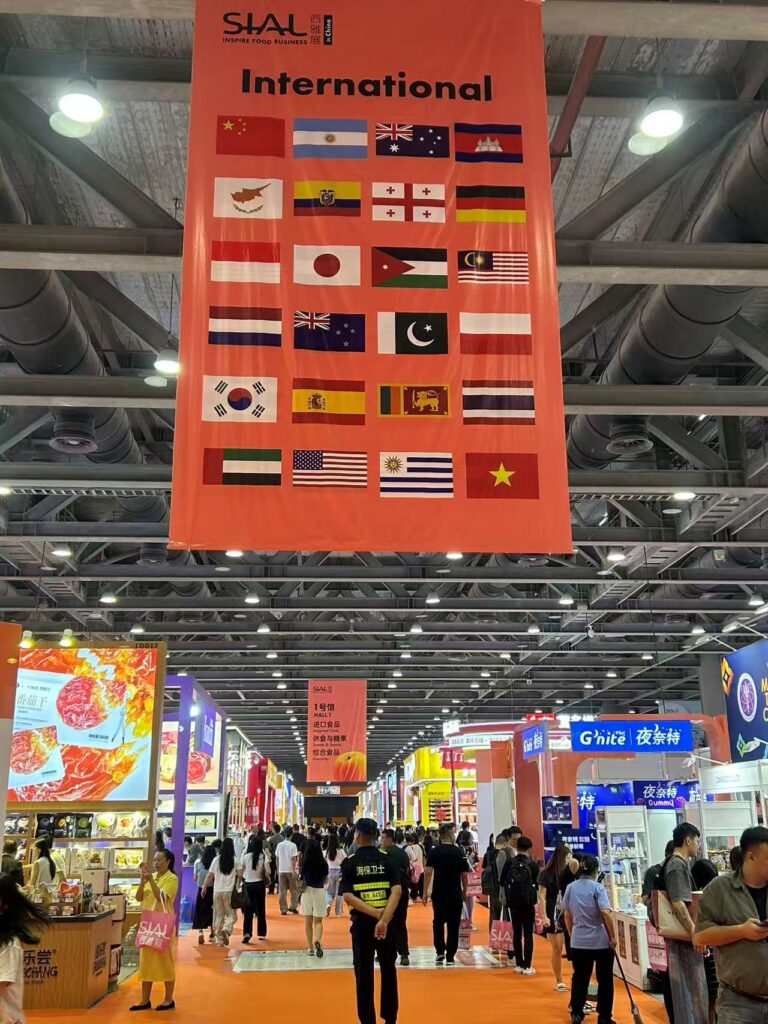
This pivot was clearly visible at SIAL Guangzhou. Beyond traditional ASEAN delegations (Thailand, Vietnam, Malaysia, Indonesia), national pavilions featured suppliers from Georgia, Jordan, Cyprus, Ecuador, and Uruguay. Multi-origin sourcing is no longer just a contingency plan—it is now a permanent procurement strategy. Each additional origin adds verification work — the scope a certified food exporter should handle extends well past documentation.
South China Operates as a Two-Way Trading Engine
Driven by the RCEP framework, South China is no longer merely an export base—it is a two-way trading hub where international brands enter China and regional buying teams source for export.
After three years in Shenzhen, SIAL South China moved to the Poly World Trade Center Expo in Guangzhou—putting it at the heart of the country’s densest wholesale market cluster. Organisers reported roughly RMB 10 billion in letters of intent and 5,883 business matchmaking sessions over three days. Delegations from Thailand, the Philippines, Singapore, and Vietnam sourced outbound products, while overseas brands used the platform to enter South China.
Strategic Implications by Channel:
- Importers: Can consolidate mixed-origin containers out of a single regional hub.
- Distributors: Get early access to innovative Asian product formats — a shift already visible in where premium ingredients are now produced — before competitors enter the space.
- Foodservice Operators: Can source finished, chef-ready formats directly from primary factories.
Domestic performance does not guarantee export readiness — the same product can require four different ingredient declarations depending on the destination market.
Value Is Moving Upstream: Factories Are Shipping Technique
Suppliers are handling processing, ageing, portioning, and reformulation directly at the origin factory, delivering finished propositions rather than raw commodities.
- Hong Kong (Technique Upgrades): To counter softer domestic spending, suppliers at RBHK upgraded product complexity instead of discounting—introducing dry-aged mainland poultry for high-end Western dining and pre-poached, mala-spiced seafood for fast kitchen assembly.
- Guangzhou (Functional Reformulation): Value-add focused on health and convenience. Low-sugar reformulation and Ready-to-Cook (RTC) / Ready-to-Heat (RTH) products led messaging across national pavilions and SIAL Innovation showcases, echoing how plant-based ranges reached parity on texture and flavour before scaling.
High-Growth Categories to Watch
1. Technique-Led Proteins (Dry-aged poultry & controlled maturation): Mainstream proteins are being elevated through controlled ageing. Key action: Verify process consistency across high-volume production runs.
2. Chef-Ready Value-Added Seafood (Pre-seasoned, portioned & pre-cooked): Helps operators save labour without compromising quality. Key action: Verify strict cold-chain management during transit.
3. Low-Sugar & Clean-Label Formulations (Functional RTE and health-focused SKUs): Strong fit for private label expansion. Key action: Check compliance of health claims with target market regulations.
4. Halal-Certified Ranges (Rapid regional expansion): Driven by APAC halal F&B market growth (projected USD 816B by 2031). Key action: Verify line-specific and SKU-specific halal certifications.
Conclusion: Why Supplier Verification Matters More Than Ever
In 2026, the primary challenge in Asian food sourcing is no longer discovery—it is verification. Finding new product formats is easy, but verifying factory compliance, certification scope, and year-round specification stability is where supply chains succeed or fail.
Working with an experienced sourcing and compliance partner in Asia helps bridge the gap between a promising trade show sample and a fully compliant, scalable import programme.