
A vegan cake is no longer a dietary substitution. For the buyer, it is a margin decision — and increasingly a competitive one, which makes choosing the right vegan dessert supplier a commercial question rather than a compliance one. The global vegan dessert market was valued at USD 4.86 billion in 2025 and is forecast to reach USD 5.43 billion in 2026, expanding to USD 13.23 billion by 2034 at a compound annual growth rate of 11.77%, according to Fortune Business Insights1. Within that market, cakes and pastries account for around 40% of value, making them the single largest product segment.
That growth has already changed procurement conversations across Asia. A specialty coffee retail buyer in Hong Kong is being asked why the pastry cabinet still has no plant-based option when a third of walk-in customers ask for one. A hotel dessert programme lead in Bangkok needs a banquet-ready item that survives buffet service and satisfies both international guests and Buddhist vegetarian requirements. A trading company in Singapore is quoting three separate regional distributors who all want the same thing: a frozen vegan cake range that can move through existing cold chain without a new handling protocol. None of these buyers is short of options. All three are short of a way to choose between them.
What makes vegan cake sourcing particularly difficult is that the failure point has moved. Ten years ago, plant-based desserts failed on formulation — the texture was wrong, the flavour was flat, the shelf life was short. Today, as our overview of the new generation of plant-based foods sets out, formulation is largely a solved problem. Products fail on selection instead: a beautiful cake that photographs well, ships cleanly and then sits in the freezer case because it was never right for that market in the first place. This article sets out a three-part test — the Three-Fit Framework — that international buyers can apply before committing to a vegan cake SKU, using products from Chinese plant-based patisserie manufacturer Orisimple as working examples.
Why Category Growth Does Not Guarantee SKU Performance
Category-level growth figures are useful for building a business case. They are close to useless for choosing a product. A market growing at nearly 12% a year is a market with more entrants, more shelf competition and more failed listings — not a market where anything plant-based sells by default.
Three structural shifts explain why the demand is real. The first is the flexitarian majority: most vegan dessert volume is now bought by consumers who are not vegan, but who are reducing dairy for health, digestive or environmental reasons. That widens the addressable audience far beyond the certified-vegetarian shopper, but it also raises the bar — a flexitarian buyer is comparing your product against a conventional cake, not against other vegan cakes.
The second is the arrival of dairy-free technique at premium level. Oat cream, coconut-milk tofu, cashew and aquafaba now support mousse, ganache and cheesecake textures that would have been impossible at scale a decade ago. The third is the normalisation of imported Asian dessert formats in Western and Middle Eastern markets — a shift visible in everything from the global matcha supply story to the rise of Asian bakery categories in mainstream supermarkets, which we examined in our analysis of high-margin ready-to-cook products for global retail.
None of that tells a buyer which of forty available SKUs will earn its freezer slot. The gap between category growth and product performance is where most sourcing budgets are lost, and it usually opens for one of three reasons: the product needs explaining before it can be sold, the flavour asks the consumer to take a risk, or the format does not fit how the buyer actually trades. Those three failure modes are the basis of the framework that follows.
From Factory to Freezer Case: What a Frozen Vegan Cake Has to Survive
Before applying any selection test, it helps to know what the product physically goes through, because several of the criteria that look like marketing questions are actually logistics questions.
Consider a Singapore distributor evaluating a frozen mousse cake range from a Chinese producer. The cakes are blast-frozen at the factory and held at −18°C or below. They ship as individually portioned units — typically nine pieces to a box and 72 pieces to a carton for single-serve items — under continuous frozen conditions through export clearance, ocean freight and the importer’s cold store. Nothing about that stage is unusual; frozen patisserie moves on the same infrastructure as any other frozen category.
The commercially decisive stage comes later. These are thaw-and-serve products: the retailer or operator moves them from frozen to chilled, they are ready to eat once thawed, they must not be refrozen, and they hold for a limited window under chilled display — commonly no more than 72 hours below 8°C. That single constraint reshapes the buying decision. A café can thaw two pieces at a time and lose nothing. A supermarket running a chilled patisserie counter has to forecast against a three-day window. A hotel banqueting team can thaw to order and treat the frozen stock as inventory rather than exposure. The same cake is a low-risk listing for one channel and a write-off risk for another, which is why frozen dessert sourcing has more in common with our guidance on frozen product logistics for retail campaigns than with conventional ambient bakery buying.
Shelf life at the frozen stage is generally generous — nine to twelve months at −18°C is typical for this category, which gives buyers room to consolidate shipments and hold safety stock. Buyers should confirm the manufacturing standard the product is produced to, the declared frozen shelf life for each specific item rather than for the range as a whole, and the full ingredient and allergen panel translated for the destination market. Colour additives deserve particular attention: a colourant cleared in one jurisdiction is not automatically cleared in another, and approval status for plant-derived colours such as vegetable carbon differs across the EU, the United States and Asia-Pacific.
The Three-Fit Framework: A Buyer’s Guide to Choosing the Right Cake from Your Vegan Dessert Supplier
The framework asks three questions in sequence. A product that fails any one of them will underperform regardless of how well it scores on the other two — which is why it works as a filter rather than a scorecard.
Filter 1 — Visual Fit: does the product need explaining before it can be sold?
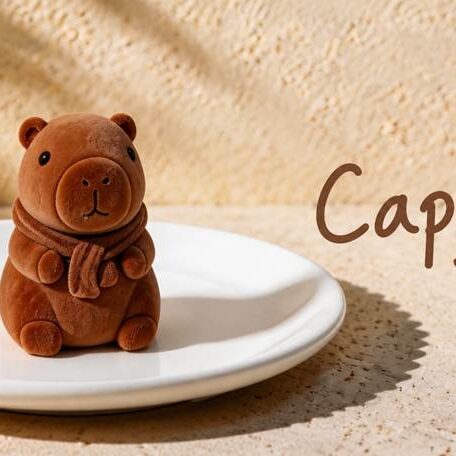
Visual fit measures how much cultural translation a product demands at the point of sale. A shape that a shopper recognises instantly costs nothing to merchandise. A shape tied to a specific festival, character or regional reference needs signage, staff briefing and often a story the retailer has no space to tell. The Capybara Chocolate Mousse Cake scores well here for a reason that has nothing to do with food: the capybara has become a globally legible internet character, recognisable across Europe, North America and Southeast Asia without a caption. Underneath the moulded form, it is a conventional premium dessert — chocolate sponge base, jasmine dark chocolate mousse, hazelnut chocolate paste and candied orange, portioned at 75g per piece in nine-piece boxes.
The challenge attached to this filter is real and should be priced in. Character-moulded desserts sell on visibility, which means they need a glass-fronted chilled display and staff who thaw them intact. In a chest freezer under film, most of the value disappears. Buyers whose retail partners cannot commit display space should treat high-visual products as a foodservice or e-commerce line, not a general retail listing.
Filter 2 — Flavour Fit: is the consumer being asked to take a risk?
Flavour fit is a question about familiarity, not quality. Plant-based desserts already ask the consumer to accept one unfamiliar variable — no dairy, no egg. Pairing that with an unfamiliar flavour profile compounds the risk and depresses trial. The safer commercial move is a novel format carrying a familiar flavour. The Tofu Pistachio Basque Cake is a clear example: Basque burnt cheesecake is now an established international bakery format rather than a regional curiosity, and pistachio has become one of the most commercially reliable premium dessert flavours of the past two years. The plant-based work happens invisibly, in a tofu-based filling replacing dairy cream cheese, and the range extends to plain and lemon variants at the same 6-inch format.
The counterweight is that “tofu” on a Western front-of-pack still carries associations that work against a dessert. Buyers have a genuine choice to make between leading with the plant-based credential — which performs well in markets with mature vegan retail sections, as the Asian vegetarian expo circuit has demonstrated — and leading with the flavour and letting the credential sit in the ingredient panel. That decision belongs to the destination market, not the manufacturer, and it should be settled before artwork is commissioned.
Filter 3 — Format Fit: does the pack match how you actually trade?
Format fit is where otherwise strong products quietly fail. Portion size, pack count, price ladder and display footprint determine whether a listing works economically, and they vary sharply by channel. The Cat Paw Coconut Mousse Cake illustrates both sides. At 35g per piece in six-piece packs, with coconut mousse over a passion fruit centre and four colourways in the same mould, it is well suited to multi-flavour retail assortments, gifting formats and dessert platters where visual variety carries the sale. Coconut and passion fruit are also among the most broadly accepted tropical flavour pairings in international markets, so it clears the second filter comfortably.
The constraint is margin structure. A 35g portion supports a low unit price, which suits retail impulse purchase but sits awkwardly in a foodservice dessert menu where the operator needs a plated item at a defensible price point. Larger-format products in the same range — 6-inch cakes designed to be sliced — solve that problem but require the operator to portion and hold. Neither format is better. The buyer’s job is to match portion architecture to channel before negotiating price, not after.
| Put the Three-Fit framework to work on your own vegan cake shortlist Jade Premium can run the Three-Fit assessment against a live product list for your market — including portion and pack options, frozen and chilled shelf-life data, ingredient and allergen panels prepared for your destination regulations, and factory verification before you commit to a first order. Share your target channel and market, and our sourcing team will come back with a shortlist rather than a catalogue. Contact the Jade Premium team to start a product review. |
The Jade Premium Approach
This brings us to a critical question: how do buyers actually translate a selection framework into a shipment that performs? Applying three filters is straightforward on paper. Verifying that a manufacturer can hold specification across a twelve-month supply relationship is a different exercise, and it is the one that separates a successful listing from an expensive lesson — a pattern we have documented in detail in our risk framework for sourcing Chinese food products.
Jade Premium was established in 2014 as part of Yuhu Group (Hong Kong). Headquartered in Hong Kong with offices in Shenzhen, Guangzhou, Shanghai, Chengdu, Wuhan and Changsha, we work directly with Chinese manufacturers across HALAL, HACCP, ISO22000 and FDA certification frameworks. For frozen patisserie specifically, that means our team can inspect production conditions in person, confirm that frozen shelf-life claims are supported by the manufacturer’s own testing, and check that ingredient panels will clear the labelling requirements of the destination market before a purchase order is raised — the end-to-end scope a certified exporter should be handling rather than paperwork alone.
For plant-based desserts, our role is usually narrower and more useful than “supplier”. Buyers come to us with a channel and a market, and we work backwards to a shortlist: which portion formats suit that display environment, which flavours have already been proven in comparable markets, which manufacturers can support a private-label variant, and which cannot. The wider Jade Premium product range extends well beyond desserts, but the method is consistent across categories.
The vegan cake opportunity is not really about veganism. It is about a category that has quietly reached parity on taste and texture, and where the remaining advantage sits entirely in judgement — knowing which products a particular market will accept without explanation, and which supply relationships will still be holding specification a year from now. Buyers who treat plant-based dessert sourcing as a selection discipline rather than a trend response will find the category considerably less crowded than the growth figures suggest.
Related Articles
Continue exploring the insights shaping global food sourcing decisions.
The New Generation of Plant-Based Foods: More Variety, More Flavour, More Possibilities
- Fortune Business Insights, “Vegan Dessert Market Size, Share, Trends” report, 2026. Global vegan dessert market size and cakes-and-pastries segment share figures cited from this report. ↩︎