
Executive Summary
- What applies: three BPJPH instruments decide whether a food shipment needs halal certification: a mandatory HS-code list, an exempt materials list, and a pre-shipment check that produces a Halal Product Assurance Report (LPPH).
- When: the transition for imported food ends on 17 October 2026. Calls for postponement exist, but BPJPH says there will be none.
- The trap: each LPPH covers one shipment, so split orders multiply inspections and fees.
Indonesia’s halal requirement for imported food is no longer a question of whether a supplier holds a certificate. It is becoming a question of whether each shipment can prove it. BPJPH Decree No. 307/2025 lists more than 950 Harmonized Tariff Schedule codes for food and beverages, plus 65 codes for food additives, that require halal certification, according to the USDA Foreign Agricultural Service1. The world’s largest Muslim-majority market is now governed by tariff lines and inspection reports, not a single logo.
Imported food and beverages were originally due to comply on 17 October 2024; Government Regulation No. 42/2024 extended that to 17 October 2026, with BPJPH market supervision starting the following day. The same rules land differently depending on the buyer:
- A frozen food importer in Jakarta needs to know which SKUs must already carry a BPJPH-registered certificate.
- A consolidator in Kuala Lumpur re-exporting Chinese dim sum needs to know whether a Malaysian certificate still counts.
- An exporter in Fujian shipping chicken dumplings needs to know whether every container now requires its own inspection.
What makes this moment particularly difficult is that the rules are still moving as the deadline arrives. The certificate basics in our halal certification requirements checklist for importers still hold; what is new is how Indonesia applies them shipment by shipment. With Ramadan 2027 orders already being placed, as our Ramadan 2027 food sourcing calendar sets out, the shipments affected are the ones leaving now.
Three Layers of BPJPH Requirements: What Actually Applies to Your Shipment
Whether a food shipment needs halal certification in Indonesia depends on three BPJPH instruments read together: a list of products that must be certified, a list of exempt materials, and a pre-shipment check for each consignment. International buyers often search for the BPJPH HS code list for importers as if it were the whole answer. It is only the first layer.
| Layer | Instrument | Status (October 2026) | What it means |
| 1. Product list | Decree No. 307/2025 | Notified to the WTO in May 2026 | A listed HS code needs a BPJPH-registered halal certificate. |
| 2. Exemptions | Decree No. 301/2026, signed 31 August 20262 | Takes effect six months after signing, on 28 February 2027 | Once in force, raw plant products, fresh milk, eggs and goods only washed, chilled, frozen, cut, dried or salted are exempt. |
| 3. Shipment check | Regulation No. 4/2026 | In force since 9 September 2026; inspection bodies and fees still being set up | Each consignment needs an LPPH before the import declaration. |
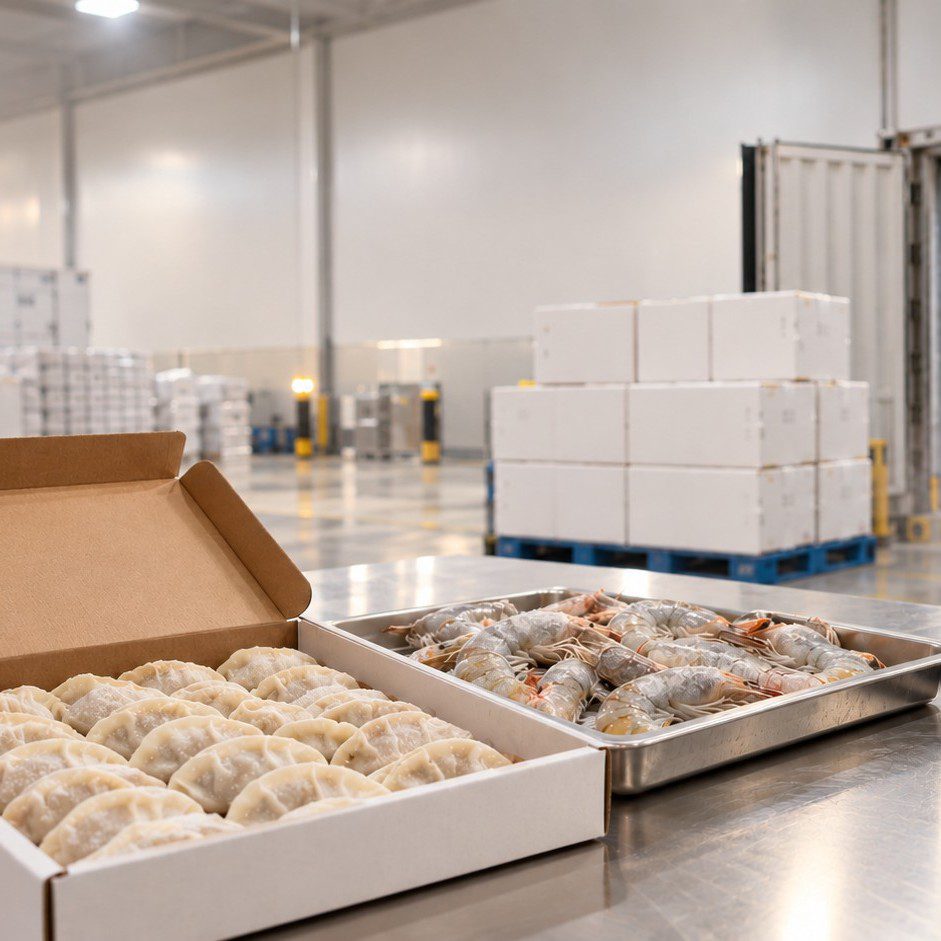
Here is how the layers shape halal certification for frozen food exports to Indonesia, using three halal-friendly categories shipped from China:
- Frozen raw prawns are listed as exempt in Decree 301/2026, which treats freezing as minimal processing, reversing what Decree 307/2025 had indicated for frozen seafood. As the exemption only applies from 28 February 2027, shipments before then should be confirmed with the importer. Once breaded or marinated as value-added seafood, prawns are back in scope.
- Chicken siu mai and dumplings are processed, and their meat content was already subject to mandatory halal certification under Indonesia’s animal husbandry law. The certificate must cover both the slaughter source and the finished product, a core check for any frozen dim sum supplier.
- Vegetarian buns and dumplings are the common blind spot: processed products made from exempt raw materials still need certification. Flavourings, emulsifiers and raising agents are what a frozen vegetarian dumpling range usually has to document.
Start with the HS code: a misclassified product can fail halal screening and customs entry at once (see our guide to HS code errors in food customs clearance), and the 65 additive codes deserve equal care for ingredient-heavy SKUs, as our note on food additives compliance explains.
Two Scenarios for 17 October: If the Deadline Holds, and If It Slips
BPJPH’s official position is that the October 2026 obligation will not be postponed, but the signals are mixed enough that buyers should prepare a plan for each outcome.
| Signals the date will hold | Signals of a slip or softer enforcement |
| BPJPH’s head told parliament in June 2026 there would be no postponement. | Apindo, the Indonesian employers’ association, has asked for a postponement, arguing the ecosystem is not ready. |
| The Indonesian Ulema Council (MUI) backed implementation without delay on 6 October 2026. | The date for foreign products is to be set by a Minister; no such instrument has been published. |
| USDA reports no written extension is planned, and that goods with a pre-deadline bill of lading must still comply. | USDA understands the LPPH mechanism is not yet operating, as inspection bodies and fees are not in place. |
Either way, enforcement under Government Regulation No. 42/2024 is administrative, not a border block: a written warning, a 30-day correction period and, if unresolved, withdrawal from circulation. Indonesia’s Trade Minister has stressed that halal certification is not an import restriction, and BPJPH allows halal or non-halal labels to be applied in the importer’s warehouse before goods circulate.
| First step | If 17 October holds | If it slips or enforcement softens |
| Importer | Check every SKU’s HS code against Decree 307/2025, confirm BPJPH registration, and label before circulation. | Finish certificate registrations and agree LPPH responsibilities with suppliers. Do not pause orders. |
| Exporter | Confirm your certifier is BPJPH-recognised for your product category; ask your importer to book the LPPH inspection. | Prepare the LPPH document set (certificate, HS-coded product list, invoice, packing list) ahead of the first post-deadline shipment. |
Three no-regret moves apply in both scenarios:
- Map every SKU to its HS code and status: listed, exempt or non-halal.
- Verify certificate registration with BPJPH, not just certificate validity.
- Build LPPH lead time into each order; one Indonesian compliance consultancy estimates two to four weeks per shipment.
The Per-Shipment LPPH Trap: Why Split Orders Multiply Halal Certification Cost
Under BPJPH Regulation No. 4/2026, a Halal Product Assurance Report (LPPH) covers a single shipment only, so every split delivery needs its own pre-shipment inspection, fee and schedule3. A BPJPH-appointed inspection body checks documents against the goods at the loading warehouse. The inspection date must be set within 30 days of payment and the inspection completed within 15 calendar days. This LPPH pre-shipment inspection is what turns an exporter’s certificate into a cleared consignment.
Consider a Surabaya importer building Ramadan stock of halal chicken dumplings from Guangdong. One full container in November means one inspection. Splitting the same volume into three monthly LCL shipments means three applications, three fees and three inspection windows, each able to push a delivery past its festive peak.
The second trap is certificate origin. The inspector confirms that the certificate was issued by a body in the same country as the production site, so a product made in China and consolidated in Singapore or Malaysia cannot rely on a local certificate there. Chinese exporters are reasonably well served: China has more BPJPH-recognised foreign halal bodies than any other country, and BPJPH invited 18 of them to a coordination meeting in April 20264.
No single halal certification cost has been published under the new system, as LPPH fees are set between BPJPH and each inspection body. The realistic cost combines certification by a recognised body, BPJPH registration, a per-shipment inspection fee, and working capital tied up while goods wait. The last two scale with shipment count, making consolidation a compliance decision as much as a freight one.
The Jade Premium Approach
This brings us to a critical question: how do buyers turn moving regulation into a shipment plan that works whichever way 17 October goes?
Jade Premium was established in 2014 as part of Yuhu Group (Hong Kong). Headquartered in Hong Kong with offices in Shenzhen, Guangzhou, Shanghai, Chengdu, Wuhan and Changsha, we work directly with Chinese manufacturers across HALAL, HACCP, ISO22000 and FDA certification frameworks. For buyers supplying Indonesia, we settle the Indonesia halal requirements for Chinese food exporters before a purchase order is raised, through three checks:
- SKU-to-HS mapping: each product classified against the mandatory and exempt lists before price negotiation.
- Certificate origin and registration: confirming the supplier’s certificate comes from a BPJPH-recognised Chinese body and covers the exact product category.
- Shipment planning around the LPPH: consolidating orders where volumes allow, so fewer consignments need inspection.
This is the end-to-end role a certified Chinese food exporter should play: compliance planned into the order, not discovered at the port.
Indonesia’s halal deadline isn’t just about a date. It is about who can turn regulatory uncertainty into a shipment that clears, circulates and stays on shelf, this October and with every consignment after it.
- USDA Foreign Agricultural Service, GAIN Report ID2026-0034, “Indonesia Issues New Halal Regulations with Trade Implications”, Jakarta, 14 September 2026. Figures on Decree No. 307/2025 and BPJPH statements on extension and bill-of-lading dates are cited from this report. ↩︎
- Decree of the Head of BPJPH No. 301 of 2026 on Products and Materials Exempted from Mandatory Halal Certification, signed in Jakarta on 31 August 2026. Its ninth dictum provides that the decree takes effect six months from the date of signing. ↩︎
- BPJPH Regulation No. 4 of 2026 on the Assurance of Conformity of Foreign Halal Products Entering the Territory of Indonesia, signed 7 August 2026, promulgated 10 August 2026, in force 9 September 2026. ↩︎
- BPJPH, news release on its coordination meeting with Chinese foreign halal certification bodies, Jakarta, 28 April 2026. ↩︎