
From March 2027, the single most effective clean label phrase in Western retail — some version of no added preservatives — becomes prohibited wording on food labels in China, even where the statement is factually true. The same sentence that sells a product in one market will be non-compliant in another. That contradiction is only possible because clean label is one of the most widely used terms in the international food trade, and one of the very few that no regulator anywhere has ever defined. There is no clean label certificate, no audit scheme, no threshold number of ingredients above which a product fails — only a commercial expectation, enforced by retailers and interpreted by consumers, that carries real money behind it. The global clean label ingredients market was valued at USD 44.97 billion in 2025 and is forecast to reach USD 83.44 billion by 2034, according to Fortune Business Insights1. That is a substantial category built entirely on a standard nobody has written down.
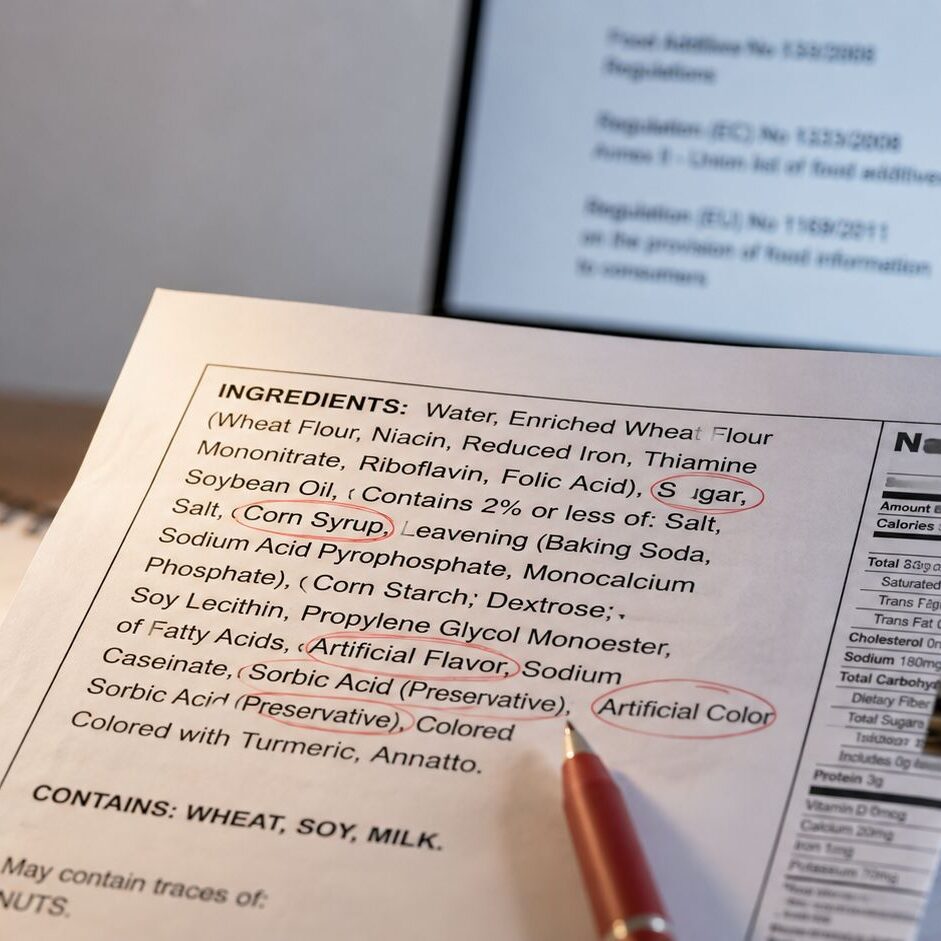
For buyers, the absence of a definition is not an abstract problem. It shows up as three different conversations happening in three different places:
- A distributor in Dubai is asked by a regional retail group for clean label assurance on a range that already holds HALAL certification, and has to work out whether the two systems overlap or run in parallel.
- A retail buyer in Chicago has a listing approved nationally, then discovers that a single colouring agent makes the same product commercially awkward in certain states.
- An importer in Rotterdam receives a technical sheet that looks clean in its original language, and finds that once the additives are translated into European numbering, the panel reads very differently to a European shopper.
What makes clean label particularly difficult is that it is not a single standard being interpreted differently in each market. It is three separate judgement systems that happen to share a name. A product travelling from an Asian factory to a European shelf passes through all three, and the requirements tighten at every stage. Buyers who have worked through certification checks for Chinese food suppliers will recognise the pattern, but clean label is harder than certification in one specific respect: there is no certificate to ask for. This article sets out where the definitional power actually sits, how the three major market blocs each apply it, and a four-question test buyers can use in the absence of any official standard.
Why No Regulator Has Ever Defined Clean Label
Clean label has no legal definition because it was never created by regulators — it emerged from the market, and the authority to define it still sits with buyers rather than with legislators. Food additive law tells manufacturers what is permitted and how it must be declared. It does not tell them what a shopper will find reassuring, and that gap is where clean label lives.
In practice, three groups hold the definitional power, none of them statutory:
- Retailer procurement policy — major grocery groups maintain their own restricted-substance lists, which frequently go further than the law requires.
- Consumer perception research — this determines whether an ingredient name reads as food or as chemistry, regardless of its safety status.
- Industry self-regulation — manufacturers reformulate pre-emptively to avoid being the last brand in a category still carrying a disputed additive.
Regulators have stayed out for a straightforward reason. Defining clean label would mean putting legal boundaries around words like natural, simple and minimally processed, and those terms resist quantification. The regulator that defined it would own the liability for every borderline case, with limited public-health benefit in return.
The scale of the problem is visible even in the market research on the category. Published estimates of the global clean label ingredients market vary by an order of magnitude between research houses, because each draws the boundary of what counts as a clean label ingredient in a different place. When professional analysts cannot agree on what the category contains, a supplier and a buyer working from different assumptions will not agree either. Every figure in this article therefore comes from a single source rather than a blend of several.
Three Markets, Three Working Definitions of Clean Label
The same ingredient panel is assessed against three different logics depending on destination, and the requirements tighten progressively along the route most Asian food exports actually travel.
| Market | Governing logic | What buyers scrutinise | Market position |
| Asia-Pacific & Middle East | Regulates the clean label claim itself, not only the additives behind it | Which wording is permitted at all; compatibility with existing certification schemes | USD 12.96bn in 2025; fastest-growing region at 9.23% CAGR |
| United States | A federal approvals framework overlaid with divergent state-level legislation | Approval status of specific additives, and how fast that status is changing | Approximately USD 9.57bn in 2025 |
| European Union | A transparent numbering system that makes every additive visible to the shopper | Whether an additive must be declared, and whether it triggers advisory labelling | Largest regional market at USD 13.98bn in 2025, growing at 5.85% CAGR |
Asia-Pacific is doing something the other two are not. China’s revised national labelling standard, effective 16 March 2027, prohibits no added, zero added and equivalent phrasing on food labels, and bars free from claims in relation to food additives altogether. The intent is consumer protection; the practical effect is a direct collision with Western clean label marketing convention. The full detail sits in our analysis of China’s 2027 food labelling rules and what they mean for traceability.
Set against the United States, the contrast is sharp: China is tightening what a manufacturer may say, while the United States is tightening what a manufacturer may use. One is a copywriting problem, the other a formulation problem, and they need entirely different responses.
The European Union is the strictest of the three, but for a reason often misread. The additives permitted in the EU are not dramatically fewer than elsewhere — what differs is visibility. The European numbering system makes every additive legible to an ordinary shopper, so an ingredient that passes unnoticed on another label becomes a visible decision point on a European one. Colour additives deserve particular care here, since approval status for the same colourant genuinely differs between jurisdictions, as came up repeatedly in our analysis of selecting plant-based desserts for international retail.
What this looks like on one production line
A manufacturer produces a single line of dried fruit snacks, sold domestically in China and exported to European retail. The European buyer wants the absence of preservatives stated on front of pack, because that is what moves the product off the shelf. The Chinese label, from March 2027, cannot carry that statement at all. Same factory, same formulation, same batch, two mutually exclusive labelling strategies. Buyers who assume one artwork brief can serve both markets tend to find out at packaging sign-off, when changing it costs the most.
The market data reinforces the point rather than contradicting it. Europe is simultaneously the largest clean label ingredients market and the most heavily regulated one, while Asia-Pacific is the fastest-growing at a 9.23% compound annual growth rate, according to Fortune Business Insights. Strict regulation has not suppressed the category; it has built it. Exporters who treat European requirements as the design target rather than the final hurdle generally find the other two markets straightforward, a logic that also applies to the documentation a certified food exporter should be handling.
A Four-Question Clean Label Test Buyers Can Apply Before Sourcing
With no certificate to request, buyers need a repeatable way to read an ingredient panel. These four questions apply to any specification sheet, in any category, before a sample is requested.
1. How many ingredients would an ordinary shopper be unable to name?
- Why it matters: this is the closest thing to a universal working definition, and the one retailers apply informally.
- What to look for: the pattern across a supplier’s whole range, not one SKU. One unrecognisable entry is a technical choice; six is a formulation culture that will not change for a single order.
2. Are there composite entries acting as a black box?
- Why it matters: entries such as compound seasoning or blended sauce base conceal their own ingredient lists.
- What to look for: several markets require these to be broken out above a given proportion, so the retail panel may end up materially longer than the one you reviewed. Request the breakdown before agreeing a specification, not after.
3. What is each ingredient’s status in the destination market, not the country of origin?
- Why it matters: this is the single most common failure point. A supplier’s compliance statement references domestic permissions — reasonable from their side, insufficient from yours.
- What to look for: an entry-by-entry assessment against destination rules, including allergen declaration requirements, which differ between jurisdictions and are easy to lose in translation.
4. If an additive were removed, what would take over its function?
- Why it matters: additives are rarely decorative. Preservatives, humectants, stabilisers and colourants each do work, and removing them transfers that work to processing technology, packaging or the cold chain.
- What to look for: a concrete alternative. A supplier who simply agrees to remove an ingredient may be creating a shelf-life problem that surfaces after shipping — which is why clean label is inseparable from frozen and chilled logistics planning. This question is examined in full in the third article of this series.
At a glance
| Question | What it reveals | Evidence to request |
| Unrecognisable ingredients | Whether the supplier’s formulation culture fits clean label positioning | Specification sheets for the full range, not a single SKU |
| Composite entries | Hidden additives that will appear on the final retail pack | Complete breakdown of every compound ingredient |
| Destination-market status | Whether the panel is legal and commercially acceptable where you sell | Entry-by-entry assessment against destination rules |
| Functional replacement | Whether removal creates a shelf-life or quality risk | Stability and shelf-life testing for the reformulated version |
| Applying this test to a live specification? Jade Premium can run all four checks against a supplier’s ingredient panel for your destination market — including compound ingredient breakdowns, destination-market additive status and allergen declaration requirements — before you commit to a first order. Contact the Jade Premium team to request an ingredient panel review. |
How Jade Premium Reads an Ingredient Panel
How does a buyer verify clean label claims when there is no certificate to verify them against? In our own sourcing work, the answer is a documented review process rather than a supplier declaration. We work through every panel in four passes:
- Translation — rendering every entry into the naming convention of the destination market, so buyer and supplier read the same document rather than two versions of it.
- Decomposition — breaking out compound entries so nothing arrives as a black box.
- Status checking — assessing each ingredient against destination-market rules rather than those of the country of production.
- Allergen review — performed last, because declaration requirements vary by jurisdiction and errors here carry the highest consequences.
Jade Premium was established in 2014 as part of Yuhu Group (Hong Kong). Headquartered in Hong Kong with offices in Shenzhen, Guangzhou, Shanghai, Chengdu, Wuhan and Changsha, we work with manufacturers across HALAL, HACCP, ISO22000 and FDA frameworks. That office network matters here because ingredient verification is not a desk exercise: confirming what is actually in a product often means being in the factory rather than reading a document about it.
Because clean label has no certification pathway, we function less as a general trading intermediary and more as a verification partner helping food exporters and their buyers meet clean label requirements market by market — across plant-based product ranges, ready-to-cook formats for supermarket retail and ingredient-led categories alike.
Clean label is not really a claim about ingredients. It is a claim about knowledge — whether a supplier can account for every line on the panel, and whether that account holds up in the market the buyer sells into. As the three blocs move in different directions at once, the suppliers who win listings will not be the ones with the fewest ingredients, but the ones who can document every decision behind them.
This is the first article in a short series on clean label sourcing.
More Clean Label Coverage on Jade Premium
Clean Label Chinese Food: Why Global Importers Are Switching to Verified Suppliers
Clean Label Food from China: Are You Overpaying for “Natural”?
Sourcing Clean Label Chinese Noodles SafelyClean Label Chili Crisp: How Chinese Chili Oil Is Redefining the Global Condiment Aisle
- Fortune Business Insights, Clean Label Ingredients Market Size, Share & Growth Report, 2026–2034. Global, regional and country-level figures in this article are taken from this single source; see the discussion in the first section on why cross-source comparison is unreliable in this category. ↩︎